

Enterprise architecture is often described as the blueprint of an organization. It connects high-level strategy with the technical details required to execute it. However, without a standardized language, this connection becomes fragmented. Different teams speak different dialects. Business leaders talk about value streams, while engineers discuss APIs and infrastructure. Bridging this gap requires a common visual grammar. This is where the ArchiMate modeling language becomes essential.
ArchiMate is not a tool. It is a framework. It provides the concepts and relationships needed to describe, analyze, and visualize architecture. By using this language, organizations can transform abstract strategies into concrete models. This guide explores the core components, the relationships, and the best practices for creating effective architectural models.
🔍 Understanding the Core Purpose
Before diving into specific elements, it is important to understand why this modeling language exists. In complex environments, information overload is a constant risk. Stakeholders need clarity. They need to see how a change in the business affects the technology. They need to understand dependencies before making decisions.
The primary goal of ArchiMate is to enable communication. It does this by defining a structured way to represent:
- Structural elements (What exists?)
- Behavioral elements (What happens?)
- Relationships (How do things connect?)
This structure allows architects to create views tailored to specific audiences. A view for a CEO looks different from a view for a developer. The underlying model remains consistent, but the abstraction level changes.
🏗️ The Three Fundamental Layers
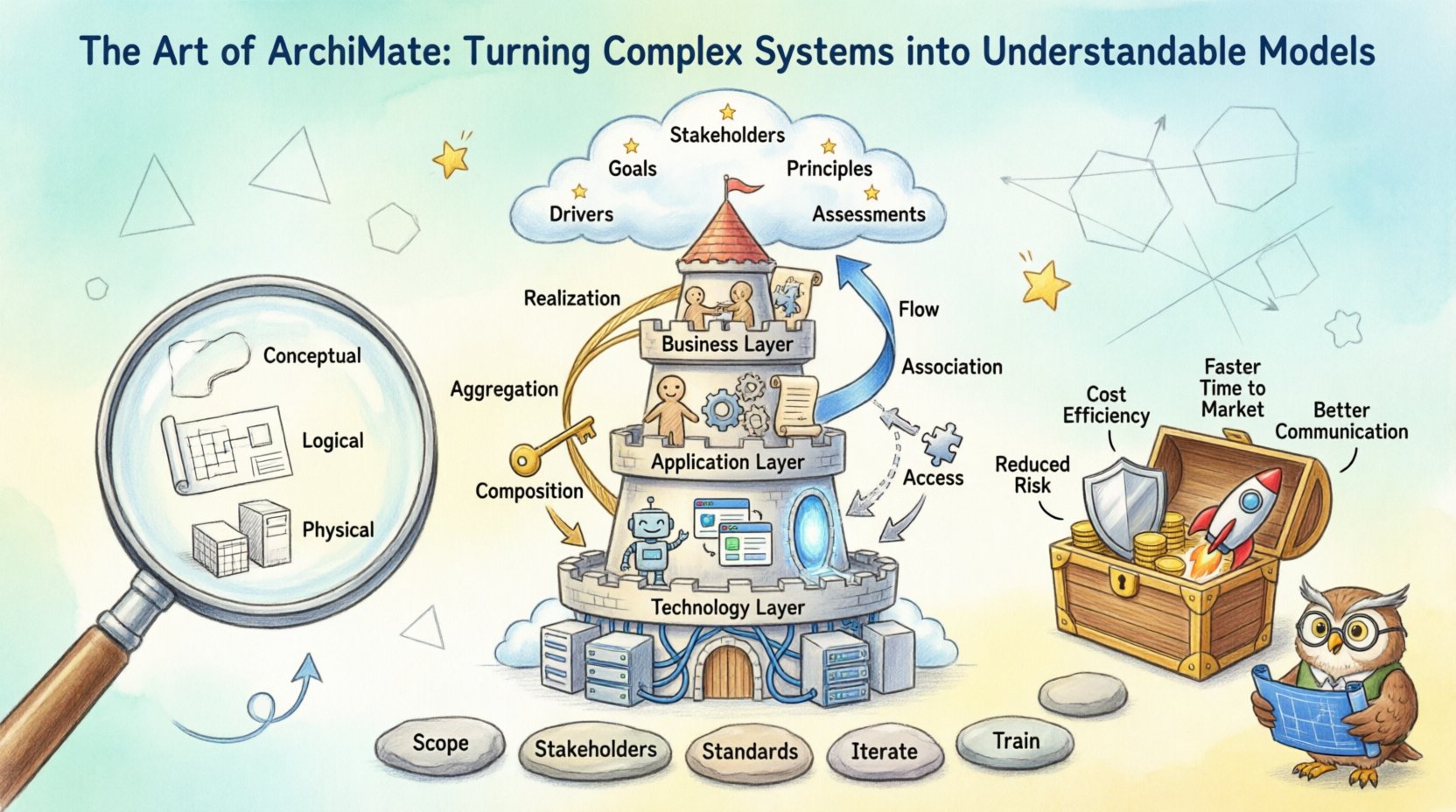
ArchiMate organizes architecture into three primary layers. This separation helps manage complexity by isolating concerns. Each layer focuses on a specific domain of the enterprise. Understanding the distinction between these layers is crucial for accurate modeling.
1. Business Layer
The Business Layer represents the organization’s structure and operations. It focuses on what the organization does, not how it does it technically. This layer includes concepts such as:
- Business Actors: People or organizations performing roles.
- Business Roles: Positions within the organization.
- Business Processes: Sequences of activities.
- Business Functions: Areas of responsibility.
- Business Objects: Data manipulated by processes.
- Business Services: Capabilities exposed to other actors.
2. Application Layer
The Application Layer represents the software systems that support business activities. It bridges the gap between business needs and technical implementation. Key concepts here include:
- Application Components: Modular software units.
- Application Interfaces: Points of interaction.
- Application Services: Functional capabilities provided by software.
- Application Function: Functions realized by applications.
3. Technology Layer
The Technology Layer represents the infrastructure that hosts the applications. This is the physical or virtual environment where software runs. Concepts in this layer include:
- Infrastructure: Hardware and network resources.
- System Software: Operating systems and middleware.
- Network: Connectivity and data transfer.
- Device: Physical computing resources.
- Technology Service: Capabilities provided by the infrastructure.
| Layer | Focus | Example Concept |
|---|---|---|
| Business | Organization & Strategy | Sales Process, Customer |
| Application | Software Systems | CRM System, Invoice Module |
| Technology | Infrastructure | Database Server, Cloud Instance |
🧩 The Motivation Layer
While the three layers describe the structure, the Motivation Layer describes the why. It captures the driving forces behind architectural decisions. This layer is often overlooked but is vital for alignment. It ensures that technical changes support actual business needs.
Key concepts in the Motivation Layer include:
- Stakeholders: Individuals or groups with an interest in the architecture.
- Goals: Desired outcomes that stakeholders wish to achieve.
- Principles: Rules or guidelines that constrain decisions.
- Requirements: Needs that must be met.
- Obstacles: Barriers preventing goal achievement.
Linking the Motivation Layer to the structural layers provides traceability. For example, a specific Goal might drive a Requirement, which is satisfied by a Business Service, which is realized by an Application Component. This chain of logic justifies every element in the model.
🔗 Understanding Relationships
Elements alone do not tell a story. Relationships define how elements interact. ArchiMate distinguishes between different types of connections. Using the correct relationship prevents misinterpretation of the model.
Association
An Association represents a static link between two elements. It implies a logical connection without implying flow or control. For example, a Business Actor might be associated with a Business Role.
Aggregation
Aggregation indicates a part-whole relationship. One element is composed of others, but the parts can exist independently. This is useful for decomposing complex functions into smaller units.
Composition
Composition is a stronger form of aggregation. If the whole ceases to exist, the parts cease to exist. This is common in structural breakdowns where the hierarchy is rigid.
Realization
Realization is perhaps the most critical relationship in enterprise architecture. It connects layers. A Business Process might be realized by an Application Function, which is realized by a Technology Service. This relationship explains how abstract concepts are implemented in concrete systems.
Flow
Flow represents the movement of information or material. It is dynamic. For instance, a Business Object flows from one Business Process to another. Flow is essential for understanding processes and data movement.
Access
Access indicates that one element uses another. It is often used to show that a Business Process uses an Application Service. This helps identify dependencies.
🛠️ Modeling Techniques and Abstraction
Creating a model is not about documenting everything. It is about selecting the right level of detail. ArchiMate supports multiple levels of abstraction. This allows architects to zoom in or out depending on the context.
Conceptual Level: High-level views focusing on the big picture. Used for strategic planning. Details are minimized.
Logical Level: More detail on structure and functions. Used for design and planning.
Physical Level: Concrete implementation details. Used for deployment and operations.
When modeling, follow these principles:
- Keep it Simple: Avoid unnecessary elements. If an element does not add value to the discussion, remove it.
- Ensure Consistency: Use the same terminology across all views.
- Focus on Relevance: Tailor the view to the audience’s needs.
- Use Colors and Shapes: Visual cues can help distinguish between layers or types of elements.
🚧 Common Challenges and Pitfalls
Even with a robust framework, modeling efforts can go off track. Recognizing common pitfalls early can save significant time and resources.
1. Over-Modeling
Attempting to model every single detail leads to maintenance nightmares. Models become outdated quickly. It is better to model what is changing or what is critical to decision-making.
2. Ignoring the Motivation Layer
Models that only show structure lack context. Without goals and drivers, stakeholders cannot understand the purpose of the architecture. Always link structural elements to the motivation layer.
3. Mixing Layers Incorrectly
While ArchiMate allows cross-layer connections, they should be logical. Do not mix Business Actors directly with Technology Devices without an intermediate application or service layer. This breaks the abstraction.
4. Lack of Governance
Without a process for updating models, they become obsolete. Architecture is dynamic. Change management processes must include updates to the architectural models.
🚀 Implementing ArchiMate Effectively
Adopting this framework requires a structured approach. It is not something that happens overnight. It involves cultural change and process integration.
Step 1: Define the Scope
Start small. Identify a specific domain or project. Do not attempt to model the entire enterprise at once. Define the boundaries of the initial effort.
Step 2: Engage Stakeholders
Involve business and technical representatives early. Their input ensures the model reflects reality. It also builds ownership of the architecture.
Step 3: Establish Standards
Create guidelines for naming conventions, notation, and diagram layout. Consistency is key for readability.
Step 4: Iterate
Models evolve. Review them regularly. Update them when processes change or when new systems are introduced. Treat the model as a living document.
Step 5: Train the Team
Ensure that everyone involved understands the language. Misinterpretations of symbols can lead to errors in implementation. Training sessions and documentation help maintain quality.
💡 The Value of Clear Modeling
Why invest time in this effort? The return on investment comes from improved decision-making. When the architecture is clear, leaders can assess the impact of changes.
- Reduced Risk: Understanding dependencies prevents unintended consequences.
- Cost Efficiency: Identifying redundant systems or processes saves money.
- Faster Time to Market: Clear blueprints reduce rework and confusion.
- Better Communication: Visual models bridge the gap between technical and business teams.
Furthermore, it supports compliance and governance. Regulators and auditors often require evidence of controls and processes. A well-maintained model provides this evidence efficiently.
🔄 Continuous Alignment
Architecture is not a one-time activity. It requires continuous alignment between strategy and execution. As the market changes, business goals shift. The technology must adapt.
Regular reviews ensure that the architecture remains relevant. They help identify drift where the implementation no longer matches the strategy. This alignment is critical for long-term success.
Organizations that master this discipline gain a competitive advantage. They are more agile. They can pivot faster because the impact of changes is understood. They do not guess; they know.
🌟 Final Thoughts
The Art of ArchiMate is about clarity. It is about taking the chaos of a complex system and organizing it into a coherent picture. It requires discipline, patience, and a commitment to truth. When done correctly, it empowers organizations to navigate change with confidence.
By focusing on the layers, relationships, and motivation, architects can create models that serve as true assets. These models guide the future of the enterprise. They turn complexity into understanding, and understanding into action.