Visual Paradigm AI Package Diagram Generator: Text to UML Packages

You’re architecting a new content management system, staring at layers, modules, and dependencies — presentation, business rules, persistence, security — but the high-level structure stays fuzzy. Manually creating packages, subpackages, and dependency arrows feels like overkill for a first draft. Enter Visual Paradigm’s AI Package Diagram Generator: describe your system in plain words, and get a clean, standards-compliant UML package diagram in seconds. It’s the fast lane from mental model to visual blueprint.

Why This AI Changes Software Architecture

  • Natural language → full UML package diagram instantly
  • Auto-identifies packages, subpackages, dependencies, and stereotypes
  • Handles layered, modular, and microservices-style structures
  • Fully editable native model — refine, add notes, merge packages
  • Desktop precision + browser chatbot for rapid iteration

1. Desktop: Prompt → Structured Architecture

In Visual Paradigm Desktop:

Tools → AI Diagram Generation → select “Package Diagram” → describe your system:

“Generate a UML Package Diagram for a content management system with Presentation Layer (Web UI, Mobile App), Business Logic Layer (Content Service, User Management, Workflow Engine), Data Access Layer (Repository, Audit Logging), and show dependencies between layers.”

The input dialog keeps it simple and focused:
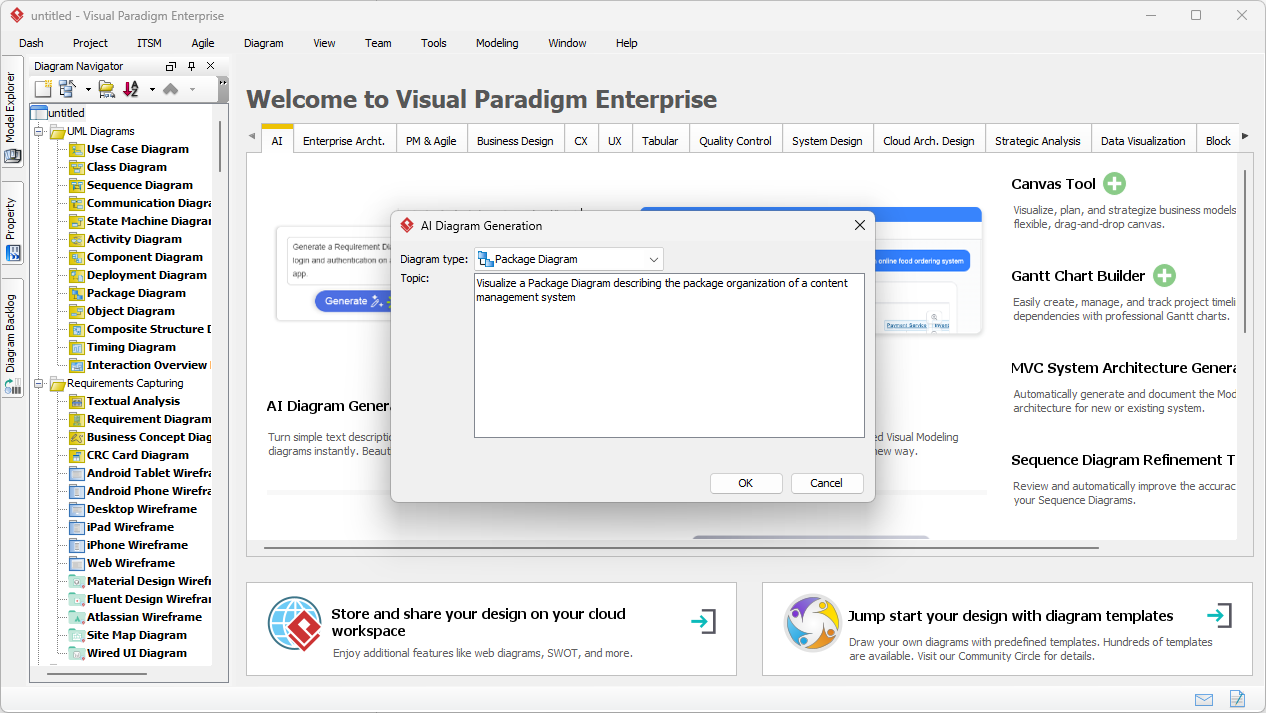
Visual Paradigm Desktop AI Package Diagram generation prompt interface

AI builds:

  • Top-level packages: Presentation Layer, Business Logic Layer, Data Access Layer
  • Subpackages: Web UI, Mobile App, Content Service, Repository
  • Clear dependency arrows (dashed) showing flow between layers

Resulting content management system package diagram — logical, layered, and ready for review:
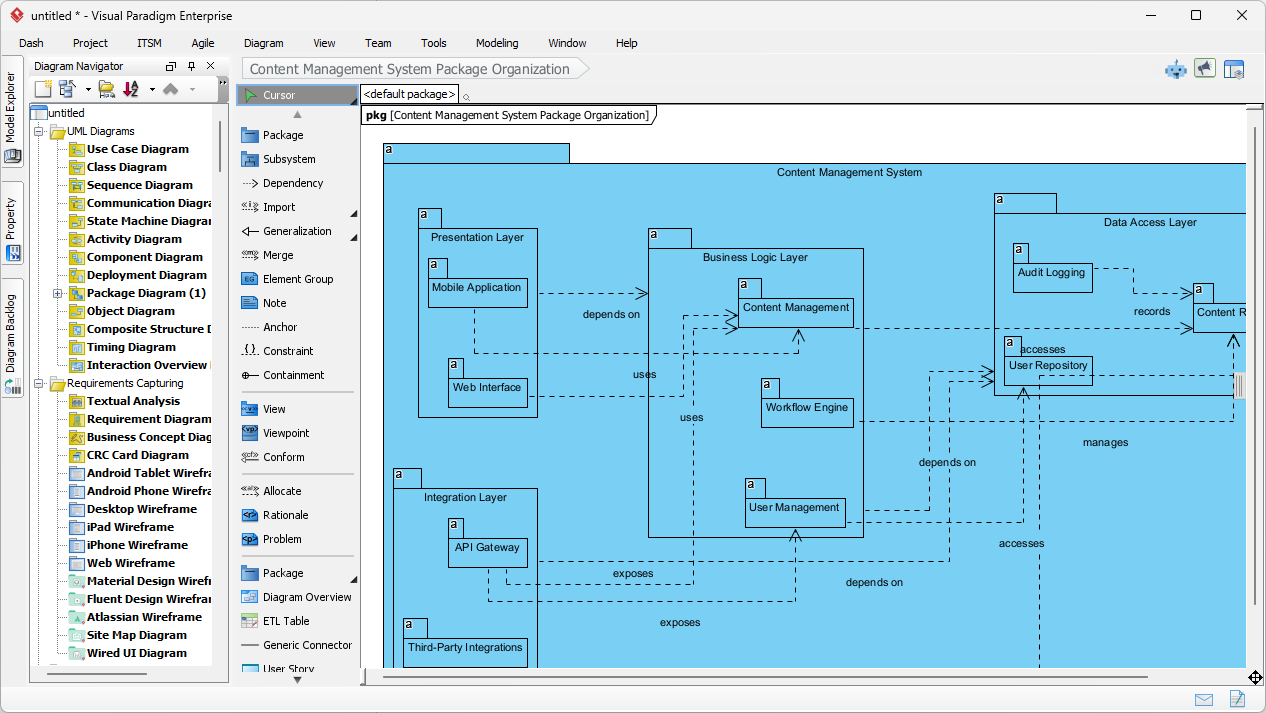
AI-generated UML Package Diagram for Content Management System

Immediately edit: add security package, adjust dependencies, or integrate with class diagrams.

2. Chatbot: Conversational Architecture on the Go

For quick sketches or remote brainstorming, open the Visual Paradigm AI Chatbot:

“Create UML Package Diagram for a banking system: Core Banking Services, Account Management, Customer Management, Transaction Processing, Compliance & Auditing.”

The chatbot generates it live — packages, subpackages, and dependencies appear instantly. Example output for a banking system:
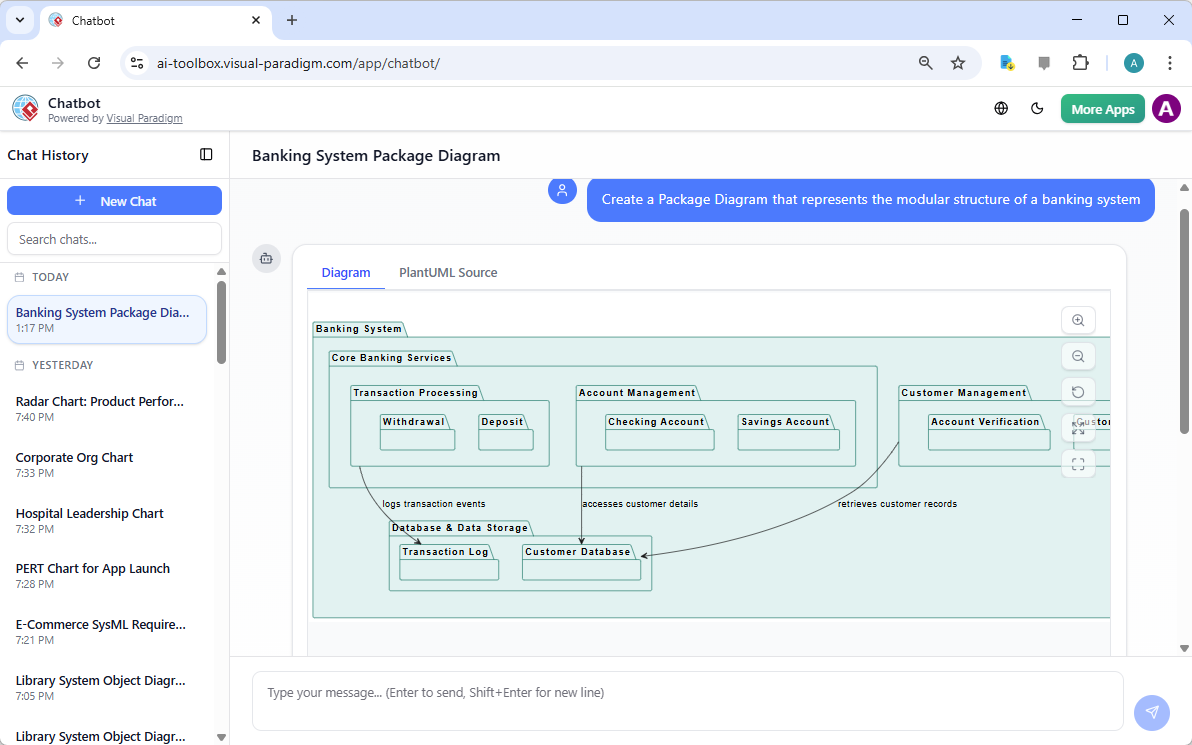
AI-generated UML Package Diagram for Banking System via Chatbot

Refine in conversation: “Add Payment Gateway package with dependency to Transaction Processing.” Instant update. Perfect for early design sessions or teaching UML.

Why Package Diagrams + AI Matter in 2026

Good architecture starts with clear boundaries. Package diagrams show modularity, layers, and dependencies before a single line of code is written. Manual creation slows you down; AI removes the friction.

Use cases that shine:

  • Layered enterprise apps
  • Microservices boundaries
  • Teaching modular design
  • Quick refactoring planning

Change scope mid-discussion? Regenerate. New module needed? Add it. That speed keeps architecture agile and team communication sharp.

Ready to Visualize Your System Structure?

Visual Paradigm’s AI Package Diagram Generator turns vague ideas into professional UML packages fast — whether for CMS, banking, e-commerce, or any modular system.

  • Download Visual Paradigm Desktop → Full modeling power: Get Desktop Now
  • Try AI Chatbot Online → Instant architecture sketches: Start Chatting

Stop wrestling with boxes and arrows. Start designing smarter — today.

Related Links

These articles explain how artificial intelligence is applied to UML package diagrams to automate the logical grouping of system elements, enabling developers to instantly generate architectural structures from natural language prompts to better manage software dependencies and system scalability.

  1. AI Diagram Generator Now Supports Package Diagrams in Visual Paradigm: This article details the release of new features that allow for the AI-powered generation of package diagrams to improve software architecture visualization.
  2. Generate UML Package Diagrams Instantly with Visual Paradigm AI: This guide focuses on utilizing AI-driven tools to create professional UML package diagrams with minimal manual effort.
  3. Interactive UML Package Diagram Generator: This resource provides access to an interactive tool for creating and editing package diagrams in real time through a conversational AI interface.
  4. UML Package Diagram: A Definitive Guide to Structuring Your Codebase with AI: This comprehensive guide explains how AI assists in structuring codebases, managing complex dependencies, and maintaining architectural integrity.
  5. Generating UML Package Diagrams from Text Prompts: This article explores how to transform raw ideas and textual prompts into detailed UML package diagrams using advanced AI modeling features.
  6. UML Package Diagram Tutorial Using Visual Paradigm: This tutorial provides a step-by-step approach to using package diagrams to structure software components and visualize their relationships effectively.
  7. Features of Package Diagram Software – Visual Paradigm Online: This overview highlights the online tools available for collaborative package diagram management, including version control and real-time editing.
  8. What is a Package Diagram in UML? – Visual Paradigm Guide: This foundational resource introduces the role of package diagrams in organizing complex software systems through logical grouping.
  9. Modeling Software Architecture with UML Package Diagrams: This article discusses best practices for using package diagrams to organize and communicate the modular structure of a system’s architecture.
  10. Package Diagram Examples & Templates – Visual Paradigm Gallery: This gallery offers a collection of real-world templates and examples to inspire and accelerate modular software design.
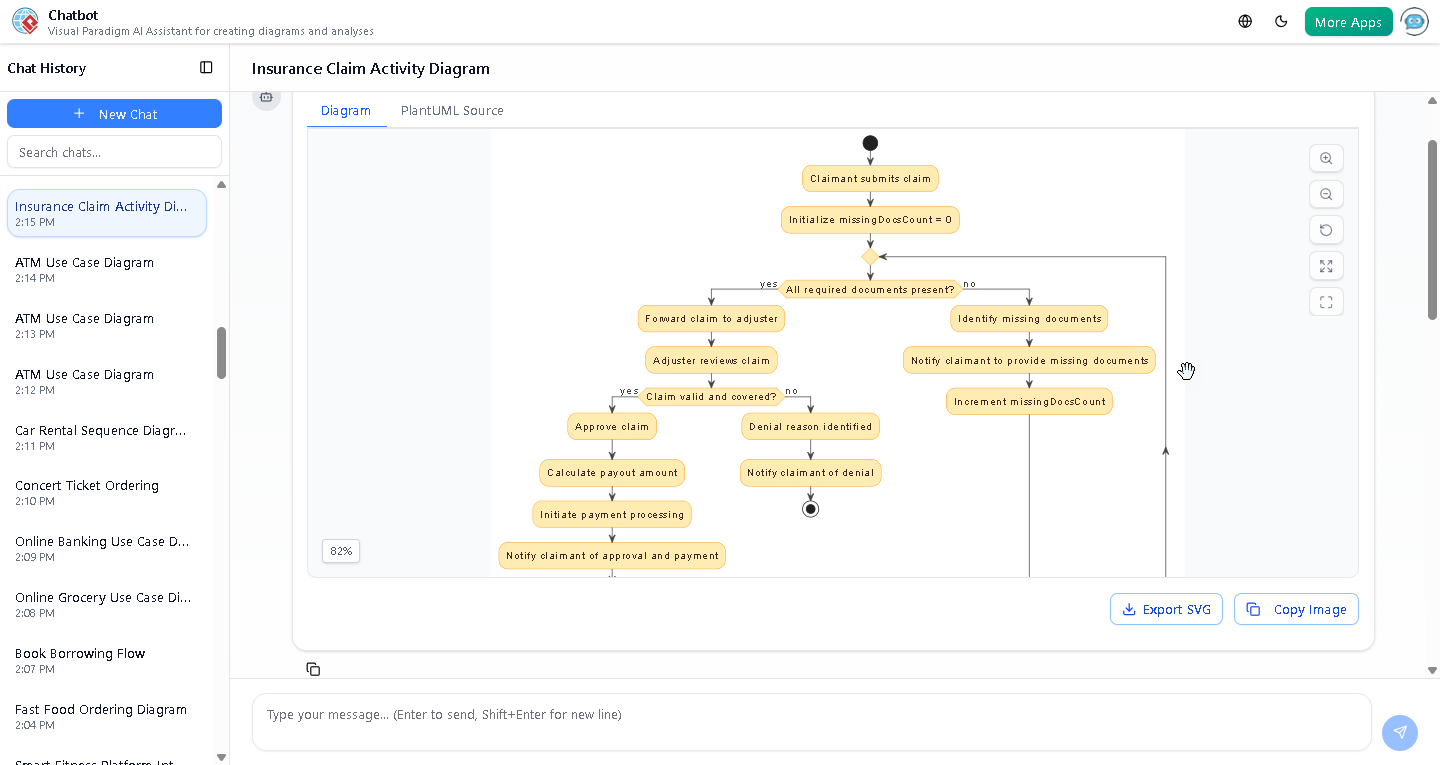
Visual Paradigm: A Comprehensive AI-Powered Visual Modeling Platform in 2026

Visual modeling continues to play a central role in software development, systems engineering, enterprise architecture, and business process design. In 2026, AI-powered visual modeling platforms enable professionals to create structured diagrams more efficiently — transforming descriptions, requirements, or discussions into accurate, readable visuals that support analysis, collaboration, and decision-making. Visual Paradigm integrates advanced generative AI features — including a conversational AI Chatbot and instant diagram generator — into a robust visual modeling environment. This combination allows users to produce high-quality diagrams rapidly while retaining full control over notation, layout, validation, and presentation.

How AI Enhances Visual Modeling Workflows

The platform’s AI capabilities focus on making visual creation faster and more intuitive without compromising diagram quality:

  • Users describe the desired diagram in natural language (“Create an activity diagram showing the user onboarding process with email verification and approval steps”)
  • The AI generates a complete, standards-compliant visual model
  • Follow-up refinements improve clarity and structure (“Use swimlanes for different roles”, “Add decision nodes for rejection paths”, “Apply a consistent color scheme for decision elements”)
  • Users can query the model directly (“Highlight the critical path in this sequence diagram”, “Suggest visual improvements for readability”)

This iterative approach supports the natural way teams develop and refine visual models — starting broad and progressively adding detail and polish.

Wide Range of Supported Visual Modeling Notations

Visual Paradigm’s AI diagram generator produces precise visuals across widely used modeling standards:

Notation Common AI-Generated Diagram Types Visual Purpose & Benefit
UML Class, Sequence, Activity, Use Case, Component, Deployment, State Machine Clear representation of structure, behavior, and interactions
SysML Block Definition (BDD), Internal Block (IBD), Requirement, Parametric Structured system composition and traceability visuals
ArchiMate Motivation, Business, Application, Technology, Implementation & Migration viewpoints Layered enterprise architecture overviews
C4 Model System Context, Containers, Components, Code views Hierarchical, readable software architecture documentation
BPMN 2.0 Processes, Collaborations, Conversations Precise workflow and role-based process visuals
ERD Logical & Physical ER Diagrams (Chen / Crow’s Foot) Clean database schema and relationship visuals

The AI respects official notation rules, ensuring generated diagrams are immediately usable in professional contexts — from internal reviews to external deliverables.

From AI Generation to Polished Visual Models

Visual Paradigm supports the complete visual modeling process:

  • Quick AI-assisted start in the browser — ideal for brainstorming, workshops, or initial drafts
  • Seamless handoff to desktop — open AI-generated models in the full Visual Paradigm Desktop application for detailed visual refinement
  • Professional visual tools:
    • Multiple layout algorithms (hierarchical, orthogonal, organic)
    • Custom themes, color palettes, and icon sets
    • Layer management, visual filters, and selective hiding
    • Annotations, hyperlinks, callouts, and embedded images
  • Validation & simulation — visual rule checking, BPMN path simulation, SysML constraint evaluation
  • Export options — high-resolution PNG/SVG, interactive PDF, Visio-compatible files, embeddable HTML

This workflow ensures that fast AI-generated visuals can evolve into clear, presentation-ready diagrams without switching tools.

Additional AI Features That Support Visual Clarity

Several specialized AI tools further improve visual modeling outcomes:

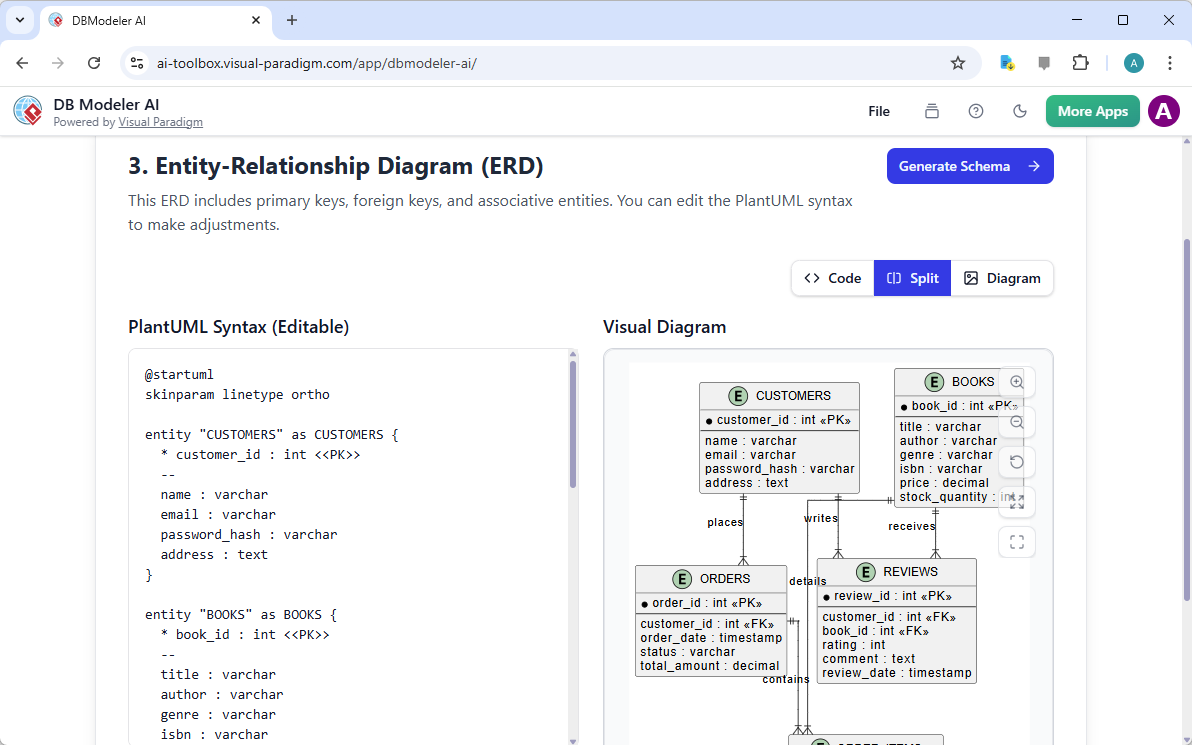
  • DBModeler AI — produces well-organized ER diagrams with clear key indicators, relationship lines, and cardinality notation
  • Text → Visual Extraction — identifies concepts from requirements text and places them into structured class or ER visuals
  • Strategic Visual Generators — creates balanced Business Model Canvas, SWOT matrices, OKR trees, and other frameworks with strong visual hierarchy

Conclusion

Visual Paradigm serves as a reliable AI-powered visual modeling platform that prioritizes both speed and quality. Its combination of conversational AI generation, accurate notation support, advanced visual editing tools, and seamless workflow continuity makes it well-suited for professionals who rely on clear, precise diagrams in their daily work.

A free online trial provides instant access to the AI Chatbot and visual modeling features — an easy way to explore its capabilities for your specific use cases.

Visit: www.visual-paradigm.com

Related Links

Share the Blueprint, Not the File: Collaborating on Architecture with Shareable AI Chat History

In complex projects, sharing a diagram as a static file (PNG, PDF) is fundamentally insufficient. It provides the final result but omits the crucial context: why the diagram was created that way, who requested the changes, and *what* alternatives were considered. This forces stakeholders to initiate tedious email chains and ask repetitive questions, delaying crucial sign-offs and increasing the risk of misinterpretation.Effective collaboration requires sharing the rationale and evolution of the model, not just the final image. The design process—the conversation itself—is as important as the artifact.

Visual Paradigm’s AI Chatbot solves this by treating the entire design conversation as the definitive artifact, making it perfectly suited for modern, transparent, and asynchronous collaboration.

Share the Evolution, Not Just the Endpoint

The AI enables two powerful collaboration features that redefine how teams work with models:

  1. Persistent Chat History: Every interaction—the initial prompt, the generated diagram (UML, C4, ArchiMate), every subsequent touch-up operation (e.g., “add container,” “rename system”), and every AI answer—is automatically saved in a persistent **chat history**. This history is the ultimate source of truth for design decisions.
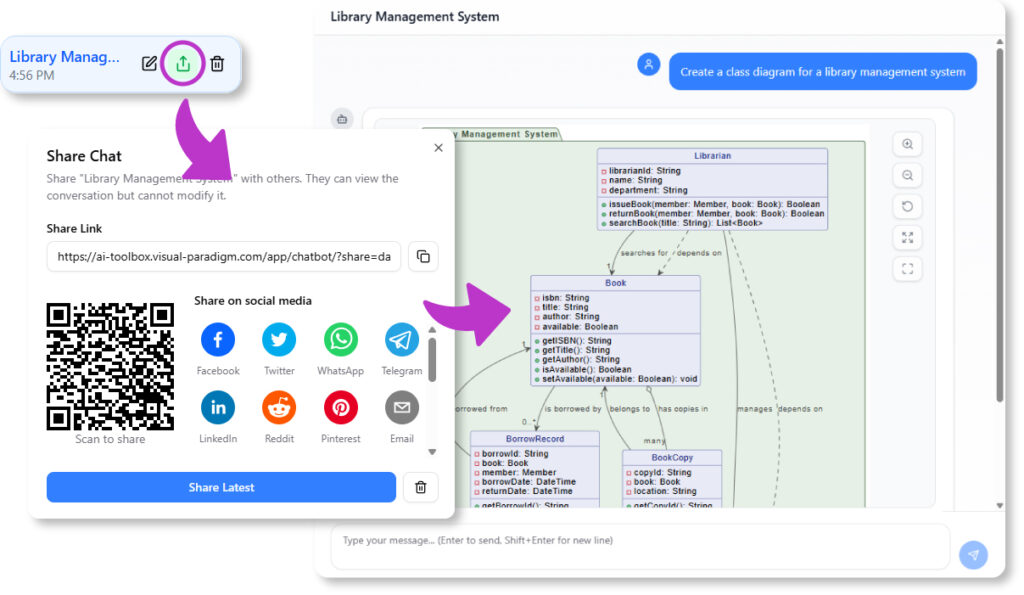
  2. Shareable URL: You can **share a chat session with others via a URL**. When a stakeholder opens the link, they see the entire transcript. They can review the design evolution from the high-level description to the final, detailed **UML Class Diagram** or **C4 Deployment Diagram**.

This creates a complete, contextual audit trail for the project, drastically reducing back-and-forth communication and ensuring all stakeholders understand the *why* behind the architecture.

Share the Blueprint, Not the File: Collaborating on Architecture with Shareable AI Chat History

Enhanced Review and Accountability

This dynamic sharing capability is invaluable for several key team activities where transparency is critical:

  • Stakeholder Review: Instead of a static presentation, send the chat history. Stakeholders can review the evolution of the model and immediately see the AI’s **suggested follow-up questions**, guiding them to consider the deeper implications of the design rather than just commenting on aesthetics.
  • Onboarding and Training: New team members can review the chat history for key models to quickly grasp the project’s architecture and the decisions that shaped it. The history acts as a living knowledge base, explaining complex concepts in context.
  • Consulting and Client Work: Consultants can use the shareable link as a transparent record of all modeling work, providing clients with an undeniable, clear record of the design process, decision rationale, and model compliance checks.
  • Auditability: The ability to track the exact prompt that led to a design change provides an indispensable record for regulatory compliance or post-incident technical review.

Collaboration Beyond the Diagram

The AI ensures all aspects of project communication are covered within the collaborative chat session.

  • Integrated Documentation: Before sharing, you can ask the AI to **generate a narrative report** summarizing the model. This report and the generating prompt are also stored in the shareable history, providing a perfect blend of visual and textual documentation.
  • Standards Adherence: Because the AI is expertly trained on major standards, the shared models adhere to clear compliance rules, making it easier for distributed teams to collaborate effectively without constant manual validation.
  • Modeling Continuity: Even after a conversation is shared, the original user can **import the model into Visual Paradigm** for professional version control and repository management, maintaining the design continuity from initial collaborative conversation to final implementation.

Stop sending outdated PDFs and static images. Start sharing the living, collaborative blueprint of your design process. The future of architectural review is conversational and transparent.

Facilitate transparent architectural collaboration today at chat.visual-paradigm.com.