
Agile environments thrive on diversity. A cross-functional squad brings together developers, designers, product owners, and testers under one umbrella. This diversity fuels innovation but also creates friction points. When personalities clash or priorities diverge, velocity drops. This guide explores how to navigate these waters without losing momentum, focusing on practical frameworks and cultural shifts that sustain high performance.
🧩 Understanding Conflict in Agile Teams
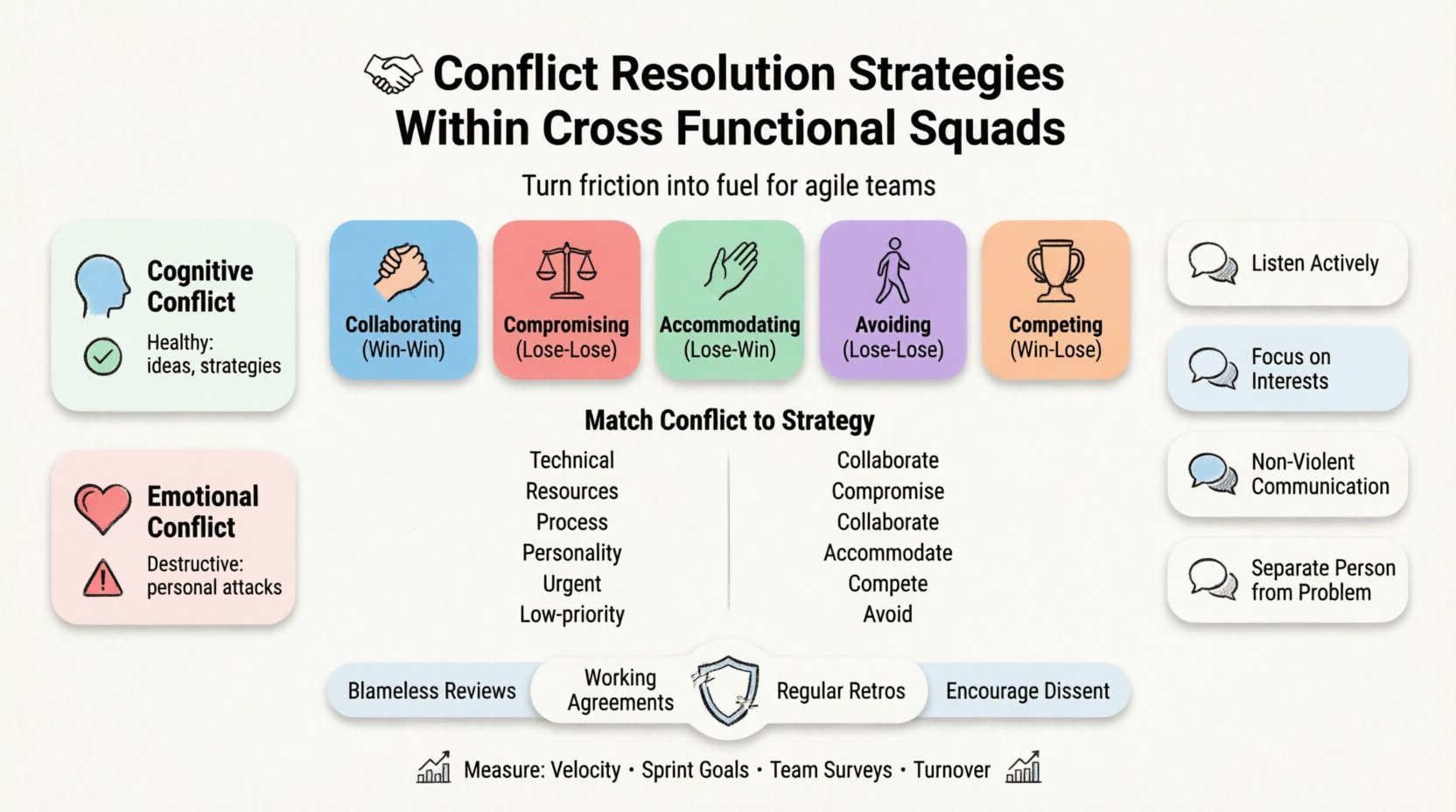
Conflict is not inherently negative. In fact, the absence of conflict often signals stagnation or a lack of critical engagement. The goal is not to eliminate friction but to manage it constructively. In the context of agile squads, we distinguish between two primary types of friction:
- Cognitive Conflict: Disagreements about ideas, strategies, and technical approaches. This is healthy and necessary for quality.
- Emotional Conflict: Interpersonal incompatibilities, personal attacks, or hidden agendas. This is destructive and requires immediate intervention.
Most disputes within a squad begin as cognitive disagreements. A developer proposes a microservice architecture while a tester argues for a monolithic approach. If handled with respect, this leads to a better system design. If handled poorly, it becomes personal. The Scrum Master or Team Lead must be vigilant in identifying which type is occurring.
🔍 Root Causes of Squad Friction
Before applying a solution, you must diagnose the source. Friction in cross-functional squads usually stems from one of the following areas:
- Role Ambiguity: Team members are unsure who owns specific decisions. Does the Product Owner own the acceptance criteria, or does the Development Team?
- Resource Contention: Multiple projects vying for the same specialist’s time. This creates bottlenecks and resentment.
- Differing Priorities: The business wants speed, while engineering wants stability. Both are valid, but they require negotiation.
- Communication Silos: Information does not flow freely between sub-functions (e.g., frontend and backend teams).
- Unspoken Expectations: Assumptions about quality standards or delivery timelines that were never explicitly agreed upon.
Identifying the root cause prevents band-aid solutions. Addressing a communication issue with a personality conflict strategy will fail. Addressing a priority issue with a communication workshop will fail.
🛠️ Core Resolution Frameworks
There are established models for handling disagreement. While these originated in general management, they translate well to agile squads. The Thomas-Kilmann Instrument categorizes five conflict-handling modes. Each has its place depending on the situation.
1. Collaborating (Win-Win)
This approach seeks a solution that fully satisfies both parties. It requires time and high energy but yields the best long-term results for complex problems.
- Best for: Complex technical decisions where both parties have vital information.
- Example: Deciding on a new database technology requires input from both the DBA and the application architect.
2. Compromising (Lose-Lose)
Each party gives up something to reach a middle ground. This is efficient but rarely optimal.
- Best for: Temporary solutions when time is critical.
- Example: Agreeing to split a feature between two teams to meet a release date, even if neither is fully satisfied with the scope.
3. Accommodating (Lose-Win)
One party yields to the other. This preserves relationships but may not solve the problem.
- Best for: When the issue is more important to the other party than to you.
- Example: A senior engineer defers to a junior developer on a UI choice to build their confidence.
4. Avoiding (Lose-Lose)
Parties withdraw from the conflict. This is often the default when emotions are high.
- Best for: When emotions are too high to discuss rationally, or when the issue is trivial.
- Risk: Avoiding conflict often leads to resentment building up over time.
5. Competing (Win-Lose)
Assertive pursuit of one’s own concerns at the expense of others.
- Best for: Emergency situations where quick, decisive action is needed.
- Risk: Damages team cohesion if used frequently.
🗣️ Communication Techniques for Resolution
Even with the right framework, poor communication will derail resolution. The following techniques help keep discussions focused on the work, not the people.
- Active Listening: Paraphrase what the other person said before responding. “So, what I hear you saying is…” This validates their perspective.
- Focusing on Interests, Not Positions: A position is “I want feature X.” An interest is “I need to reduce user churn.” Focusing on interests opens up more solutions.
- Non-Violent Communication: Use the formula: Observation, Feeling, Need, Request. “When the code is deployed late (Observation), I feel anxious (Feeling) because we need stability (Need). Can we implement a rollback plan? (Request).”
- Separating the Person from the Problem: Attack the issue, not the individual. Avoid phrases like “You always…” or “You never…”
📊 Conflict Types vs. Resolution Approaches
Not all conflicts require the same intensity of intervention. Use the table below to determine the appropriate response based on the source of the friction.
| Conflict Source | Recommended Strategy | Key Action |
|---|---|---|
| Technical Disagreement | Collaborating | Conduct a spike or proof of concept. |
| Resource Scheduling | Compromising | Review capacity and negotiate scope. |
| Process Ambiguity | Collaborating | Update the Working Agreement. |
| Personality Clash | Accommodating / Mediating | Facilitate a private 1:1 discussion. |
| Urgent Decision Needed | Competing | Assign a decision owner (DRI). |
| Low Priority Issue | Avoiding | Defer to the next retrospective. |
🛡️ Building Psychological Safety
Prevention is better than cure. The most effective way to manage conflict is to build a culture where it can be addressed safely. Psychological safety is the belief that you will not be punished or humiliated for speaking up with ideas, questions, concerns, or mistakes.
- Blameless Post-Mortems: When things go wrong, focus on the process, not the person. Ask “What in the system allowed this to happen?” rather than “Who did this?”
- Explicit Working Agreements: Define how the team works together. How do we handle code reviews? How do we handle late arrivals? Having written agreements reduces ambiguity.
- Regular Retrospectives: Use the retrospective to discuss team dynamics, not just project progress. Ask “How did we work together this sprint?”
- Encourage Dissent: Leaders should actively invite opposing views. “I want to hear why this might fail.” This normalizes disagreement as part of the process.
🧑⚖️ The Role of Leadership
The Scrum Master or Team Lead plays a pivotal role in conflict resolution. They are not there to judge who is right, but to facilitate the process. Their toolkit includes:
- Facilitation: Guiding the conversation to ensure everyone is heard.
- Coaching: Helping team members develop their own conflict resolution skills.
- Escalation Management: Knowing when a conflict is beyond the team’s capability and requires management intervention.
- Environment Shaping: Removing impediments that cause friction, such as unclear requirements or tooling issues.
Leadership must model the behavior they expect. If a leader reacts defensively to feedback, the team will hide their conflicts. If a leader admits mistakes openly, the team will feel safe to do the same.
📈 Measuring Team Health
You cannot manage what you do not measure. While subjective feelings are important, objective data helps track progress. Consider the following metrics to gauge the effectiveness of your conflict resolution efforts.
- Velocity Consistency: High conflict often leads to fluctuating velocity. A stable trend suggests better alignment.
- Sprint Goal Success Rate: Are you failing sprint goals due to scope creep (conflict) or technical debt?
- Team Health Surveys: Anonymous surveys asking about trust, safety, and satisfaction.
- Turnover Rate: High conflict often leads to attrition. Watch for departures of key team members.
- Communication Frequency: Are communication channels active and healthy, or are they silent and formal?
🛠️ Specific Scenarios and Solutions
Real-world application requires context. Here are common scenarios and how to approach them.
Scenario 1: The Quality vs. Speed Debate
The Situation: The Product Owner wants to ship a feature by Friday. The Lead Developer argues it needs more testing to avoid bugs.
The Resolution: Hold a risk assessment session. Define what “done” means. If the risk is low, ship with a plan to monitor. If the risk is high, negotiate scope reduction rather than time reduction. Find a middle ground where a subset of features is shipped safely.
Scenario 2: The Code Review Standoff
The Situation: Two senior engineers disagree on the implementation pattern. Reviews are taking weeks.
The Resolution: Switch to pair programming for a short period. This allows them to work through the logic together in real-time. Alternatively, appoint a third party to make the tie-breaking decision after listening to both sides.
Scenario 3: The Silent Disagreement
The Situation: During planning, the team nods along, but implementation is poor. No one speaks up.
The Resolution: This is a culture issue. The facilitator must ask specific questions. “Who has concerns about this story?” “What is the worst-case scenario here?” Use anonymous voting tools during estimation to reveal hidden dissent.
🔄 Continuous Improvement Loop
Conflict resolution is not a one-time event. It is a continuous loop of diagnosis, intervention, and reflection. After a conflict is resolved, the team should reflect on the process.
- What triggered the conflict?
- Was the resolution effective?
- Did we damage any relationships?
- How can we prevent this specific trigger next time?
Integrating this reflection into the retrospective ensures that the squad learns from every disagreement. Over time, the team builds a shared language for handling friction, reducing the emotional cost of conflict.
🌱 Long-Term Cultural Shifts
Sustainable improvement requires more than tactical fixes. It requires a shift in how the organization views work. This involves moving from a culture of compliance to a culture of commitment.
- Empowerment: Give teams the authority to make decisions. Uncertainty causes conflict; clarity reduces it.
- Transparency: Make work visible. When everyone sees the same information, misunderstandings decrease.
- Feedback Loops: Shorten the feedback cycle. The faster feedback arrives, the faster conflicts can be addressed before they escalate.
- Respect for Expertise: Value the specific knowledge of each function. A designer knows UX; a developer knows performance. Both are needed.
🏁 Moving Forward
Conflict within a cross-functional squad is inevitable. It is a natural byproduct of intelligent people working on complex problems. The objective is not to create a harmonious team where everyone agrees all the time. That is impossible. The objective is to create a team that can disagree without being disagreeable.
By applying structured frameworks, fostering psychological safety, and maintaining open communication, squads can turn friction into fuel. This leads to better products, happier teams, and a sustainable pace of delivery. The journey requires patience and consistent effort, but the return on investment is a high-performing agile organization.
Start by observing your current dynamics. Identify the root causes of your friction. Choose the appropriate strategy from the frameworks provided. Measure the results. Iterate. This is the path to a resilient team.