
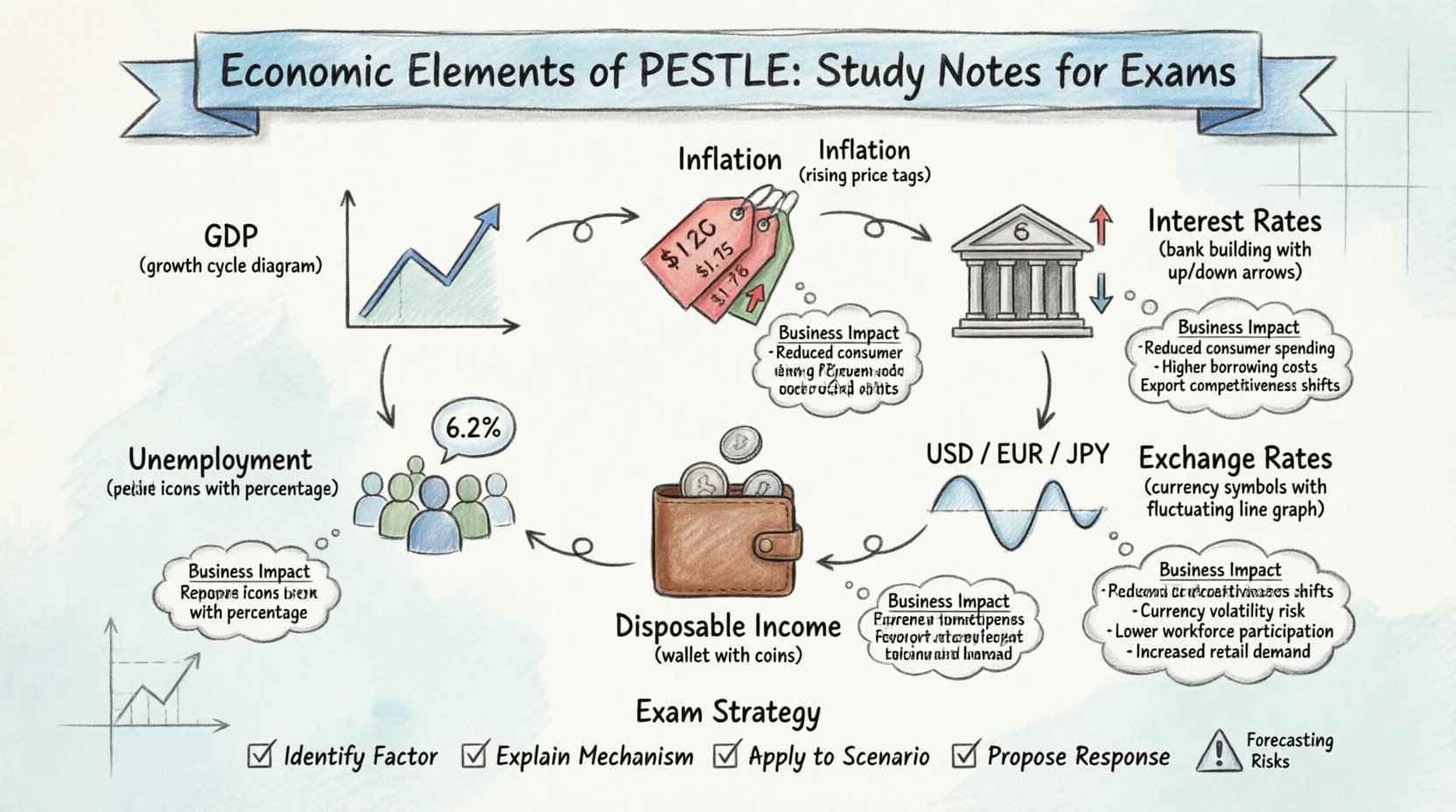
🏛️ Understanding the Economic Component
The PESTLE framework serves as a foundational tool for strategic analysis, helping organizations and students identify external factors that impact business operations. While the framework encompasses Political, Social, Technological, Legal, and Environmental aspects, the Economic element stands out as a critical driver of market dynamics. For exam candidates, mastering this section requires more than memorization; it demands an understanding of how macroeconomic variables influence micro-level business decisions.
When analyzing the economic factors in PESTLE, the focus shifts to the broader financial environment. This includes indicators that signal the health of an economy, such as growth rates, inflation levels, and interest rates. These elements determine consumer spending power, the cost of capital, and the viability of expansion strategies. In an exam setting, questions often present a business scenario and ask you to evaluate risks or opportunities based on current economic conditions.
📈 Key Economic Indicators Overview
To perform a robust analysis, one must understand the specific metrics used to gauge economic health. The following table outlines the primary indicators you should be familiar with, their definitions, and their general impact on business strategy.
| Indicator | Definition | Impact on Business |
|---|---|---|
| Gross Domestic Product (GDP) | Total value of goods produced | High GDP suggests strong demand; low GDP signals recession risks |
| Inflation Rate | Rate at which prices rise | High inflation increases costs and reduces purchasing power |
| Interest Rates | Cost of borrowing money | High rates discourage investment and increase debt servicing costs |
| Exchange Rates | Value of currency relative to others | Affects import/export costs and competitiveness abroad |
| Unemployment Rate | Percentage of workforce without jobs | High unemployment reduces consumer spending but lowers wage pressures |
| Disposable Income | Income available after taxes | Directly influences consumer purchasing power |
💰 Interest Rates and Monetary Policy
Interest rates represent the cost of borrowing money. Central banks adjust these rates to control inflation and manage economic growth. When interest rates rise, borrowing becomes more expensive for businesses. This affects capital-intensive projects, such as purchasing new machinery or expanding facilities.
- Impact on Debt: Companies with significant debt loads face higher repayment costs, reducing net profit margins.
- Investment Decisions: High rates often lead to a delay in investment projects due to increased cost of capital.
- Consumer Behavior: Higher rates on loans and mortgages reduce disposable income, leading to lower consumer spending.
- Savings: Conversely, high interest rates encourage saving, which can reduce immediate liquidity in the market.
For exam questions, consider how a company with high leverage might struggle during a period of tightening monetary policy. Conversely, a cash-rich company might benefit from higher interest earned on deposits.
💱 Exchange Rates and Currency Fluctuation
Exchange rates determine the value of one currency compared to another. This is particularly relevant for businesses involved in international trade. Fluctuations can create both opportunities and significant risks.
- Exporters: A weaker domestic currency makes exports cheaper for foreign buyers, potentially boosting sales volume.
- Importers: A weaker domestic currency makes imported raw materials more expensive, squeezing profit margins.
- Hedging Strategies: Companies often use financial instruments to lock in rates, though this adds complexity and cost.
- Tourism: Exchange rates directly influence travel costs, affecting the hospitality and service sectors.
In a PESTLE analysis, you must assess whether the business relies heavily on imports or exports. A volatile currency environment requires robust risk management plans.
📉 Inflation and Purchasing Power
Inflation measures the rate at which the general level of prices for goods and services is rising. It erodes purchasing power, meaning consumers can buy less with the same amount of money.
- Cost Push Inflation: When production costs rise (e.g., raw materials), businesses pass these costs to consumers through price hikes.
- Demand Pull Inflation: Occurs when demand exceeds supply, driving prices up.
- Wage-Price Spiral: Workers demand higher wages to match inflation, leading businesses to raise prices again.
- Contract Negotiations: Long-term supply contracts may need to include clauses for price adjustments to account for inflation.
During exam scenarios, analyze how a business can maintain margins. Strategies might include efficiency improvements, product redesign, or selective price increases.
📊 GDP and Economic Growth Cycles
Gross Domestic Product (GDP) is the sum of all goods and services produced. It indicates the overall health of the economy. Economies move through cycles of expansion and contraction.
- Expansion Phase: GDP grows, unemployment falls, and confidence is high. Businesses typically invest and hire.
- Recession: GDP contracts for two consecutive quarters. Consumer confidence drops, and sales decline.
- Stagflation: A rare but difficult scenario where inflation is high, growth is slow, and unemployment is rising.
- Pro-cyclical vs. Counter-cyclical: Some industries, like luxury goods, thrive in expansion. Others, like discount retailers, may perform better in recessions.
Understanding the current stage of the economic cycle helps in forecasting future demand. For exams, linking the current GDP trend to specific industry performance is a key scoring point.
👥 Unemployment and Disposable Income
Unemployment levels affect the labor market and consumer spending. High unemployment means fewer people have income to spend, reducing aggregate demand.
- Labor Supply: High unemployment can lead to a surplus of workers, allowing employers to offer lower wages.
- Consumer Confidence: Fear of job loss often leads to increased savings and reduced spending, even among employed individuals.
- Government Spending: High unemployment often triggers increased government welfare spending, which can impact tax levels.
- Disposable Income: This is the money households have left after paying taxes. It is the primary fuel for retail and service sectors.
When analyzing a retail brand, high unemployment is a negative signal. Conversely, a staffing agency might view high unemployment as a challenge to fill roles, or a negative signal depending on the sector.
🌍 Global vs. Local Economic Conditions
Businesses operate in a layered economic environment. They must consider both the global stage and local specifics.
- Global Supply Chains: A disruption in a major economy can ripple through global supply chains, affecting local availability of goods.
- Local Regulations: National fiscal policies, such as tax cuts or stimulus packages, can differ significantly from global trends.
- Market Segmentation: A business might expand into a developing economy while contracting operations in a mature market.
- Currency Risk: Global companies face currency risk even if they do not trade internationally, due to hedging costs.
Examiners often look for this distinction. Identifying that a local factor is actually driven by a global event demonstrates deep analytical skills.
📝 Exam Strategy: Answering Economic Questions
To score well in exams, structure your analysis logically. Do not simply list factors; explain the cause and effect.
- Identify the Factor: Clearly state which economic element is relevant (e.g., “Rising Interest Rates”).
- Explain the Mechanism: Describe how this factor changes costs or revenue (e.g., “Increases cost of borrowing”).
- Apply to the Scenario: Link it to the specific business mentioned in the case study (e.g., “The manufacturing firm faces higher debt servicing costs”).
- Propose a Response: Suggest a strategic move to mitigate the risk or capitalize on the opportunity.
⚠️ Risks in Economic Forecasting
Even with robust data, economic forecasting carries inherent risks. Predictions can be wrong due to unforeseen events.
- External Shocks: Events like pandemics or geopolitical conflicts can instantly alter economic trajectories.
- Data Lag: Economic data is often published with a delay, meaning decisions are based on past information.
- Over-reliance: Focusing solely on economic data while ignoring social or technological shifts can lead to strategic blindness.
- Assumption Errors: Assuming linear growth when the market is volatile can result in poor planning.
Awareness of these limitations shows critical thinking. Acknowledging uncertainty in your analysis adds credibility.
💡 Practical Application in Business Planning
Beyond exams, these elements guide real-world strategy. Financial planners use this data to set budgets. Marketing teams use it to set pricing. HR departments use it to plan hiring.
- Budgeting: Inflation rates determine the budget for next year’s operating costs.
- Pricing: Exchange rates influence the pricing of imported goods.
- Expansion: GDP growth rates justify opening new branches in specific regions.
- Workforce: Unemployment rates influence recruitment strategies and salary offers.
The Economic element of PESTLE is not static. It requires continuous monitoring. For students, treating it as a dynamic variable rather than a fixed fact is the key to success. By understanding the mechanics behind these indicators, you build a framework that applies to both academic assessment and professional practice.
📚 Summary of Key Takeaways
To recap the essential points for your revision:
- Economic factors are macro-level indicators affecting business performance.
- Interest rates impact borrowing costs and consumer spending power.
- Exchange rates influence import/export competitiveness.
- Inflation erodes purchasing power and increases input costs.
- GDP indicates the overall economic health and growth cycle.
- Unemployment affects labor supply and consumer confidence.
- Always link theoretical indicators to the specific business context in your answers.
Use this guide to structure your study sessions. Focus on understanding the relationships between these variables rather than rote memorization. This approach will serve you well in exams and future professional endeavors.