
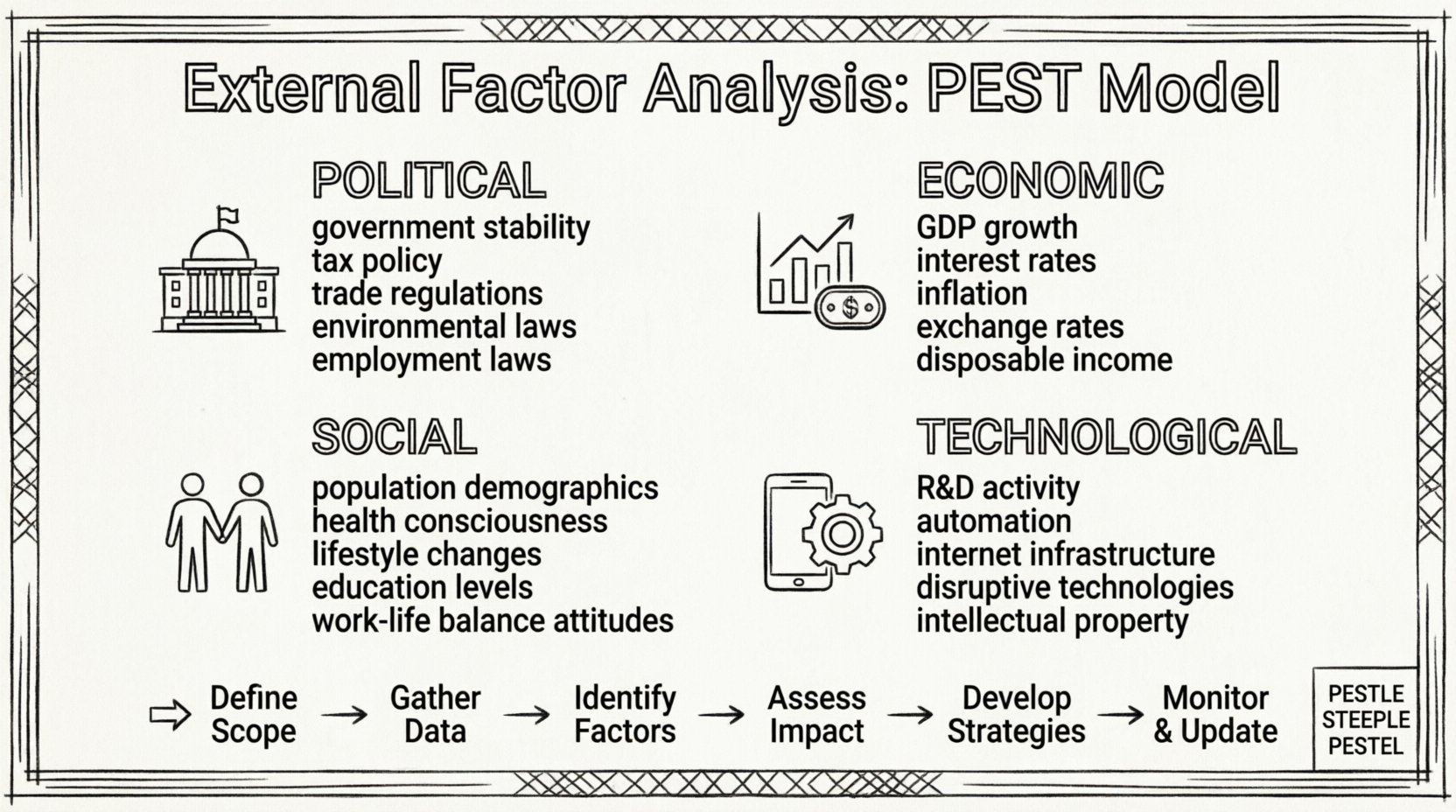
In the landscape of strategic planning, understanding the macro-environment is critical for long-term success. Organizations that ignore external forces often find themselves reacting to changes rather than anticipating them. The PEST model serves as a foundational framework for external factor analysis, allowing businesses to identify opportunities and threats beyond their direct control. This article provides a comprehensive breakdown of the PEST analysis, exploring its components, application, and strategic value without the use of buzzwords or fluff.
What is the PEST Model? 📊
The PEST analysis is a strategic tool used to scan the external environment of a business. It stands for Political, Economic, Social, and Technological factors. By categorizing these elements, decision-makers can gain a holistic view of the market conditions that influence their operations.
- Origin: Developed in the 1960s, the framework has evolved to remain relevant across various industries.
- Purpose: It helps organizations avoid blind spots when formulating strategy.
- Application: Useful for market entry, product launches, and annual planning cycles.
This analysis does not replace internal auditing but complements it. While internal analysis focuses on strengths and weaknesses, PEST focuses on the opportunities and threats presented by the wider world.
The Four Pillars of External Analysis 🔍
To conduct a robust analysis, each pillar must be examined in detail. These categories represent the macro-environmental forces that affect all organizations within a specific market.
1. Political Factors 🏛️
Political factors refer to how government intervention influences the economy and business sectors. These are often the most volatile elements in a PEST analysis.
- Government Stability: Is the current administration stable? Political unrest can disrupt supply chains.
- Tax Policy: Changes in corporate tax rates directly impact profitability and cash flow.
- Trade Regulations: Tariffs, quotas, and trade agreements determine the cost of importing or exporting goods.
- Environmental Laws: Regulations regarding carbon emissions or waste disposal affect manufacturing costs.
- Employment Laws: Minimum wage requirements and labor rights impact operational budgets.
For example, a company planning to expand into a new region must research the political climate. If a country is moving toward protectionism, tariffs could erode margins on imported raw materials.
2. Economic Factors 💰
Economic factors relate to the performance of the economy as a whole. These variables affect consumer purchasing power and the cost of capital.
- Economic Growth: GDP growth rates indicate whether the market is expanding or contracting.
- Interest Rates: High rates increase the cost of borrowing for expansion or inventory.
- Inflation: Rising prices increase the cost of goods and services, potentially squeezing margins.
- Exchange Rates: Fluctuations impact the cost of foreign sourcing and the competitiveness of exports.
- Disposable Income: The amount of money available to consumers determines demand for non-essential goods.
| Economic Indicator | Impact on Business | Strategic Response |
|---|---|---|
| Recession | Reduced consumer spending | Pivot to value-oriented products |
| High Inflation | Increased input costs | Adjust pricing or source locally |
| Low Interest Rates | Cheaper capital | Invest in growth or R&D |
3. Social Factors 🧑🤝🧑
Social factors encompass the demographic and cultural aspects of the external environment. These trends shape consumer behavior and workforce expectations.
- Population Growth: Aging populations require different services than growing youth populations.
- Health Consciousness: Shifts in wellness trends affect food, fitness, and insurance industries.
- Lifestyle Changes: Remote work trends alter the demand for commercial real estate.
- Education Levels: Higher education levels can create a more skilled workforce and informed consumers.
- Attitudes toward Work: Priorities regarding work-life balance influence recruitment and retention.
Understanding these nuances is vital for marketing and product development. A brand ignoring the shift toward sustainability may find itself losing relevance among younger demographics.
4. Technological Factors 📱
Technological factors cover innovations that create new markets or render existing products obsolete. This is often the fastest-moving category.
- R&D Activity: The rate of innovation in the industry dictates the pace of change.
- Automation: Automation reduces labor costs but requires capital investment.
- Internet Infrastructure: Connectivity speeds determine the viability of digital services.
- Disruptive Technologies: AI, blockchain, or cloud computing can transform business models.
- Intellectual Property: Patent laws protect innovation and define competitive advantages.
How to Conduct a PEST Analysis 🛠️
Executing a PEST analysis requires a structured approach. It is not merely a brainstorming session but a data-driven exercise.
- Define the Scope: Determine the specific market or product line being analyzed. A global strategy requires a different analysis than a local one.
- Gather Data: Collect information from credible sources. Government reports, industry journals, and economic forecasts are key.
- Identify Factors: Brainstorm specific factors under each of the four categories. Be specific; avoid vague statements.
- Assess Impact: Evaluate the significance of each factor. Which ones pose the greatest risk or offer the biggest opportunity?
- Develop Strategies: Translate findings into actionable plans. If a new tax law is imminent, adjust the budget.
- Monitor and Update: The external environment changes constantly. Review the analysis annually or when significant shifts occur.
Integrating Findings into Strategy 🚀
Collecting data is only half the battle. The true value lies in integration. How do these external factors influence the internal strategic plan?
- Risk Management: If political instability is high, diversify supply chains to reduce dependency on one region.
- Market Entry: If social trends favor mobile usage, prioritize mobile-first platform development.
- Product Development: If economic forecasts suggest a downturn, focus on durable goods rather than luxury items.
- Resource Allocation: If technological shifts are rapid, allocate more budget to R&D and less to long-term infrastructure.
This integration ensures that the strategy is resilient. It moves the organization from a reactive stance to a proactive one.
Common Pitfalls in External Analysis ⚠️
Even experienced strategists can make mistakes when analyzing the external environment. Awareness of these pitfalls helps maintain accuracy.
- Confirmation Bias: Only looking for data that supports existing assumptions. Seek out contradictory evidence.
- Overlooking Weak Signals: Focusing only on immediate threats while ignoring long-term trends like climate change or demographic shifts.
- Static Analysis: Treating the analysis as a one-time event. The environment is dynamic.
- Lack of Specificity: Using generic statements like “economy is growing” without quantifying the growth rate or sector.
- Ignoring Interconnectivity: Treating factors in isolation. Economic factors often influence social trends, which in turn drive political policy.
PEST Variations: Expanding the Framework 🔎
While the standard PEST model is widely used, variations exist to address specific needs. These modifications add depth to the analysis.
| Model | Additional Factors | Best Used For |
|---|---|---|
| PESTLE | Legal, Environmental | Compliance-heavy industries |
| STEEPLE | Social, Technological, Economic, Environmental, Political, Legal, Ethical | Corporate Social Responsibility focus |
| PESTEL | Environmental, Legal | Sustainability planning |
The choice of model depends on the industry. A pharmaceutical company, for instance, must prioritize Legal and Regulatory factors significantly more than a tech startup might.
Real-World Application Scenarios 🌐
To illustrate the utility of this framework, consider how different sectors utilize external factor analysis.
Retail Sector
Retailers face intense scrutiny on social and economic factors. A shift in consumer spending habits due to inflation can force a retailer to change its inventory mix. Political factors regarding minimum wage hikes directly impact labor costs. Technological factors like the rise of e-commerce compel brick-and-mortar stores to adopt omnichannel strategies.
Manufacturing Sector
Manufacturers are heavily influenced by political trade policies and economic commodity prices. A change in import tariffs can make overseas sourcing unviable. Environmental regulations regarding waste disposal require significant capital investment. Technological advancements in automation allow for higher efficiency but require workforce retraining.
Service Industry
Service providers rely on social demographics and economic stability. An aging population creates demand for healthcare and leisure services. Economic downturns reduce discretionary spending on travel and entertainment. Technological shifts in communication tools change how services are delivered remotely.
Ensuring Data Quality 📈
The reliability of a PEST analysis depends entirely on the quality of the data used. Relying on outdated or anecdotal information leads to flawed strategies.
- Use Primary Sources: Government census data, central bank reports, and industry whitepapers are more reliable than news articles.
- Check Timeliness: Ensure data is current. Economic conditions can shift within a quarter.
- Verify Sources: Cross-reference findings. If multiple independent sources report the same trend, confidence increases.
- Quantify Where Possible: Use percentages and dollar amounts rather than qualitative descriptors like “high” or “low”.
Strategic Agility and Continuous Monitoring 🔄
The goal of external factor analysis is not to predict the future with certainty but to prepare for various scenarios. Organizations must build agility into their structures.
- Scenario Planning: Develop plans for different outcomes based on the PEST factors.
- Early Warning Systems: Set up alerts for specific indicators, such as legislative proposals or currency fluctuations.
- Flexible Budgeting: Allow for budget adjustments as external conditions change.
- Regular Reviews: Schedule quarterly reviews of the PEST analysis to update findings.
This approach ensures that the organization remains responsive. It transforms the PEST analysis from a static document into a living part of the strategic management process.
Final Thoughts on Strategic Planning 🤔
External factor analysis provides the necessary context for internal decision-making. Without understanding the political, economic, social, and technological landscape, even the best internal strategies can fail. The PEST model offers a structured way to capture this complexity.
By adhering to the principles of data quality, avoiding common biases, and integrating findings into actionable plans, businesses can navigate uncertainty with greater confidence. The framework is a tool for clarity in a complex world. Continuous monitoring and adaptation remain the keys to long-term viability.
Remember, the environment does not wait for anyone. Strategic planning must be an ongoing discipline, ensuring that the organization evolves alongside the forces that shape its future.