Moving from seed funding to Series A represents a fundamental shift in your company’s trajectory. It is the transition from a vision to a verified business model. Investors at this stage are no longer betting solely on the founder’s intuition. They are investing in a system capable of scaling. Governance structures become the backbone of that system. They provide the necessary framework to manage risk while preserving the agility that drives growth.
This guide outlines the essential governance structures required to satisfy Series A investors. It focuses on maintaining operational speed while introducing the transparency and control mechanisms that institutional capital demands. We will explore board composition, reporting cadences, and the delicate balance between agility and oversight.
Understanding the Investor Mindset 🧠
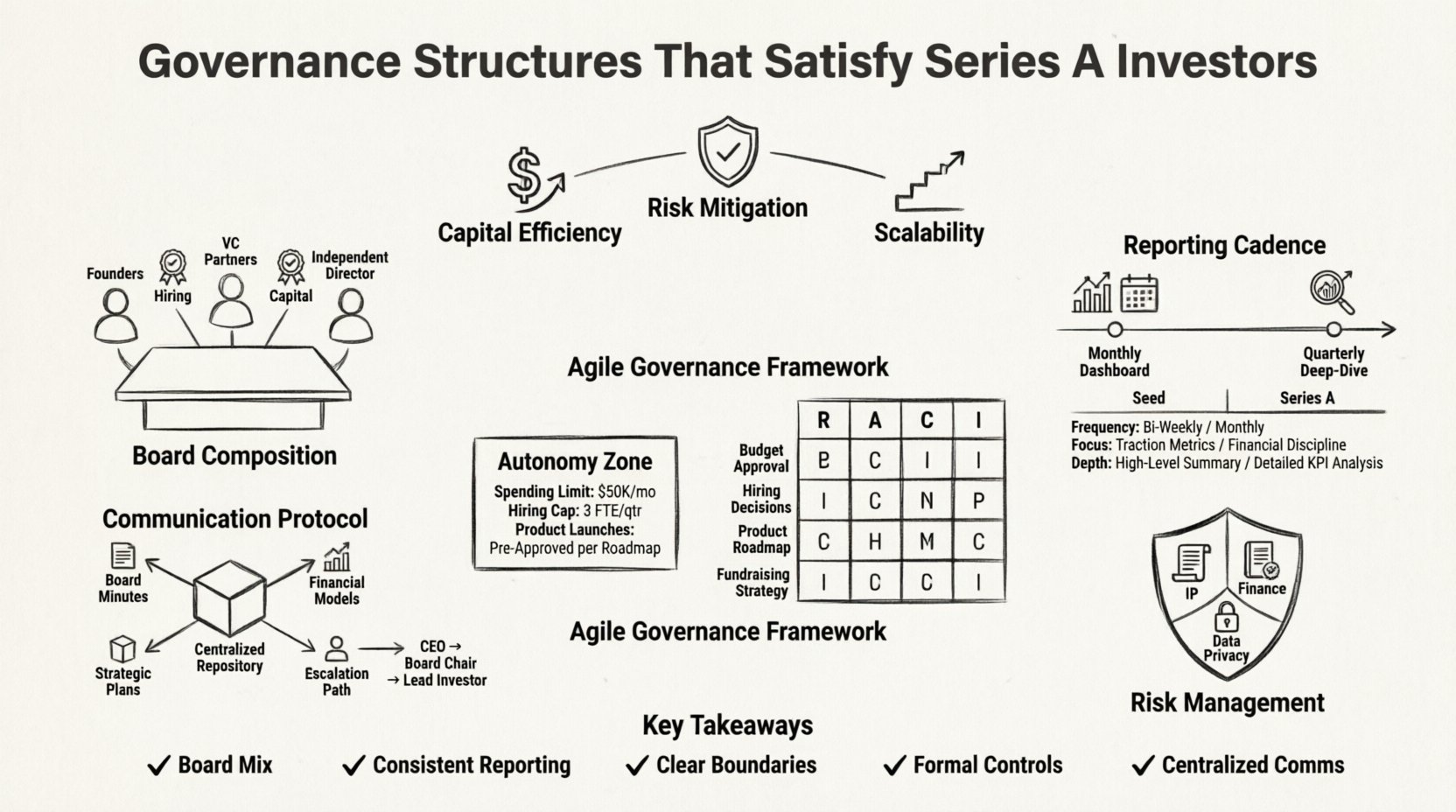
Before implementing any structure, you must understand what Series A investors are looking for. They are not trying to micromanage your daily operations. Instead, they seek three core assurances:
- Capital Efficiency: How effectively are you converting cash into growth?
- Risk Mitigation: What systems are in place to prevent catastrophic failure?
- Scalability: Can the current team and processes handle a 10x increase in revenue?
Investors operate on a timeline. They expect to see a path to an exit event, such as an IPO or acquisition. Governance structures are the evidence that you are building a vehicle capable of reaching that destination. Without them, the business appears fragile. With them, the business appears investable.
Board Composition and Roles 📋
The board of directors is the primary governance vehicle. At the Series A stage, the board typically expands beyond the founders. It often includes one or two venture capital partners and potentially an independent director.
Key Board Functions
- Strategic Oversight: The board reviews long-term strategy, not daily tactics.
- Hiring and Firing: Approval is often required for the hiring or termination of the CEO.
- Capital Allocation: Major expenditures, such as raising new debt or equity, usually require board consent.
- Milestone Tracking: Ensuring the company meets the KPIs agreed upon during the investment round.
Independent Directors
Adding an independent director is highly recommended. This person brings objectivity to the boardroom. They often have industry experience or operational expertise that complements the founders and investors. Their role is to:
- Provide unbiased advice during high-pressure decisions.
- Mediate conflicts between founders and investors.
- Offer a broader perspective on market trends.
When selecting an independent director, look for someone who understands the sector but does not have a conflicting relationship with other stakeholders. This ensures they can advocate for the company’s long-term health without being influenced by short-term investor pressures.
Reporting Cadences and Transparency 📊
Consistency in reporting builds trust. Investors need to know where the company stands without having to chase you for updates. A standardized reporting cadence removes ambiguity.
The Monthly Dashboard
A monthly report should be the heartbeat of your investor relations. It must be concise yet comprehensive. Key components include:
- Financials: Actuals versus budget, cash burn rate, and runway calculation.
- Key Metrics: Revenue, user growth, churn rate, and customer acquisition costs.
- Strategic Updates: Major wins, losses, or pivots made during the month.
- Hiring Updates: Key roles filled or open positions.
Quarterly Deep Dives
While monthly updates keep the pulse check, quarterly reviews allow for strategic analysis. This is when you discuss:
- Year-over-year growth comparisons.
- Changes in the competitive landscape.
- Long-term hiring plans.
- Product roadmap alignment with market needs.
Transparency is critical. If a metric misses its target, report it immediately. Investors appreciate honesty over optimism. Hiding bad news until it becomes a crisis destroys trust faster than any missed target.
Reporting Table: Series A Expectations
| Area | Seed Stage | Series A Stage |
|---|---|---|
| Frequency | Quarterly | Monthly |
| Focus | Vision and Product | Metrics and Unit Economics |
| Depth | High Level | Detailed Data |
| Board Access | Informal | Formal Meetings |
Agile Governance Framework ⚙️
One of the biggest concerns for agile teams is that governance will slow them down. This is a false dichotomy. Effective governance enables agility by removing uncertainty. You can structure governance to support rapid iteration rather than hinder it.
Defining Boundaries
Agile governance works by defining clear boundaries within which the team has full autonomy. Outside these boundaries, approval is required. This prevents bottlenecks for routine decisions while ensuring control over high-risk actions.
- Spending Limits: Allow the team to spend up to $10,000 without board approval. Anything above requires a review.
- Hiring Limits: The CEO can hire up to a certain salary grade without board consent.
- Product Changes: Minor feature tweaks are up to the product team. Major platform shifts require strategic review.
Decision Rights Matrix
Clarity on who decides what is essential. A RACI matrix (Responsible, Accountable, Consulted, Informed) can be adapted for governance.
- Responsible: The team executing the work.
- Accountable: The person with final authority (usually the CEO).
- Consulted: Stakeholders whose input is needed (e.g., Board Member).
- Informed: Stakeholders who need to know the outcome (e.g., Investors).
By clearly assigning these roles, you prevent decision paralysis. The team knows when they need to ask for permission and when they can move forward immediately.
Risk Management and Compliance 🛡️
Series A investors are increasingly focused on risk management. They need to know that the company is compliant with laws and that intellectual property is protected. Governance structures must address these areas formally.
Intellectual Property (IP)
Ensure that all IP belongs to the company, not the founders personally. This is a standard due diligence requirement. Governance should include:
- Regular audits of IP assignments.
- Contracts with contractors and employees that assign IP rights to the company.
- Documentation of code ownership and licensing.
Financial Controls
Internal controls protect the company from fraud and error. As you scale, manual processes become risky. Implementing structured financial governance includes:
- Segregation of duties (the person signing checks should not be the one reconciling accounts).
- Regular bank reconciliations.
- Approval workflows for vendor payments.
Data Privacy and Security
Handling user data requires strict governance. Investors will assess your adherence to regulations like GDPR or CCPA. Governance policies should cover:
- Data retention policies.
- Access controls for sensitive information.
- Breach response protocols.
Communication Protocols 🗣️
How you communicate is as important as what you communicate. Investors often have multiple portfolio companies. They expect a streamlined way to get information without constant ad-hoc meetings.
Single Source of Truth
Maintain a central repository for all governance documents. This includes:
- Board minutes.
- Financial models.
- Strategic plans.
- Meeting agendas.
Having a centralized location ensures that everyone is working from the same information. It reduces the risk of version control issues and miscommunication.
Escalation Paths
Define clear paths for escalation when issues arise. If a problem occurs that cannot be resolved at the operational level, it must be communicated up the chain quickly. The governance structure should specify:
- Who owns the escalation process.
- The timeline for reporting issues.
- The format for escalation reports.
Common Pitfalls to Avoid ⚠️
Even with the best intentions, companies often stumble in their governance approach. Awareness of common mistakes helps you navigate the Series A transition smoothly.
Over-Governance
Creating too many rules stifles innovation. If every small decision requires a board meeting, the company loses its speed. Keep the governance framework lean. Focus on high-impact areas only.
Under-Governance
Conversely, failing to document decisions creates liability. If a strategic pivot is made verbally without record, it can lead to disputes later. Always document major decisions, even if they are made quickly.
Ignoring the Team
Governance is not just for investors. It must be understood by the entire leadership team. If the CTO or CMO does not understand the reporting requirements, the data will be inconsistent. Train your leadership team on governance expectations early.
Focusing Only on Finance
While financial reporting is vital, non-financial metrics matter too. Investors need to see product development progress, customer satisfaction scores, and engineering velocity. A balanced scorecard approach provides a more complete picture of company health.
Building the Roadmap to Series B 🚀
Governance is not a one-time setup. It evolves as you grow. The structures you put in place for Series A should serve as a foundation for Series B. This means designing systems that can scale without requiring a complete overhaul.
- Automate Reporting: Use tools to pull data automatically where possible to reduce manual effort.
- Standardize Processes: Document procedures so that new hires can follow them.
- Review Annually: Conduct an annual review of your governance structure to ensure it still fits the company’s stage.
By planning for the future, you ensure that your governance remains relevant. This forward-thinking approach signals to investors that you are building a mature organization.
Summary of Key Takeaways ✅
Establishing governance structures that satisfy Series A investors requires a balance between control and flexibility. It is about building trust through transparency and consistency.
- Board Composition: Ensure a mix of founders, investors, and independent directors.
- Reporting: Maintain a consistent cadence with clear, accurate data.
- Agility: Define clear boundaries to allow teams to move fast within safe limits.
- Risk: Formalize controls around IP, finance, and data security.
- Communication: Centralize information and define clear escalation paths.
When these elements are in place, the company is positioned for sustainable growth. Investors see a partner who respects their capital and values their oversight. This partnership creates the stability needed to execute on the vision. Governance is not a constraint on creativity; it is the structure that allows creativity to flourish at scale.