
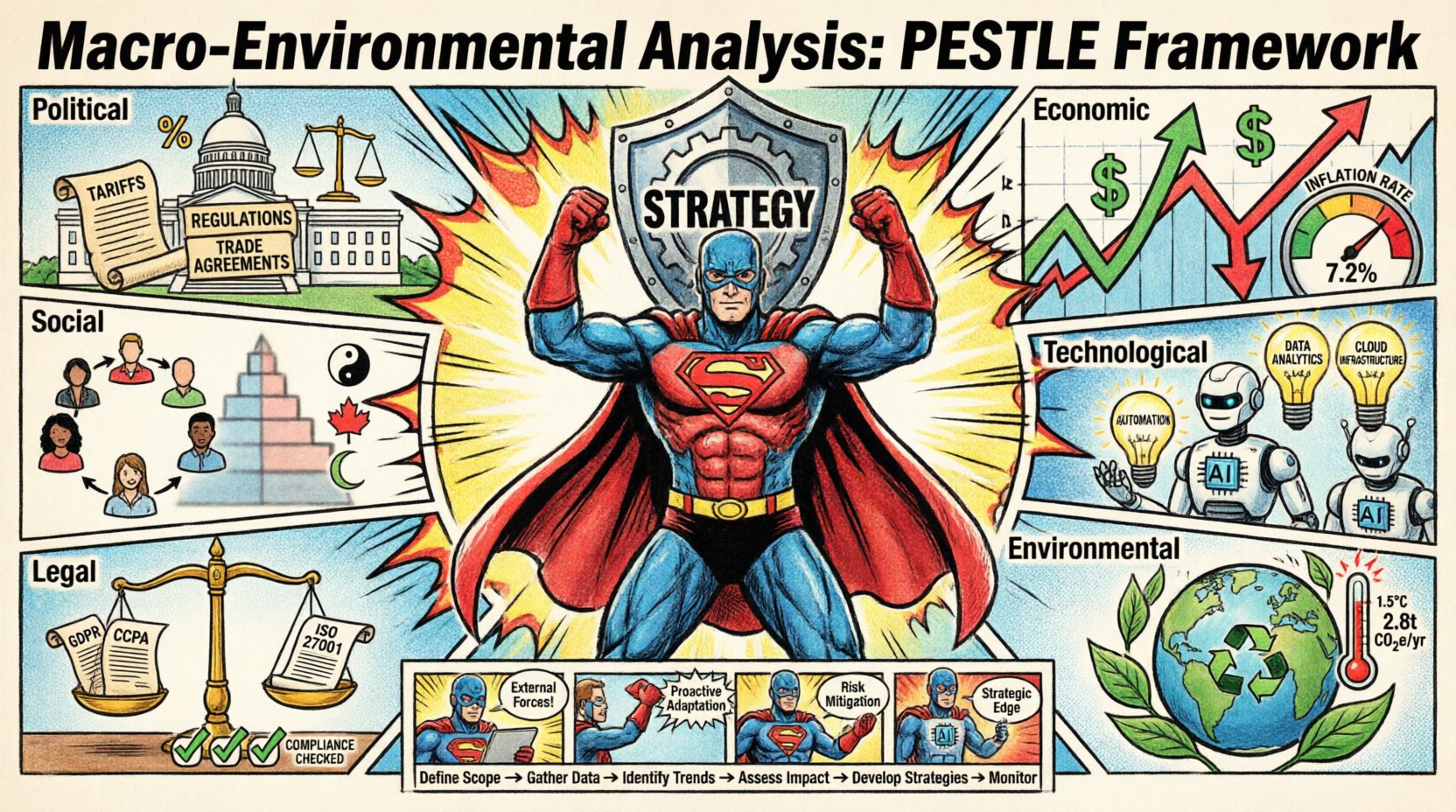
Businesses operate within a dynamic ecosystem where internal capabilities intersect with external forces. Understanding these external forces is critical for sustainable growth and risk mitigation. Macro-environmental analysis provides the framework for examining broad factors that influence an organization. This process involves evaluating Political, Economic, Social, and Technological factors. Often referred to as the PEST or PESTLE analysis, this tool offers a structured approach to strategic planning.
This guide explores the foundational principles of macro-environmental scanning. We will dissect each component of the framework, discuss practical applications, and outline the steps required for effective implementation. The goal is to equip decision-makers with the clarity needed to navigate complex market conditions without relying on guesswork.
🔍 Understanding the Macro-Environment
The macro-environment consists of external factors that affect an industry or business but are beyond its direct control. Unlike the micro-environment, which includes customers, competitors, and suppliers, the macro-environment encompasses societal forces that shape the landscape. These forces are generally uncontrollable by a single organization.
Organizations that ignore these factors risk strategic misalignment. For instance, a company focusing solely on product innovation might miss a regulatory shift that renders its technology obsolete. Conversely, understanding these drivers allows for proactive adaptation rather than reactive scrambling.
Key characteristics of macro-environmental factors include:
- External Origin: They originate outside the organization.
- Uncontrollable: Individual firms cannot dictate these conditions.
- Long-term Impact: Changes often evolve slowly but have lasting effects.
- Interconnectedness: A shift in one area often triggers changes in others.
🏛️ The Core Components of PESTLE
The most common framework for this analysis is PESTLE. It expands upon the original PEST model by adding Legal and Environmental dimensions. Each letter represents a category of external influence. Below is a breakdown of each component with specific considerations for strategic application.
1. 🏛️ Political Factors
Political factors refer to government intervention in the economy. These include tax policy, labor law, environmental law, trade restrictions, tariffs, and political stability. The actions of the government can create new opportunities or impose significant constraints.
- Trade Regulations: Tariffs and import/export quotas directly impact supply chain costs.
- Tax Policy: Corporate tax rates affect net profit margins and reinvestment capacity.
- Political Stability: Regions with high instability present higher risks for long-term investment.
- Government Spending: Public sector investment can stimulate demand in specific industries.
2. 💰 Economic Factors
Economic factors influence consumer purchasing power and the cost of capital. These include inflation rates, interest rates, economic growth, exchange rates, and unemployment levels. Economic conditions determine the viability of demand for products and services.
- Inflation: High inflation erodes purchasing power and increases input costs.
- Interest Rates: High rates increase borrowing costs, potentially slowing expansion.
- GDP Growth: Strong economic growth usually correlates with higher consumer spending.
- Exchange Rates: Fluctuations affect the cost of imported materials and the competitiveness of exports.
3. 🌍 Social Factors
Social factors involve the demographic and cultural aspects of the external environment. These include population growth, age distribution, career attitudes, health consciousness, and cultural barriers. Understanding the society in which you operate is essential for product-market fit.
- Demographics: Ageing populations create different needs compared to youthful demographics.
- Cultural Norms: Values and beliefs dictate consumer behavior and acceptance of new ideas.
- Health Trends: Increasing awareness of health impacts demand for wellness-oriented products.
- Lifestyle Changes: Shifts in work-life balance affect demand for convenience and remote solutions.
4. ⚙️ Technological Factors
Technological factors include innovation, automation, research and development (R&D) activity, and technological incentives. This category is often the fastest changing. It determines how products are manufactured, delivered, and consumed.
- Innovation: New technologies can disrupt existing business models.
- Automation: Efficiency gains through automation reduce labor costs but require capital investment.
- Internet Infrastructure: Connectivity levels dictate the reach of digital services.
- Patents: Intellectual property laws protect innovation and define competitive advantages.
5. ⚖️ Legal Factors
Legal factors are distinct from political factors as they focus on the laws that govern business operations. This includes employment law, consumer protection, health and safety, and antitrust legislation. Compliance is not optional; it is a baseline requirement.
- Employment Law: Regulations regarding hiring, firing, and working hours.
- Consumer Protection: Laws ensuring product safety and accurate advertising.
- Data Privacy: Regulations governing the collection and use of customer information.
- Health and Safety: Standards required to protect employees and the public.
6. 🌱 Environmental Factors
Environmental factors encompass ecological and environmental aspects. These include weather, climate change, carbon footprint targets, and waste management. Sustainability is no longer a niche concern but a core strategic imperative.
- Climate Change: Physical risks to operations and supply chains.
- Resource Scarcity: Availability of raw materials impacts production costs.
- Regulatory Compliance: Emissions standards and waste disposal laws.
- Consumer Sentiment: Growing preference for eco-friendly brands.
📋 Comparative Overview of Factors
To visualize the distinct nature of these categories, consider the following comparison. This table highlights the primary focus and typical data sources for each element.
| Factor | Primary Focus | Typical Data Sources |
|---|---|---|
| Political | Government policy and stability | Legislative records, election results, policy papers |
| Economic | Financial performance and growth | Central bank reports, GDP statistics, inflation data |
| Social | Cultural and demographic trends | Census data, market research, sociological studies |
| Technological | Innovation and technical capability | R&D journals, patent filings, tech news |
| Legal | Compliance and regulation | Legal statutes, court rulings, compliance guides |
| Environmental | Ecological and sustainability issues | Environmental agencies, NGO reports, climate data |
🚀 Strategic Applications
Conducting an analysis is not an academic exercise; it serves a practical purpose. Organizations utilize this information to inform strategic decisions across various departments. Below are key areas where macro-environmental insights drive value.
1. Market Entry and Expansion
Before entering a new geographic market, companies must assess the macro-environment. A favorable PESTLE profile suggests a lower barrier to entry and higher potential for success. For example, a company considering expansion into a region with strict environmental laws must evaluate if their product aligns with those regulations.
2. Risk Management
Identifying potential threats early allows for contingency planning. If economic indicators suggest a recession, a business might tighten credit terms or reduce inventory levels. Proactive risk management minimizes the impact of external shocks.
3. Product Development
Technological and social trends often signal where the market is heading. If data shows a shift toward remote work, software companies can pivot to develop collaboration tools. Aligning product roadmaps with environmental trends ensures relevance.
4. Investment Decisions
Capital allocation requires a clear view of the external landscape. Political instability might deter investment in a specific sector. Conversely, government subsidies for green energy might attract capital. Analysis guides where to deploy resources for maximum return.
🛠️ Conducting the Analysis: A Step-by-Step Process
Executing a macro-environmental analysis requires a systematic approach. Adherence to a structured process ensures that no critical factors are overlooked. The following steps outline the standard workflow.
- Define the Scope: Determine the specific industry, geography, and time horizon for the analysis. A global scope requires different data than a local one.
- Gather Data: Collect information from reliable sources. This includes government publications, industry reports, news outlets, and academic journals. Ensure data is current and credible.
- Identify Trends: Analyze the raw data to identify significant trends. Look for patterns that indicate direction and magnitude. Distinguish between noise and signal.
- Assess Impact: Evaluate how each factor impacts the organization. Consider both positive opportunities and negative threats. Quantify the impact where possible.
- Develop Strategies: Translate insights into actionable strategies. Adjust business plans to leverage opportunities and mitigate threats.
- Monitor Continuously: The environment is dynamic. Establish a system for ongoing monitoring to update the analysis as conditions change.
⚠️ Common Challenges and Limitations
While valuable, this framework is not without limitations. Understanding these constraints helps in applying the tool more effectively.
- Static Snapshot: A traditional analysis often represents a point in time. The environment changes rapidly, requiring frequent updates.
- Subjectivity: Interpretation of data can vary between stakeholders. Bias can influence which factors are deemed significant.
- Information Overload: There is vast amounts of data available. Filtering for relevant information requires discipline and clear criteria.
- Interdependency: Factors rarely exist in isolation. A political decision might drive an economic shift. Simple categorization can sometimes oversimplify complex causality.
🔄 Integration with Other Frameworks
Macro-environmental analysis works best when integrated with other strategic tools. It sets the stage for deeper internal analysis.
SWOT Analysis
SWOT (Strengths, Weaknesses, Opportunities, Threats) is a natural companion. PESTLE factors typically feed into the Opportunities and Threats sections of a SWOT analysis. This linkage connects external reality with internal capability.
Porter’s Five Forces
While PESTLE looks at the broad environment, Porter’s Five Forces focuses on industry competition. Economic and regulatory factors from PESTLE often influence the bargaining power of suppliers and buyers in Porter’s model.
Scenario Planning
Scenario planning uses PESTLE data to construct multiple future narratives. By exploring different combinations of political, economic, and social outcomes, organizations prepare for various futures rather than betting on a single prediction.
📈 Future Trends in Environmental Scanning
The practice of scanning the macro-environment is evolving. Modern challenges demand new approaches to data collection and interpretation.
- Data Analytics: Advanced analytics allow for the processing of vast datasets to identify subtle trends faster than manual review.
- Real-Time Monitoring: Digital tools enable continuous monitoring of social sentiment and market shifts, moving away from annual reviews.
- Governance, Social, and Environmental (GSE): There is a growing emphasis on ESG metrics as a core component of the analysis, reflecting investor and consumer priorities.
- Global Interconnectivity: Events in one region now ripple globally instantly. Analysis must account for cross-border dependencies.
💡 Practical Considerations for Implementation
Successful implementation relies on organizational culture as much as the framework itself. Leadership commitment is essential. If senior management does not value external scanning, the analysis will not influence strategy.
Collaboration is another key factor. Marketing, finance, operations, and legal teams should all contribute insights. Each department sees different signals in the macro-environment. Synthesizing these views creates a comprehensive picture.
Documentation is also vital. Decisions based on the analysis must be recorded. This creates an audit trail that justifies strategic shifts. It also allows for retrospective analysis to improve future accuracy.
🌐 Global Perspectives
Different regions present unique macro-environmental profiles. A strategy that works in one country may fail in another due to divergent factors.
- Emerging Markets: Often characterized by rapid economic growth but higher political risk. Social factors may shift quickly as populations urbanize.
- Developed Markets: Typically stable but saturated. Technological and social innovation drives growth rather than basic economic expansion.
- Regulated Markets: Industries like healthcare and energy face strict legal and political scrutiny. Compliance costs are a major economic factor.
📝 Summary of Key Takeaways
Macro-environmental analysis is a fundamental tool for strategic management. It provides a structured method to understand the external forces shaping business performance. By systematically evaluating Political, Economic, Social, Technological, Legal, and Environmental factors, organizations can anticipate change and adapt accordingly.
The process requires diligence, accurate data, and honest interpretation. It is not a one-time task but a continuous cycle of monitoring and adjustment. When integrated with internal analysis, it forms the bedrock of resilient business strategy.
Businesses that master the art of environmental scanning gain a competitive edge. They navigate uncertainty with clarity and position themselves to capitalize on emerging opportunities while avoiding potential pitfalls. The landscape will continue to shift, but the framework remains a reliable guide.