
In the high-velocity environment of early-stage ventures, the margin for error is thin. Every hour billed, every dollar spent, and every shift in team focus carries significant weight. For lean startup teams operating under the principles of Agile methodology, resource allocation is not merely an administrative task; it is a strategic imperative that dictates survival and growth. The challenge lies in distributing limited assets—time, capital, and talent—toward initiatives that validate hypotheses and drive product-market fit without exhausting the runway.
This guide explores the mechanics of effective resource distribution within a constrained environment. We will examine how to balance immediate delivery with long-term viability, ensuring that the team remains agile without becoming fragmented. The focus remains on structural efficiency and decision-making frameworks rather than external tools or hype.
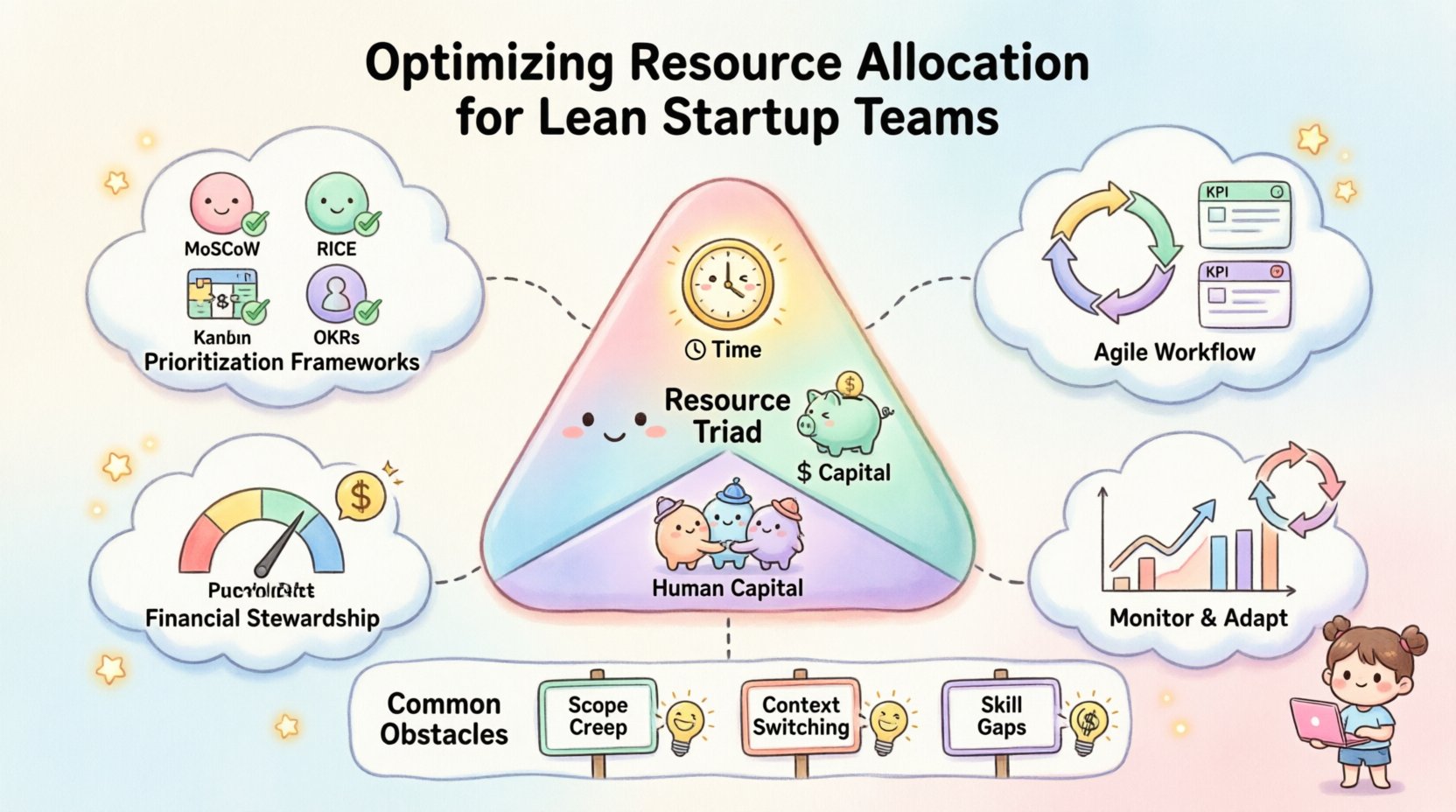
📊 Understanding the Resource Triad
Resource allocation in a lean context requires a clear understanding of the three primary constraints that define the project’s reality. Unlike established enterprises with abundant budgets and dedicated departments, startups often face a simultaneous shortage across all three areas. Recognizing this triad allows leadership to make informed trade-offs.
⏱️ Time as a Finite Asset
Time is the only non-renewable resource in development. In an Agile sprint cycle, time is fixed, making scope the variable. However, the broader timeline to market is also critical. Allocating time effectively means protecting the team from context switching and meeting bloat.
- Focus Blocks: Designate periods where deep work is prioritized over communication.
- Sprint Cadence: Maintain consistent lengths (e.g., two weeks) to create a predictable rhythm.
- Lead Time: Monitor how long a feature takes to move from idea to production to identify bottlenecks.
💰 Capital Efficiency
Financial resources in a startup are typically measured in runway. Allocating capital is about maximizing the return on investment for every dollar spent. This does not mean cutting costs indiscriminately, but rather directing funds toward activities that generate data or revenue.
- MVP Validation: Direct funds toward building the minimum viable product necessary to test assumptions.
- Operational Burn: Keep fixed costs low to extend the timeline for achieving milestones.
- Variable Costs: Align spending with activity levels to avoid over-provisioning infrastructure.
👥 Human Capital Distribution
People are the engine of execution. Misaligning skills with tasks leads to burnout, technical debt, and slower velocity. In a lean team, every member often wears multiple hats, requiring careful management of capacity and mental load.
- Skill Mapping: Identify core competencies and ensure they are applied to high-leverage tasks.
- Cognitive Load: Avoid overloading individuals with too many concurrent responsibilities.
- Cross-Training: Develop shared knowledge to prevent single points of failure.
🎯 Strategic Prioritization Frameworks
When resources are scarce, the ability to say no is as important as the ability to say yes. Prioritization frameworks provide a structured way to evaluate initiatives based on value, risk, and effort. This prevents the team from chasing shiny objects or reacting to every stakeholder request.
Evaluating Feature Value
Not all features are created equal. Some are required for the product to function, while others are enhancements. A rigorous evaluation process helps distinguish between the two.
- Must-Have vs. Nice-to-Have: Determine which capabilities are essential for the next release cycle.
- Customer Impact: Prioritize work that solves the most pressing pain points for the target user.
- Strategic Alignment: Ensure tasks contribute directly to the current North Star metric.
Comparison of Allocation Models
Different frameworks suit different stages of development. The table below outlines common approaches and their suitability for lean teams.
| Framework | Primary Focus | Best Use Case |
|---|---|---|
| MoSCoW Method | Priority Ranking | Fixed scope projects with clear deadlines |
| RICE Scoring | Quantitative Impact | When multiple stakeholders compete for resources |
| Kanban | Flow Efficiency | Continuous delivery environments with high variability |
| OKRs | Goal Alignment | Ensuring team output matches organizational strategy |
🔄 Integrating with Agile Workflows
Agile methodology offers a natural structure for resource allocation through its iterative cycles. The flexibility of sprints allows teams to adjust resource distribution based on new information without derailing the entire project.
Sprint Planning and Capacity
The sprint planning session is the primary event for resource commitment. Capacity planning involves calculating the total available hours of the team and subtracting known non-project time.
- Velocity Tracking: Use historical data to estimate how much work the team can realistically complete.
- Burnout Prevention: Do not plan for 100% utilization. Leave buffer space for unplanned work and maintenance.
- Task Granularity: Break large initiatives into small, estimable units to improve accuracy.
Backlog Grooming
A well-maintained backlog acts as a reservoir of potential work. Regular grooming sessions ensure that the team always has a pipeline of vetted tasks ready for allocation.
- Refinement: Clarify requirements before work begins to reduce rework.
- Sequencing: Order items by value and dependency to ensure logical flow.
- De-scoping: Remove items that no longer align with current goals to free up mental energy.
💸 Financial Stewardship in Early Stages
Financial resources are often the most rigid constraint. Unlike time, which can sometimes be extended, cash flow is binary. Effective allocation requires a rigorous approach to budgeting and forecasting.
Burn Rate Management
Monitoring the burn rate ensures the team understands how long the current resources will last. This metric should be reviewed monthly to anticipate cash flow issues before they become critical.
- Fixed vs. Variable: Identify which costs remain constant and which fluctuate with activity.
- Runway Calculation: Regularly calculate remaining cash divided by monthly burn.
- Contingency Planning: Maintain a reserve for unexpected expenses or delays.
Cost-Benefit Analysis
Before committing financial resources to a new initiative, a simple analysis can prevent waste. This involves estimating the cost of the work against the potential value it generates.
- Development Costs: Estimate the hours required multiplied by the fully loaded cost of labor.
- Infrastructure Costs: Account for hosting, storage, and third-party service fees.
- Opportunity Cost: Consider what else could be built if the resources were spent elsewhere.
📈 Monitoring and Adaptation
Resource allocation is not a one-time event. It requires continuous monitoring and adjustment. As the market changes and the product evolves, the allocation of resources must shift accordingly.
Key Performance Indicators
To measure the effectiveness of resource usage, specific metrics must be tracked. These indicators provide feedback on whether the current strategy is working.
- Velocity: Tracks the amount of work completed per cycle to gauge capacity.
- Cycle Time: Measures the time from start to finish for a task to identify delays.
- Lead Time: Measures the time from request to delivery to assess responsiveness.
- Budget Variance: Compares planned spending against actual spending.
Feedback Loops
Agile relies on short feedback loops to validate decisions. If a resource allocation decision is not yielding the expected results, it should be corrected quickly.
- Retrospectives: Regularly review what went well and what did not regarding resource usage.
- Stakeholder Reviews: Ensure external expectations are aligned with internal capacity.
- User Feedback: Validate that the time spent building matches user needs.
⚠️ Common Obstacles and Solutions
Even with the best planning, resource allocation faces challenges. Recognizing these obstacles early allows teams to implement solutions before they impact delivery.
Scope Creep
Scope creep occurs when requirements expand beyond the original agreement without additional resources. This is a common issue in startups where the vision evolves rapidly.
- Solution: Implement a formal change request process that requires approval for any addition to the scope.
- Solution: Reinforce the boundary between the current sprint and future iterations.
- Solution: Communicate clearly that adding features often means removing others to maintain balance.
Context Switching
When team members are pulled in multiple directions, productivity drops significantly. This is often caused by ad-hoc requests or emergency tasks.
- Solution: Establish “no-meeting” days to allow for focused work.
- Solution: Assign a specific point of contact for urgent requests to filter interruptions.
- Solution: Batch communication channels to reduce notification fatigue.
Skill Gaps
As the product grows, the team may encounter tasks that exceed their current skill set. This can lead to delays and lower quality output.
- Solution: Invest in training for critical skills before the gap becomes a bottleneck.
- Solution: Pair junior members with senior mentors to accelerate learning.
- Solution: Consider outsourcing specialized tasks if internal hiring is not feasible.
🏗️ Building a Sustainable Culture
Ultimately, resource allocation is a cultural issue. It requires a shared understanding of value and a collective commitment to efficiency. A sustainable culture prioritizes long-term health over short-term wins.
Transparency
Everyone on the team should understand the constraints they are working within. Transparency regarding budget, time, and capacity builds trust and allows for better decision-making.
- Open Budgets: Share financial constraints with the technical team.
- Visible Roadmaps: Ensure the team knows the direction and priority of work.
- Honest Estimates: Encourage realistic forecasting rather than optimistic promises.
Respect for Capacity
Respecting the team’s capacity means acknowledging that rest and recovery are necessary for sustained performance. Overworking leads to errors and turnover.
- Work-Life Balance: Encourage time off to recharge.
- Realistic Deadlines: Set dates that allow for quality work.
- Prioritization of Health: Make well-being a priority in performance reviews.
Continuous Improvement
The process of allocation should never be static. Teams should constantly look for ways to optimize their workflow and reduce waste.
- Process Audits: Regularly review workflows to identify inefficiencies.
- Tool Evaluation: Assess whether current methods are supporting or hindering progress.
- Knowledge Sharing: Document lessons learned to prevent repeating mistakes.
Optimizing resource allocation is an ongoing discipline. It requires vigilance, data-driven decision-making, and a deep respect for the constraints of the business. By focusing on the core triad of time, capital, and people, and integrating these principles into Agile workflows, lean startup teams can navigate uncertainty with confidence. The goal is not just to ship code, but to build a viable, scalable organization that can withstand market pressures. Success comes from the steady application of these practices, ensuring that every resource contributes meaningfully to the mission.