
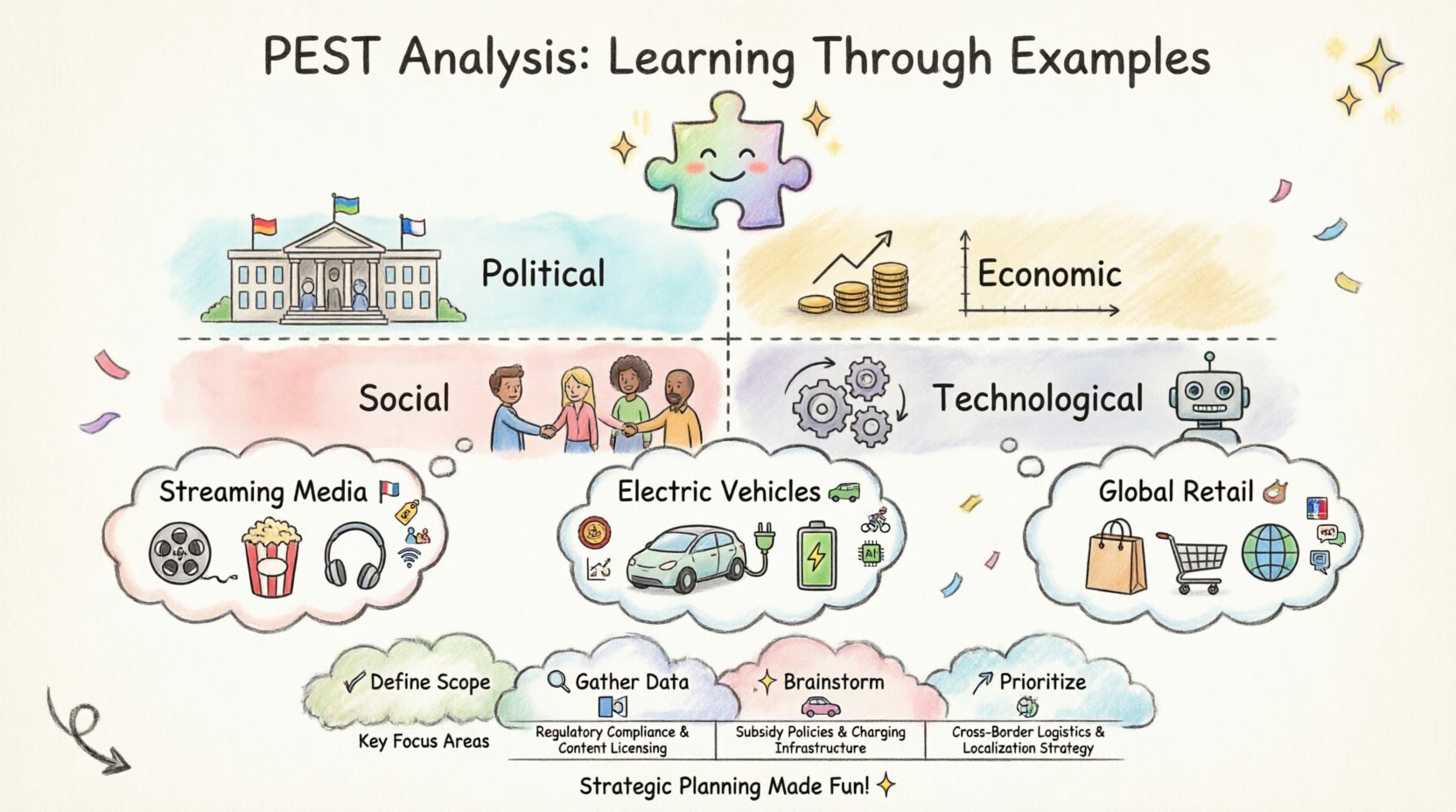
Strategic planning requires a clear view of the environment surrounding an organization. The PEST Analysis framework offers a structured method to examine external factors influencing a business. By analyzing Political, Economic, Social, and Technological elements, leaders can anticipate shifts and adapt accordingly. This article explores practical applications through real-world scenarios. We will look at how different industries navigate these external forces without relying on specific software tools.
Understanding the Framework 🧩
Before diving into specific examples, it is essential to understand the core components. PEST stands for Political, Economic, Social, and Technological. Each category represents a distinct set of variables that can impact operations, profitability, and long-term viability.
- Political: Government policies, tax laws, trade restrictions, and labor regulations.
- Economic: Interest rates, inflation, exchange rates, and economic growth cycles.
- Social: Demographics, cultural trends, health consciousness, and lifestyle changes.
- Technological: Innovation rates, automation, R&D activity, and technology incentives.
Using these categories helps organizations move beyond internal metrics. It forces a look at the horizon. The following case studies demonstrate how this framework functions in practice across varied sectors.
Case Study 1: The Streaming Media Industry 🎬
The entertainment sector has undergone massive transformation due to digital disruption. A major streaming service faces a complex external landscape. Below is a breakdown of how PEST factors apply to this specific context.
Political Factors 🏛️
Government intervention plays a significant role in media distribution. Content licensing agreements often depend on international treaties. Trade tariffs can affect the cost of hardware used for consumption.
- Regulation: Data privacy laws vary by country, requiring different compliance strategies for user data.
- Content Quotas: Some nations mandate a percentage of local content be produced or purchased.
- Intellectual Property: Strengthening copyright laws protects original content but can increase licensing costs.
Economic Factors 💰
Disposable income levels directly influence subscription rates. Economic downturns can lead to “subscription fatigue,” where consumers cut back on non-essential services.
- Inflation: Rising production costs for original content squeeze margins.
- Exchange Rates: Fluctuations impact revenue when converting earnings from different currencies.
- Advertising Models: Economic shifts drive the move toward ad-supported tiers to capture price-sensitive users.
Social Factors 👥
Changing viewing habits define the success of this sector. The shift from traditional broadcast to on-demand consumption is a primary driver.
- Binge-Watching: Audiences prefer consuming multiple episodes at once, influencing release schedules.
- Diversity: There is increasing demand for representation in content, affecting casting and storytelling choices.
- Family Dynamics: Shared devices within households require multi-user profile features.
Technological Factors ⚙️
Infrastructure and innovation dictate the user experience. Bandwidth availability and compression algorithms are critical.
- Streaming Quality: The push for 4K and HDR requires more robust data transmission capabilities.
- AI Recommendations: Algorithms suggest content based on viewing history, increasing retention.
- Device Compatibility: Support for smart TVs, gaming consoles, and mobile devices is mandatory.
Case Study 2: Automotive Transition to Electric Vehicles 🚗
The automotive industry faces one of the most significant shifts in its history. Moving from internal combustion engines to battery-electric vehicles requires navigating a new set of external pressures.
Political Factors 🏛️
Government mandates are the primary catalyst for this transition. Policies regarding emissions standards drive manufacturers toward electrification.
- Subsidies: Tax credits for buyers and manufacturers reduce the cost barrier for adoption.
- Fuel Taxes: Higher taxes on gasoline incentivize the switch to electric powertrains.
- Trade Barriers: Tariffs on batteries or critical minerals impact supply chain costs.
Economic Factors 💰
Cost structures are fundamentally changing. The price of raw materials, such as lithium and cobalt, fluctuates wildly.
- Oil Prices: Volatility in fossil fuel prices makes electric vehicles more attractive financially.
- Interest Rates: High financing costs can deter consumers from purchasing expensive new vehicles.
- Infrastructure Investment: Public funding for charging stations is crucial for widespread adoption.
Social Factors 👥
Consumer perception and lifestyle needs influence adoption rates. Environmental awareness is a key social driver.
- Environmental Concerns: Growing awareness of climate change pushes buyers toward greener options.
- Range Anxiety: Concerns about battery life and charging availability remain a barrier.
- Status Symbol: Electric vehicles are increasingly viewed as innovative and high-status.
Technological Factors ⚙️
Battery technology and charging speed are the main battlegrounds.
- Battery Density: Improvements allow for longer range without increasing vehicle weight.
- Charging Speed: Fast-charging networks reduce downtime for long-distance travel.
- Autonomous Driving: Integration of self-driving features adds value and complexity to the vehicle.
Case Study 3: Global Retail and Consumer Goods 🛍️
Retailers must constantly adapt to how people shop. The shift to omnichannel experiences combines physical and digital interactions.
Political Factors 🏛️
Trade agreements and local labor laws affect supply chains and operations.
- Minimum Wage: Changes in labor costs impact pricing strategies and profitability.
- Import Duties: Tariffs on goods from specific regions increase the cost of inventory.
- Consumer Protection: Laws regarding returns and warranties vary by jurisdiction.
Economic Factors 💰
Consumer spending power is the lifeblood of retail. Inflation and recession risks must be managed.
- Disposable Income: Economic health dictates how much customers spend on non-essentials.
- Supply Chain Costs: Shipping and logistics costs fluctuate with fuel prices and demand.
- Currency Exchange: Importing goods exposes retailers to exchange rate risks.
Social Factors 👥
Trends in health, sustainability, and convenience shape product offerings.
- Health Consciousness: Demand for organic and natural products has grown significantly.
- Convenience: Same-day delivery and click-and-collect options are now expected standards.
- Ethical Sourcing: Consumers increasingly demand transparency regarding labor practices.
Technological Factors ⚙️
Digital transformation is no longer optional. Data analytics and e-commerce platforms are central.
- E-commerce Platforms: Robust online stores are required to capture digital traffic.
- Inventory Management: Real-time tracking prevents stockouts and overstocking.
- Mobile Payments: Integration of digital wallets streamlines the checkout process.
Comparative Overview of Factors 📋
To visualize the differences across industries, the table below summarizes the primary focus areas.
| Industry | Primary Political Focus | Primary Economic Focus | Primary Social Focus | Primary Technological Focus |
|---|---|---|---|---|
| Streaming Media | Data Privacy & Licensing | Inflation & Subscription Models | Binge-Watching Trends | Compression & 4K Quality |
| Automotive (EV) | Emission Standards & Subsidies | Raw Material Costs | Environmental Awareness | Battery Density |
| Global Retail | Labor Laws & Tariffs | Consumer Spending Power | Health & Convenience | E-commerce Integration |
How to Conduct Your Own Analysis 📝
Implementing a PEST Analysis requires a disciplined approach. It is not a one-time task but a recurring exercise to keep strategy aligned with reality.
Step 1: Define the Scope 🎯
Identify the specific market or product line you are analyzing. A global company may have different political factors in different regions. Narrowing the scope ensures relevance.
- Is this for a new market entry?
- Is this for a product launch?
- Is this for a strategic review?
Step 2: Gather Data 🔍
Collect information from reliable sources. Government reports, industry publications, and economic forecasts provide the raw material.
- Review annual reports from competitors.
- Analyze government white papers.
- Monitor social media trends and news cycles.
Step 3: Brainstorm Implications 💡
List the factors and discuss their potential impact. Ask how each factor could create a threat or an opportunity.
- Political: Could new regulations increase costs?
- Economic: Will inflation reduce demand?
- Social: Are consumer values shifting?
- Technological: Could a new invention disrupt the market?
Step 4: Prioritize and Act 🚀
Not all factors are equal. Rank them by likelihood and impact. Focus resources on the areas that matter most to your strategic goals.
Common Pitfalls to Avoid ⚠️
Even with a solid framework, mistakes happen. Being aware of common errors helps maintain the integrity of the analysis.
- Static Analysis: Treating the environment as unchanging. Markets evolve rapidly.
- Internal Bias: Focusing too much on internal capabilities rather than external reality.
- Overwhelm: Listing too many factors without prioritizing. Focus on the top drivers.
- Ignoring Interconnections: Factors often overlap. Technology can drive social change.
- Lack of Action: Completing the analysis but failing to adjust strategy based on findings.
Integration with Other Tools 🔗
PEST Analysis is rarely used in isolation. It pairs well with other strategic frameworks to provide a complete picture.
SWOT Analysis
PEST provides the external data needed for the “Opportunities” and “Threats” sections of a SWOT analysis. Strengths and Weaknesses come from internal auditing.
- External factors from PEST feed into SWOT Opportunities.
- External risks from PEST feed into SWOT Threats.
Porter’s Five Forces
While PEST looks at the macro environment, Porter’s Five Forces examines industry competition. Together, they offer a view from both the macro and micro levels.
Final Considerations 🌟
Strategic planning is an ongoing process. The external environment is dynamic. Regularly updating your PEST Analysis ensures your organization remains agile. By studying examples and understanding the mechanics of each factor, leaders can make informed decisions.
Focus on accuracy and relevance. Avoid generic lists. Tailor the analysis to your specific context. This approach builds resilience and positions the organization to navigate uncertainty with confidence.
Remember that data is only useful if it drives action. Use these insights to shape product roadmaps, marketing strategies, and operational plans. The goal is sustainable growth in a complex world.