
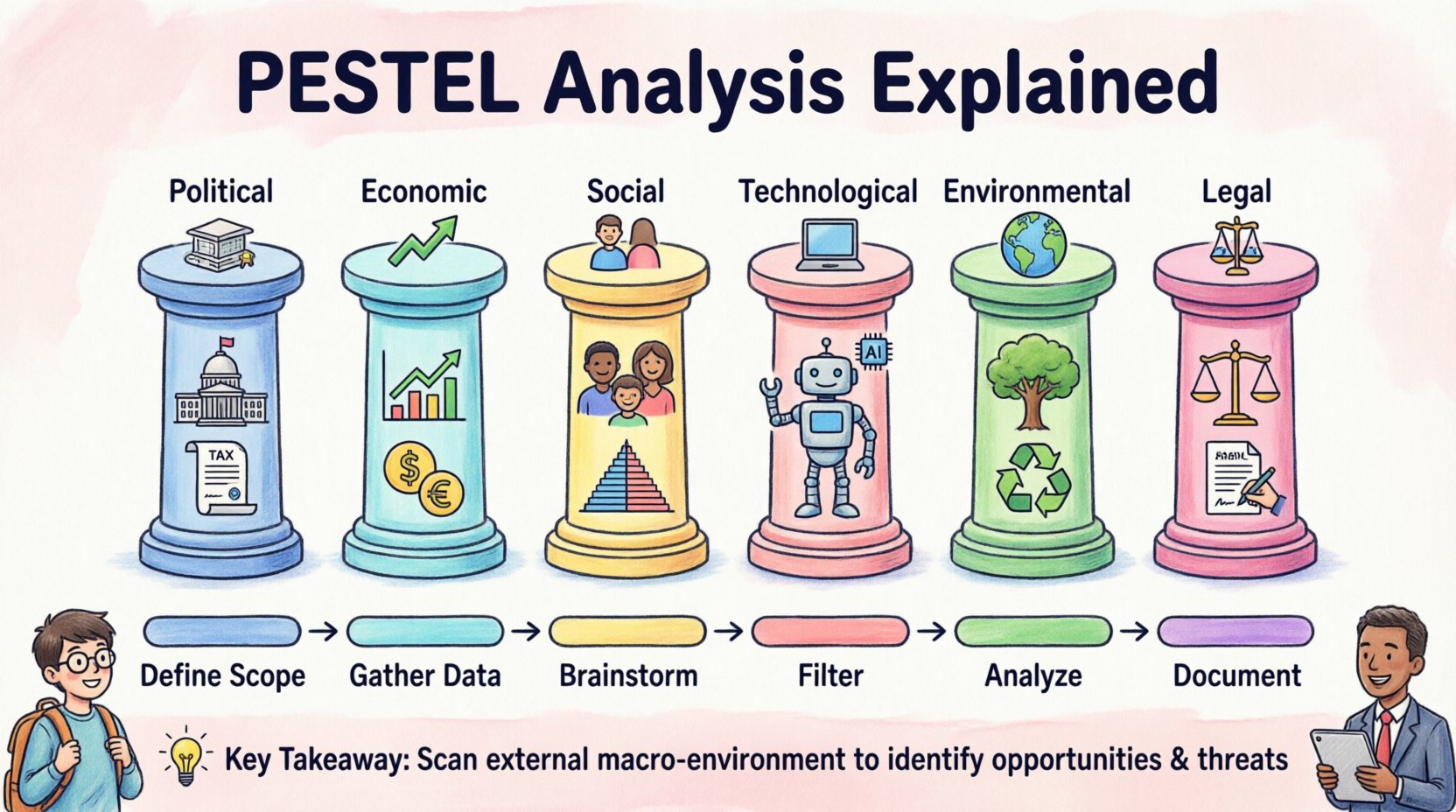
Strategic planning forms the backbone of successful business operations and academic case studies. Among the various frameworks available, the PESTEL analysis stands out as a critical tool for examining external factors. This method allows researchers and students to evaluate the macro-environmental influences affecting an organization. By understanding these forces, learners can make informed decisions and develop robust strategies.
This guide provides a comprehensive overview of the PESTEL framework. It details each component, explains the methodology, and offers practical examples. Whether you are writing a thesis or preparing for a business strategy module, this resource serves as a foundational reference.
🧐 What is PESTEL Analysis?
PESTEL is an acronym that represents six key external factors. These factors influence an organization or project from the outside. Unlike internal analyses, PESTEL focuses on the broader environment where the entity operates. It helps identify opportunities and threats that lie beyond direct control.
The framework originated from the need for a structured approach to environmental scanning. It breaks down complex external data into manageable categories. For academic learners, it offers a clear structure to organize research findings. It ensures that no major external influence is overlooked during the planning phase.
🔍 The Six Pillars of PESTEL
Each letter in the acronym represents a specific category of influence. Understanding the nuances of each pillar is essential for accurate analysis.
1. Political Factors 🏛️
Political factors involve the degree of government intervention in the economy. This includes tax policy, labor laws, trade restrictions, and political stability.
- Government Stability: How secure is the current administration? Instability can lead to policy shifts.
- Trade Regulations: Tariffs and quotas affect international business operations.
- Tax Policy: Corporate tax rates influence profitability and investment decisions.
- Labor Laws: Regulations regarding minimum wage, unions, and working conditions.
2. Economic Factors 📈
Economic factors determine the purchasing power of potential customers and the cost of capital. These are often cyclical and vary across different regions.
- Economic Growth: GDP growth rates indicate market potential.
- Exchange Rates: Fluctuations impact import and export costs.
- Inflation Rates: High inflation increases costs and reduces consumer spending.
- Interest Rates: The cost of borrowing affects expansion plans.
3. Social Factors 👥
Social factors encompass the demographic and cultural aspects of the target market. These trends shift slowly but have long-term impacts on demand.
- Population Growth: Affects market size and labor supply.
- Age Distribution: An aging population requires different products than a youth-centric market.
- Health Consciousness: Trends in wellness affect industries like food and fitness.
- Attitudes and Values: Cultural norms influence consumer behavior and brand perception.
4. Technological Factors 💻
Technological factors relate to innovation and the rate of technological change. This is often the fastest-moving category in modern analysis.
- R&D Activity: Focus on research drives new product development.
- Automation: Technology can reduce labor costs and increase efficiency.
- Internet Infrastructure: Connectivity levels determine digital market access.
- Technology Incentives: Government grants or subsidies for tech adoption.
5. Environmental Factors 🌍
Environmental factors address ecological and physical aspects. Sustainability has become a central theme in academic and business discourse.
- Climate Change: Risks associated with weather patterns and natural disasters.
- Carbon Footprint: Emissions regulations and corporate responsibility.
- Waste Management: Policies on disposal and recycling.
- Resource Availability: Scarcity of raw materials impacts production.
6. Legal Factors ⚖️
Legal factors include discrimination law, consumer protection, and health and safety regulations. These are mandatory compliance requirements.
- Employment Law: Contracts, safety, and rights of workers.
- Consumer Protection: Laws regarding product safety and advertising.
- Intellectual Property: Patents, copyrights, and trademarks.
- Health and Safety: Standards for workplace environments.
🛠️ How to Conduct a PESTEL Analysis
Conducting this analysis requires a systematic approach. Randomly listing factors often leads to incomplete insights. Follow these steps for a structured outcome.
- Define the Scope: Determine the specific market or project being analyzed. A global expansion requires different factors than a local startup.
- Gather Data: Collect information from credible sources. Academic journals, government reports, and industry publications are reliable.
- Brainstorm Factors: List potential factors under each of the six headings. Do not limit ideas at this stage.
- Filter and Prioritize: Identify the factors that have the most significant impact. Not all factors are equally relevant.
- Analyze Implications: Determine whether each factor is a threat or an opportunity.
- Document Findings: Create a report or presentation that summarizes the analysis.
📅 Comparison Table: PESTEL vs. Other Frameworks
Understanding how PESTEL fits alongside other tools is vital for academic rigor. Below is a comparison of common strategic frameworks.
| Framework | Focus | Best Used For |
|---|---|---|
| PESTEL | External Macro-Environment | Market entry, strategic planning |
| SWOT | Internal and External | General business health check |
| Porter’s Five Forces | Industry Competition | Competitive advantage analysis |
| Scenario Planning | Future Uncertainty | Long-term risk management |
🌍 Real-World Application Example
To illustrate the utility of this framework, consider a hypothetical electric vehicle manufacturer planning to enter a new international market. The analysis would proceed as follows:
- Political: The government offers subsidies for green energy vehicles.
- Economic: Rising fuel prices increase demand for electric options.
- Social: Consumers are increasingly environmentally conscious.
- Technological: Improvements in battery technology reduce range anxiety.
- Environmental: Strict emissions targets force a shift away from combustion engines.
- Legal: Safety regulations for high-voltage batteries must be met.
This structured breakdown provides a clear picture of the market viability. It moves beyond intuition and relies on observable external data.
⚠️ Common Pitfalls to Avoid
Even experienced analysts make mistakes when using this framework. Awareness of common errors helps ensure the quality of academic work.
- Confusing Internal with External: PESTEL is strictly for external factors. Internal strengths belong in a SWOT analysis.
- Being Too Vague: Statements like “technology is important” lack depth. Specify which technology and why.
- Ignoring Interconnections: Factors often overlap. Economic shifts can influence political decisions.
- Outdated Data: Macro-environments change rapidly. Ensure all data is current.
- Analysis Paralysis: Do not let the analysis delay decision-making. It is a tool for action, not just study.
🔍 Integrating Research Methods
For academic learners, the PESTEL analysis is often part of a larger research project. Combining it with qualitative and quantitative methods enhances validity.
- Secondary Research: Use existing literature, government statistics, and industry reports to populate the factors.
- Primary Research: Conduct interviews with industry experts to validate assumptions about future trends.
- Case Studies: Compare the target entity with similar organizations to identify common external pressures.
This multi-method approach strengthens the argument presented in a thesis or dissertation. It demonstrates a thorough understanding of the research landscape.
📉 Limitations of the Framework
No analytical tool is perfect. Acknowledging limitations shows critical thinking, a key requirement in academic writing.
- Static Snapshot: PESTEL captures a moment in time. It does not inherently predict future changes without external forecasting.
- Lack of Prioritization: The framework lists factors but does not rank them by importance. The analyst must decide this manually.
- Complexity: In highly dynamic markets, the number of factors can become overwhelming.
- Subjectivity: The selection of factors often depends on the analyst’s perspective and bias.
🚀 Moving Forward with Strategic Planning
Once the analysis is complete, the insights must be translated into action. The data gathered informs the strategic direction of the organization. It helps leaders allocate resources effectively and mitigate risks.
For students, the ability to perform this analysis demonstrates competence in strategic management. It shows the capacity to synthesize complex information into actionable intelligence. This skill is highly valued in professional environments and further academic pursuits.
By mastering the nuances of each pillar, learners can construct compelling arguments. They can support their conclusions with robust evidence derived from the macro-environment. This approach elevates the quality of academic output significantly.
📚 Additional Resources for Further Study
To deepen your understanding, consider exploring the following areas:
- Strategic Management Textbooks: Look for chapters on environmental scanning.
- Industry Reports: Review annual reports from major consultancies.
- Government Publications: Access economic and political data directly from official sources.
- Academic Journals: Search for case studies utilizing the PESTEL framework.
Continuous learning ensures that your analysis remains relevant. The external environment is never static, and neither should your knowledge be.