
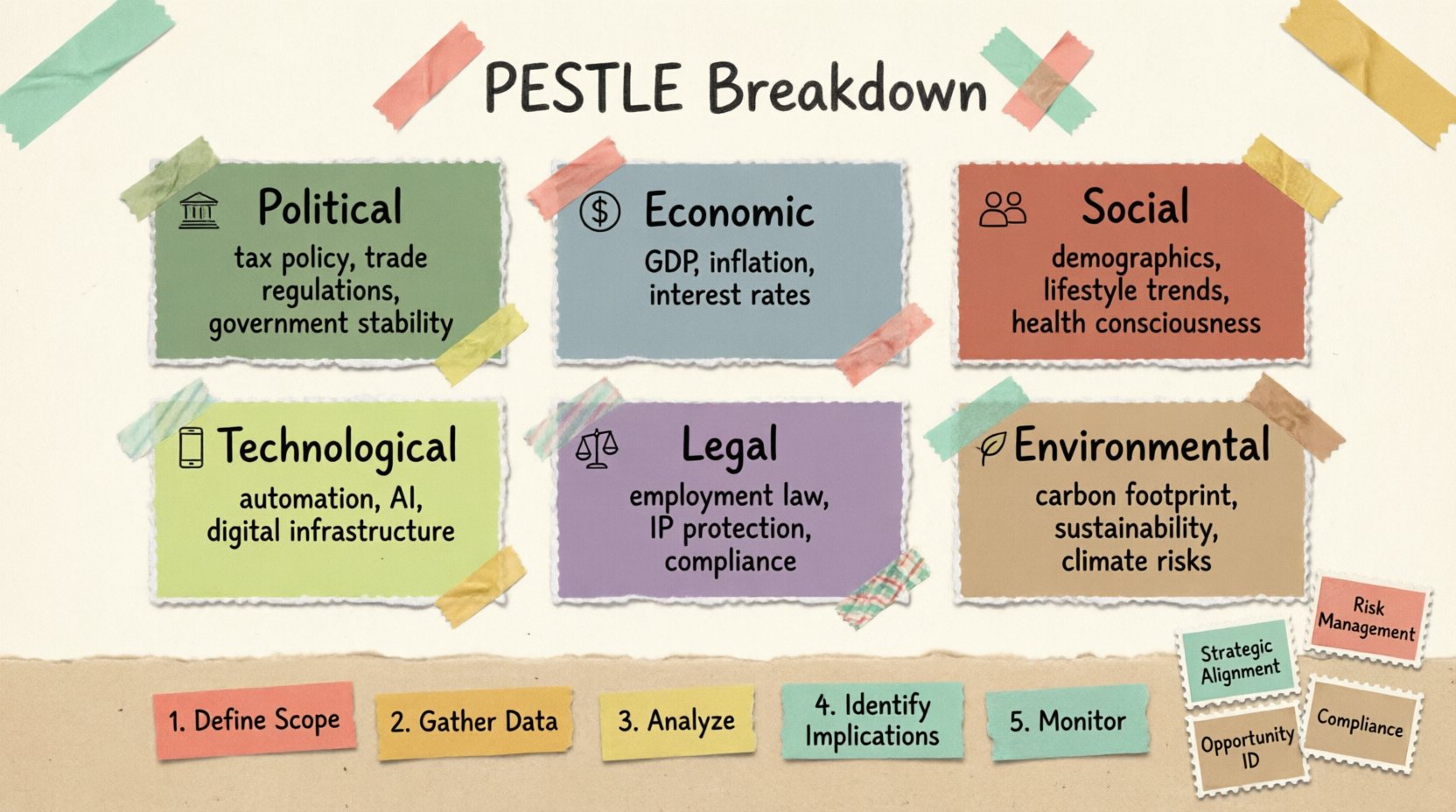
Every organization operates within a broader context that influences its ability to succeed. These external forces exist outside the control of management but significantly impact strategy, operations, and long-term viability. Understanding these forces is essential for sustainable growth and risk mitigation. This article provides a comprehensive breakdown of macro-environment factors using the PESTLE framework, offering a clear view of how external elements shape business landscapes.
What is PESTLE Analysis? 📊
PESTLE analysis is a strategic framework used to scan the external macro-environment of an organization. It stands for Political, Economic, Social, Technological, Legal, and Environmental factors. While often referred to simply as PEST analysis, the addition of Legal and Environmental factors provides a more robust view of current global complexities.
Originally developed in the 1960s as a tool for strategic planning, it has evolved to become a standard practice in market research and business intelligence. The goal is not to predict the future with certainty, but to identify trends and potential disruptions early. By categorizing external drivers, teams can allocate resources more effectively and anticipate changes in the operating environment.
Key benefits include:
- Strategic Alignment: Ensures business goals match external realities.
- Risk Management: Identifies potential threats before they materialize.
- Opportunity Identification: Highlights gaps in the market created by shifting trends.
- Compliance: Keeps organizations aware of regulatory requirements.
The 6 Pillars of the PESTLE Breakdown 🔍
To conduct a thorough analysis, each component must be examined in detail. Below is a deep dive into what constitutes each factor and how it influences decision-making.
1. Political Factors 🏛️
Political factors relate to government intervention in the economy. These include tax policy, labor laws, environmental regulations, trade restrictions, tariffs, and political stability. The degree of government interference in the free market is a primary driver of this category.
Businesses must monitor:
- Government Stability: Frequent changes in leadership can create uncertainty for long-term investments.
- Trade Regulations: Tariffs and quotas affect supply chain costs and international expansion.
- Tax Policy: Corporate tax rates influence profitability and reinvestment capacity.
- Political Rhetoric: Campaign promises and policy shifts often signal upcoming legislative changes.
- Public Sector Spending: Government contracts can be a significant revenue source for certain industries.
2. Economic Factors 💰
Economic factors directly affect the purchasing power of potential customers and the cost of capital. These factors are often cyclical, moving between periods of growth and recession. Understanding the economic climate is vital for pricing strategies and financial planning.
Key considerations include:
- Economic Growth: Measured by GDP, this indicates the health of the economy and consumer confidence.
- Interest Rates: High rates increase borrowing costs, potentially slowing expansion.
- Inflation Rates: Rising prices erode purchasing power and increase operational costs.
- Exchange Rates: Fluctuations impact import/export costs and competitiveness in global markets.
- Disposable Income: Determines the budget available for non-essential goods and services.
3. Social Factors 👥
Social factors look at the human side of the market. This includes population growth, age distribution, career attitudes, health consciousness, and cultural trends. These factors help organizations understand consumer behavior and demand patterns.
Important social elements to track:
- Demographics: Aging populations or youth bulges dictate different product needs.
- Attitudes Towards Health: Shifts in wellness culture can drive demand for specific products.
- Lifestyle Changes: Remote work trends, for example, alter the demand for office supplies versus home technology.
- Educational Levels: A more educated workforce may require different management styles and training.
- Consumer Protection: Societal expectations regarding ethical sourcing and fair trade.
4. Technological Factors 📱
Technological factors involve innovations that create new markets or render existing ones obsolete. This includes research and development activity, automation, technology incentives, and the rate of technological change. Ignoring this factor can lead to rapid obsolescence.
Areas of focus:
- Automation: Reduces labor costs but may impact workforce demographics.
- Internet Infrastructure: Connectivity levels determine the feasibility of digital business models.
- Data Security: As threats evolve, investment in cybersecurity becomes a necessity.
- R&D Focus: The pace of innovation in your specific sector.
- Technology Barriers: Patents or proprietary systems that prevent new entrants.
5. Legal Factors ⚖️
Legal factors are distinct from political ones in that they focus on the specific laws and regulations that businesses must comply with. These vary significantly by country and industry. Non-compliance can lead to fines, lawsuits, and reputational damage.
Common legal areas:
- Employment Law: Regulations regarding hiring, firing, wages, and working hours.
- Health and Safety: Standards for physical work environments and product safety.
- Consumer Protection: Laws regarding product labeling, warranties, and refunds.
- Intellectual Property: Copyrights, trademarks, and patents protect innovations.
- Antitrust Laws: Prevents monopolies and ensures fair competition.
6. Environmental Factors 🌱
Environmental factors have gained prominence in recent years due to increased awareness of climate change. This includes weather, climate change, environmental policies, and ecological shifts. Sustainability is no longer optional for many stakeholders.
Key environmental drivers:
- Carbon Footprint: Pressure to reduce emissions and energy consumption.
- Waste Management: Regulations on disposal and recycling of industrial waste.
- Sustainability Trends: Consumer preference for eco-friendly products.
- Climate Risks: Physical risks to supply chains due to extreme weather events.
- Resource Scarcity: Availability of raw materials like water and rare earth metals.
PESTLE vs PEST: A Comparison 📋
While PESTLE is the more comprehensive model, PEST remains in use. The distinction lies in the inclusion of Legal and Environmental factors. In many modern contexts, omitting these two can lead to a blind spot regarding compliance and sustainability risks.
| Factor | PEST | PESTLE |
|---|---|---|
| Political | Yes | Yes |
| Economic | Yes | Yes |
| Social | Yes | Yes |
| Technological | Yes | Yes |
| Legal | No | Yes |
| Environmental | No | Yes |
How to Conduct a PESTLE Analysis 🛠️
Executing a PESTLE analysis requires a structured approach. It is not a one-time task but a recurring process that should be integrated into regular strategic reviews.
Step 1: Define the Scope
Clearly identify the market, region, or industry you are analyzing. A global analysis differs significantly from a local one. The scope determines the relevance of specific data points.
Step 2: Gather Data
Collect information from diverse sources. This includes government reports, industry news, economic indicators, academic research, and internal sales data. Ensure the information is current and verifiable.
Step 3: Analyze the Factors
Review the collected data against the six categories. Ask specific questions for each factor. For example, under Economic, ask how inflation might affect pricing. Under Legal, ask if new regulations are pending.
Step 4: Identify Implications
Translate findings into business implications. Does a new law require a change in operations? Does a demographic shift suggest a new product line? Map these implications to your current strategy.
Step 5: Monitor and Update
The macro-environment is dynamic. What is true today may change next year. Set a schedule to review and update the analysis to ensure continued relevance.
Real-World Applications and Examples 💡
Theoretical frameworks are best understood through application. Here is how different sectors utilize PESTLE to navigate their environments.
Automotive Industry
- Political: Subsidies for electric vehicles (EVs) and trade tariffs on imported parts.
- Technological: Advances in battery technology and autonomous driving software.
- Environmental: Stricter emissions standards and pressure to reduce manufacturing waste.
Healthcare Sector
- Legal: Changes in patient privacy laws and drug pricing regulations.
- Social: Aging population increases demand for geriatric care services.
- Economic: Insurance reimbursement rates and public health funding budgets.
Retail and E-Commerce
- Technological: Mobile payment adoption and logistics automation.
- Social: Shift towards online shopping and demand for ethical fashion.
- Legal: Data protection laws regarding customer information handling.
Common Pitfalls and Best Practices ⚠️
Even with a solid framework, mistakes can occur during the analysis process. Recognizing these pitfalls helps improve the accuracy of the output.
Pitfalls to Avoid
- Data Overload: Collecting too much information without prioritizing what matters.
- Internal Bias: Interpreting data in a way that supports existing beliefs rather than objective reality.
- Static Analysis: Treating the analysis as a single snapshot rather than an ongoing trend.
- Lack of Context: Failing to connect external factors to internal capabilities.
Best Practices
- Diverse Input: Involve stakeholders from different departments to get varied perspectives.
- Focus on Impact: Prioritize factors that have a high probability and high impact on the business.
- Scenario Planning: Use the findings to build multiple future scenarios rather than a single prediction.
- Clear Documentation: Record assumptions and sources to maintain auditability.
Integrating PESTLE into Strategic Planning 📝
The value of PESTLE lies in its integration into the broader strategic planning cycle. It is not a standalone report but a foundational element for decision-making.
SWOT Connection
PESTLE factors often feed directly into the Opportunities and Threats quadrants of a SWOT analysis. For instance, a new technology (Technological) might create an opportunity, while a new regulation (Legal) might create a threat.
Resource Allocation
Insights from the analysis guide budget decisions. If environmental factors indicate stricter regulations, capital expenditure might shift toward sustainability initiatives. If economic factors suggest a downturn, cash reserves might be prioritized over expansion.
Risk Mitigation Strategy
Identified threats should trigger contingency plans. If a political factor suggests instability in a key market, a business might diversify its supply chain to reduce dependency.
The Interconnectivity of Factors 🔗
It is rare for these factors to operate in isolation. They are deeply interconnected. A change in one area often triggers changes in others.
For example, consider the impact of Technological advancements on Legal issues. The rise of artificial intelligence has forced governments to draft new laws regarding liability and data privacy. Similarly, Environmental concerns often drive Political action, resulting in carbon taxes that influence Economic outcomes.
Recognizing these correlations prevents siloed thinking. A strategy that addresses one factor without considering its ripple effects on others may fail to achieve the desired outcome. Comprehensive planning requires a systems-thinking approach.
Data Collection and Validation 📈
The quality of the analysis depends on the quality of the data. Relying on outdated or biased information can lead to flawed strategies.
Effective data sources include:
- Government Publications: Census data, economic reports, and legislative updates.
- Industry Associations: Reports on sector-specific trends and standards.
- Financial Institutions: Market analysis from banks and investment firms.
- Academic Research: Peer-reviewed studies on social and environmental trends.
- Competitor Intelligence: Public filings and press releases from key rivals.
Validation is equally important. Cross-reference data points to ensure consistency. If one source claims a market is growing while another claims it is shrinking, further investigation is required to understand the discrepancy.
Conclusion on Macro-Environment Analysis 🏁
Understanding macro-environment factors is a critical competency for any organization aiming for longevity. The PESTLE framework offers a structured way to examine the external landscape, ensuring that internal strategies are resilient against external shocks. By systematically analyzing Political, Economic, Social, Technological, Legal, and Environmental factors, leaders can make informed decisions that align with reality.
The process requires discipline and continuous effort. It is not a task to be completed once and filed away. The environment changes rapidly, and so must the analysis. Regular reviews and the integration of findings into strategic planning ensure that the organization remains agile and competitive. Success depends on the ability to adapt to these external forces rather than attempting to control them.