
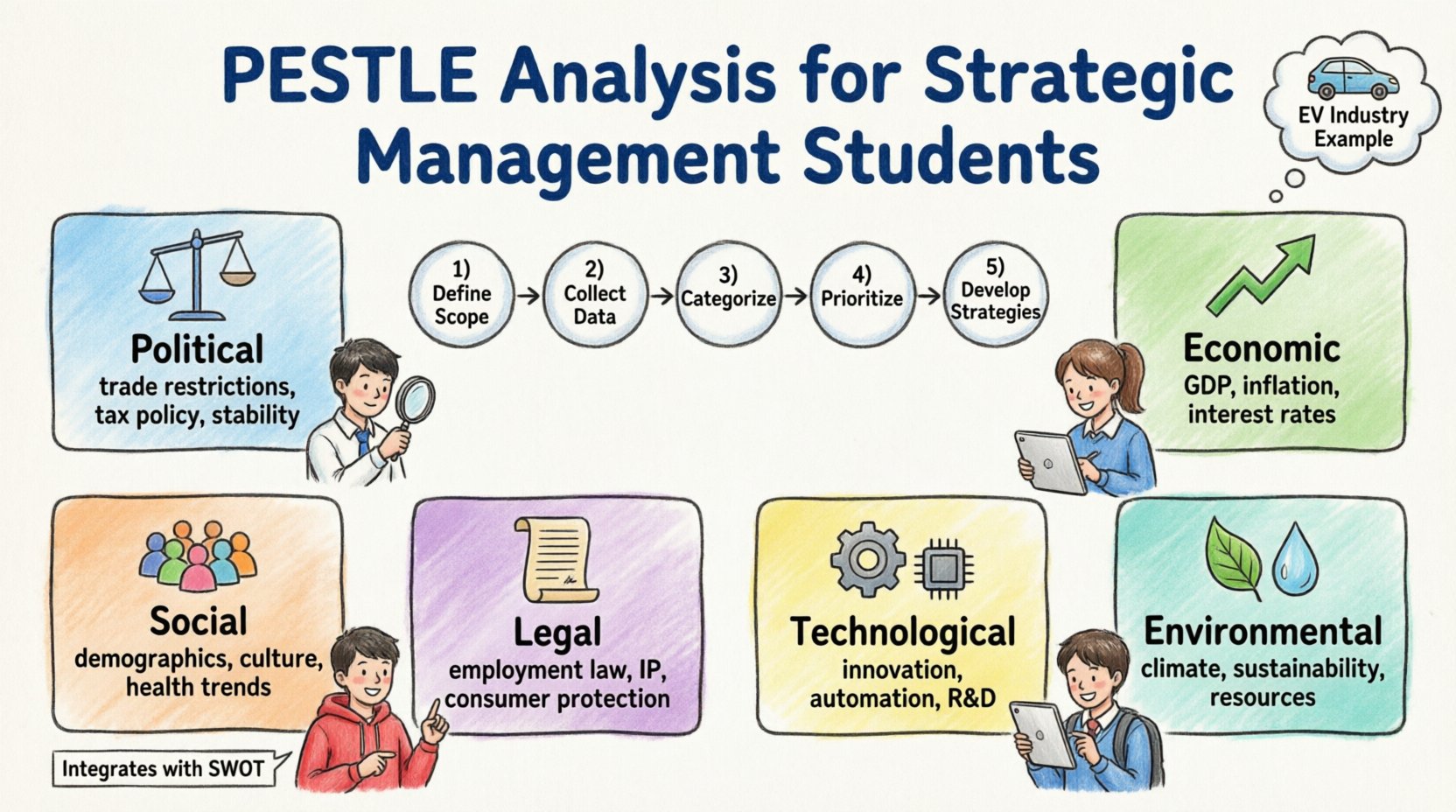
Strategic management requires more than just intuition. It demands a structured approach to understanding the external forces that shape an industry. For students navigating the complexities of business strategy, the PESTLE analysis stands as a foundational tool. This framework helps identify the macro-environmental factors influencing an organization. By systematically examining these elements, students can predict market shifts and formulate robust long-term plans. This guide delves into the mechanics, application, and strategic value of the PESTLE model.
🧩 What Is the PESTLE Framework?
The PESTLE analysis is a strategic tool used to scan the macro-environment. It stands for Political, Economic, Social, Technological, Legal, and Environmental factors. Unlike internal audits that focus on strengths and weaknesses, PESTLE looks outward. It assesses the uncontrollable variables that an organization must navigate. For strategic management students, mastering this framework is essential for case studies, exams, and real-world consultancy.
Originally developed in the 1960s, the model has evolved. The original PEST model added “Legal” and “Environmental” aspects later to reflect modern regulatory and sustainability concerns. Today, it is a standard component of the external analysis section of strategic planning. It complements tools like SWOT by providing the data for the “Opportunities” and “Threats” quadrants.
🌍 The Six Pillars of External Analysis
To conduct a thorough analysis, one must understand each component deeply. Each letter represents a category of external factors. Below is a breakdown of what each pillar entails.
1. ⚖️ Political Factors
Political factors refer to how government intervention impacts the economy or specific industries. This is not just about elections; it is about the stability and direction of governance.
- Trade Restrictions: Tariffs, quotas, and embargoes affect international trade.
- Tax Policy: Corporate tax rates influence profitability and investment decisions.
- Labour Laws: Regulations regarding minimum wage, unions, and working hours.
- Political Stability: The risk of civil unrest or policy shifts in a specific region.
- Subsidies: Government financial support for specific sectors like agriculture or renewable energy.
2. 📈 Economic Factors
Economic factors determine the purchasing power of potential customers and the cost of capital. These variables fluctuate frequently and require constant monitoring.
- Economic Growth: GDP trends indicate the health of the market.
- Exchange Rates: Fluctuations affect import costs and export competitiveness.
- Inflation Rates: High inflation erodes purchasing power and increases costs.
- Interest Rates: These impact borrowing costs for expansion or inventory.
- Unemployment Rates: High unemployment may lower wages but reduce consumer demand.
3. 🧑🤝🧑 Social Factors
Social factors involve the demographic and cultural aspects of the external environment. Understanding the population is key to marketing and product development.
- Population Growth: Affects market size and labor supply.
- Age Distribution: Aging populations require different services than youthful ones.
- Health Consciousness: Trends in wellness impact food, fitness, and insurance industries.
- Career Attitudes: Shifts in work-life balance expectations influence hiring strategies.
- Cultural Norms: Customs and taboos that dictate consumer behavior.
4. 💻 Technological Factors
Technological factors cover innovations that create new markets or render old ones obsolete. In the digital age, this is often the most volatile category.
- R&D Activity: The pace of innovation in the industry.
- Automation: The potential to reduce labor costs and increase efficiency.
- Internet Infrastructure: Connectivity levels dictate e-commerce viability.
- Technology Incentives: Grants or tax breaks for adopting new tech.
- Disruptive Tech: Emerging technologies that threaten current business models.
5. ⚖️ Legal Factors
While similar to political factors, legal factors focus specifically on the law as it is written and enforced. This includes compliance requirements.
- Employment Law: Contracts, discrimination, and safety standards.
- Consumer Protection: Rights regarding warranties and product safety.
- Intellectual Property: Patents, copyrights, and trademarks.
- Health and Safety: Regulations governing workplace environments.
- Antitrust Laws: Rules preventing monopolies and ensuring fair competition.
6. 🌱 Environmental Factors
Environmental factors have grown in prominence due to climate change and sustainability concerns. Companies are now judged on their ecological footprint.
- Climate Change: Risks related to extreme weather events.
- Carbon Footprint: Emissions regulations and reporting requirements.
- Waste Disposal: Laws regarding recycling and hazardous materials.
- Sustainability: Consumer demand for eco-friendly products.
- Resource Availability: Scarcity of raw materials like water or timber.
📝 How to Conduct a PESTLE Analysis
Executing this analysis requires a methodical approach. It is not enough to list factors; they must be evaluated for impact and likelihood. Follow this structured process.
Step 1: Define the Scope
Before gathering data, establish the boundaries. Are you analyzing a specific product, a regional branch, or the entire corporation? A narrow scope yields more actionable data.
Step 2: Data Collection
Gather information from reliable sources. Academic journals, government reports, and industry news provide the necessary evidence. Avoid speculation. Use primary data where possible.
Step 3: Categorize and List
Place each data point into the appropriate category. Do not force a factor into a box where it does not fit. If a factor is unclear, seek further clarification.
Step 4: Prioritize
Not all factors are equally important. Use a scoring system to rank them by impact and certainty. Focus strategic attention on the high-impact, high-probability items.
Step 5: Develop Strategies
Translate findings into action. If a political risk is high, consider hedging strategies. If a technological opportunity exists, allocate R&D budget accordingly.
📊 Example: Industry Application Table
To visualize how this works in practice, consider a hypothetical analysis of the Electric Vehicle (EV) Manufacturing Industry. The table below illustrates how factors are mapped.
| Factor | Example Variable | Impact on Industry |
|---|---|---|
| Political | Battery import tariffs | Increases production costs for domestic manufacturers. |
| Economic | Rising interest rates | Reduces consumer financing for high-ticket vehicle purchases. |
| Social | Shift toward eco-conscious living | Increases demand for zero-emission vehicles. |
| Technological | Battery energy density improvements | Extends driving range, reducing range anxiety. |
| Legal | Stricter emission standards | Forces manufacturers to accelerate EV production lines. |
| Environmental | Scarcity of Lithium | Threatens supply chain stability and long-term production. |
🔗 Integrating PESTLE with Other Models
Strategic management rarely relies on a single tool. PESTLE is most powerful when integrated with other frameworks. It serves as the input for the SWOT analysis. The external factors identified in PESTLE become the Opportunities and Threats in a SWOT matrix.
For instance, a Technological factor like “rapid AI adoption” becomes an Opportunity if the company can integrate it, or a Threat if competitors use it to undercut prices. Similarly, PESTLE informs Porter’s Five Forces by highlighting external pressures that affect supplier power or buyer bargaining.
❌ Common Pitfalls for Students
Even with a solid framework, errors occur. Students often make specific mistakes that reduce the value of their analysis. Avoid these common traps.
- Listing Without Analysis: Simply listing factors without explaining their strategic relevance is insufficient. Ask “So what?” for every point.
- Ignoring Interconnectivity: Factors are rarely isolated. A Political change often triggers Economic consequences. Consider the ripple effects.
- Outdated Data: Using data from five years ago can lead to flawed conclusions. The macro-environment changes rapidly.
- Confusing Internal and External: Do not include company-specific strengths or weaknesses in a PESTLE analysis. Keep it strictly external.
- Overgeneralization: Avoid broad statements like “economy is growing.” Specify the region and the sector.
⚠️ Limitations of the Model
While robust, the PESTLE analysis is not without limitations. It provides a snapshot in time. It does not predict the future with certainty. It also tends to treat factors as independent, whereas they are often deeply interwoven. Furthermore, it can be subjective. Different analysts might weigh the same factor differently based on their perspective.
Students should view PESTLE as a starting point, not the final word. It sets the stage for deeper investigation. It helps organize information, but it does not make the strategic decision for you.
🚀 Future Trends in Strategic Scanning
The landscape of strategic management is evolving. The static nature of traditional PESTLE is being challenged by dynamic models. Some experts suggest adding a “C” for Cultural or “E” for Ethical factors to reflect modern values. Others propose continuous monitoring rather than periodic reviews.
For students, staying updated is crucial. The rise of ESG (Environmental, Social, and Governance) investing means that Environmental and Legal factors are now financial imperatives, not just compliance checkboxes. Understanding the intersection of these variables will define the next generation of strategists.
📚 Conclusion on Application
The PESTLE analysis remains a cornerstone of strategic management education. It forces students to look beyond the immediate business operations and consider the broader context. By systematically evaluating Political, Economic, Social, Technological, Legal, and Environmental factors, organizations can better position themselves for the future. For students, practicing this framework builds critical thinking skills that are transferable to any industry. It transforms raw data into strategic insight.
Success in this field comes from discipline and depth. Do not rush the process. Gather accurate data. Prioritize the critical factors. And always link the findings back to actionable strategy. This approach ensures that your analysis holds weight in academic and professional settings alike.