
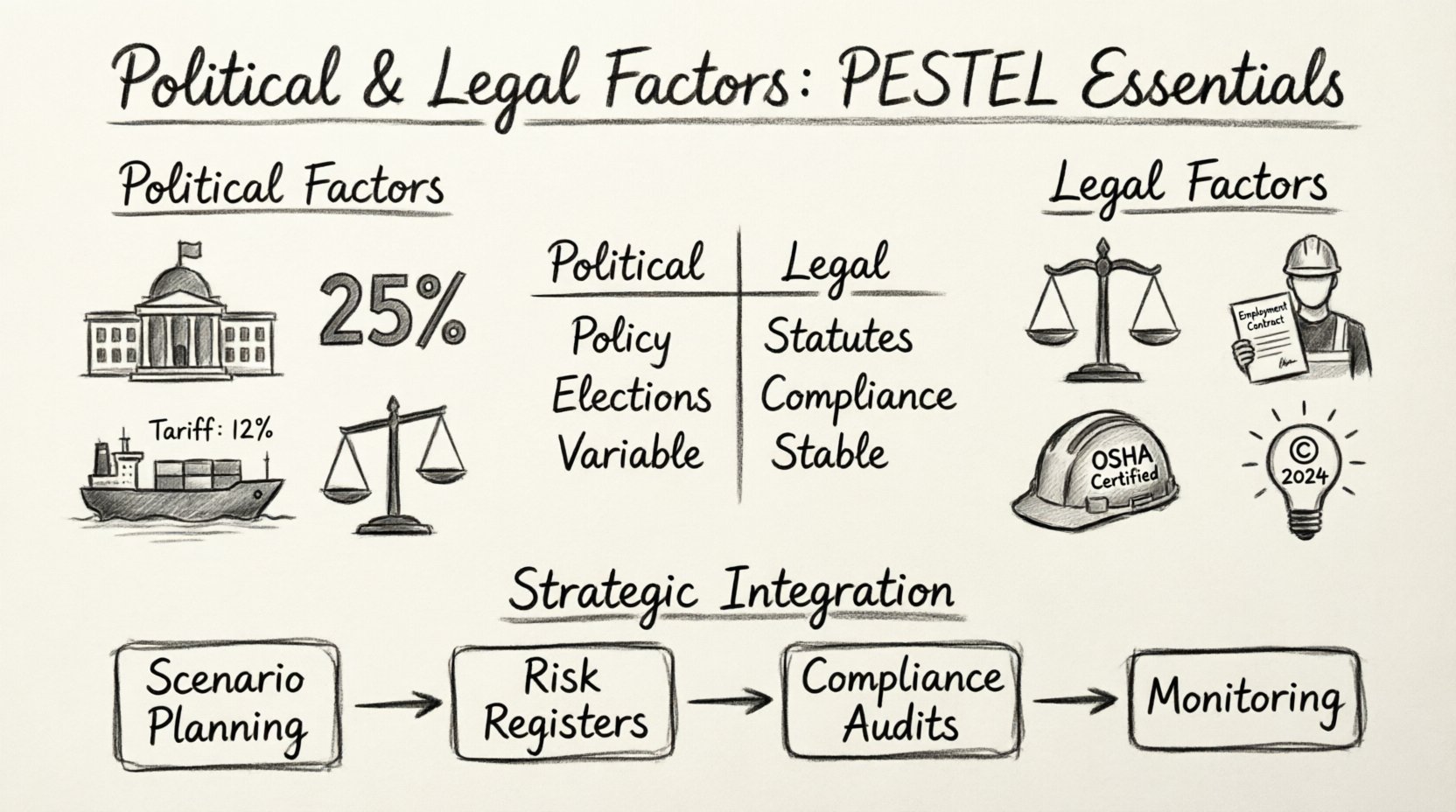
Businesses operate within a complex ecosystem of external forces. To navigate this environment effectively, organizations utilize frameworks designed to map these influences. The PESTEL analysis stands out as a critical tool for strategic planning. While the acronym covers six distinct areas—Political, Economic, Social, Technological, Environmental, and Legal—the political and legal dimensions often carry the most immediate weight in regulatory-heavy industries.
Understanding the nuances between political stability and legal compliance is not merely an academic exercise. It is a operational necessity. Decisions regarding market entry, pricing strategies, and supply chain logistics depend heavily on the rules set by governments and the courts. This article provides a deep dive into these specific factors, offering a structured approach to assessment without relying on buzzwords or unnecessary fluff.
Understanding Political Factors 🌍
Political factors encompass the influence of government activities and policies on the business environment. These elements dictate the boundaries within which companies must operate. Unlike economic factors which often fluctuate with market cycles, political factors can change rapidly following elections or shifts in policy direction.
Taxation Policies 💰
Taxation is a direct lever used by governments to influence economic behavior. Corporate tax rates determine the bottom line, while VAT or sales tax impacts consumer pricing. Changes in tax codes can alter the profitability of an entire sector overnight.
- Corporate Tax Rates: High rates may discourage investment or encourage relocation to lower-tax jurisdictions.
- Indirect Taxes: Shifts in consumption taxes can reduce demand for non-essential goods.
- Subsidies and Grants: Governments may offer financial incentives to promote specific industries, such as renewable energy or technology.
Businesses must forecast potential tax changes to ensure long-term viability. A strategy built on current tax assumptions may fail if a new administration introduces austerity measures.
Trade Restrictions and Tariffs 🚢
In a globalized economy, international trade is vital for many companies. Political decisions regarding trade agreements directly impact the cost of goods and the ability to export.
- Tariffs: Taxes imposed on imports can raise costs for manufacturers relying on foreign raw materials.
- Quotas: Limits on the quantity of goods that can be imported or exported restrict market access.
- Sanctions: Political sanctions against specific countries can sever supply lines and close markets entirely.
- Trade Agreements: Partnerships like free trade zones can lower barriers and encourage expansion.
Companies with international supply chains must monitor geopolitical tensions closely. A trade war can disrupt operations just as effectively as a natural disaster.
Political Stability and Government Intervention 🏛️
The stability of a government determines the risk profile of an investment. In unstable regions, the risk of expropriation, civil unrest, or sudden policy shifts is high.
- Stability: Stable governments provide a predictable environment for long-term planning.
- Corruption: High levels of corruption increase the cost of doing business and introduce legal risks.
- Intervention: Governments may nationalize industries or impose price controls on essential goods during crises.
- Political Ideology: The ruling party’s stance on regulation, labor, and environment shapes the operating landscape.
Navigating Legal Factors ⚖️
Legal factors are the laws and regulations that businesses must obey. While political factors are about power and policy direction, legal factors are about specific rules and enforcement. Non-compliance can lead to fines, lawsuits, or shutdowns.
Employment and Labor Laws 👥
Every organization employs people, making employment law a core area of concern. Regulations vary significantly by country and region.
- Hiring and Firing: Laws dictate notice periods, severance pay, and the grounds for dismissal.
- Minimum Wage: Legal minimums set a baseline for payroll costs.
- Working Hours: Regulations on overtime, breaks, and maximum hours affect scheduling.
- Unionization: Laws regarding collective bargaining influence negotiations between management and staff.
Failure to adhere to labor laws can result in costly litigation and reputational damage. Companies expanding into new regions must audit their HR policies against local statutes.
Consumer Protection and Product Liability 🛡️
Protecting the consumer is a primary function of modern legal systems. Businesses must ensure their products and services do not harm customers.
- Labeling Requirements: Accurate information must be provided regarding ingredients, origin, and usage.
- Warranties: Legal mandates often require minimum warranty periods for certain goods.
- Product Safety: Standards for manufacturing ensure items are safe for intended use.
- Advertising Standards: False or misleading claims are subject to regulatory action.
A single product liability lawsuit can drain resources. Robust quality control and legal review processes are essential defenses.
Health and Safety Regulations 🏥
Ensuring a safe workplace is a legal obligation. These regulations protect employees and visitors from harm.
- Workplace Safety: Standards for machinery, chemicals, and physical environments.
- Occupational Health: Rules regarding exposure to hazards and ergonomic requirements.
- Emergency Procedures: Mandates for fire safety, evacuation plans, and first aid.
- Inspections: Regulatory bodies have the right to inspect facilities for compliance.
Intellectual Property Rights 📜
Innovation is protected through legal frameworks. Intellectual property (IP) laws safeguard inventions, designs, and brand assets.
- Patents: Protect inventions and technical processes from unauthorized use.
- Trademarks: Protect brand names, logos, and slogans.
- Copyrights: Protect creative works, software code, and content.
- Trade Secrets: Legal protection for confidential business information.
Strong IP management prevents competitors from copying products. It also provides leverage in negotiations and partnerships.
Distinguishing Political from Legal Factors 📋
While political and legal factors are often grouped together, they represent different types of risk. Political factors are about the environment and policy direction. Legal factors are about the specific rules and enforcement mechanisms.
| Factor Type | Nature of Influence | Primary Impact | Time Horizon |
|---|---|---|---|
| Political | Government policy, stability, ideology | Market access, tax rates, trade barriers | Variable (Elections, Regimes) |
| Legal | Statutes, regulations, case law | Compliance, litigation, operational rules | Stable (Until amended) |
| Interaction | Politics creates Law | Law enforces Political Will | Dynamic |
The table above highlights the distinction. Political shifts often precede legal changes. A new government (Political) may pass new legislation (Legal). Understanding this sequence allows for proactive rather than reactive planning.
Integrating Analysis into Strategic Planning 📈
Collecting data is not enough. The insights must be integrated into the strategy. This involves translating external factors into internal actions.
- Scenario Planning: Develop strategies for different political outcomes (e.g., election results, policy shifts).
- Risk Registers: Document specific legal risks and assign probability and impact scores.
- Compliance Audits: Regularly review operations against current legal standards.
- Lobbying and Advocacy: Engage with policymakers to shape favorable regulations where appropriate.
Strategic planning must be iterative. Political and legal landscapes evolve. A strategy valid today may be obsolete in a year. Regular reviews ensure alignment.
Monitoring External Variables 🔍
Continuous monitoring is required to stay ahead of changes. This involves tracking news, legislation, and political discourse.
- Legislative Tracking: Follow bills and regulations in relevant jurisdictions.
- Political News: Monitor election cycles and policy announcements.
- Industry Reports: Read analyses from legal and political think tanks.
- Stakeholder Feedback: Listen to customers and partners regarding regulatory pain points.
Automated alerts for specific keywords can help keep teams informed. However, human analysis is still required to interpret the nuance of political shifts.
Common Pitfalls in PESTEL Analysis ❌
Even experienced strategists make mistakes when analyzing these factors. Avoiding these common errors improves the quality of the output.
- Assuming Stability: Believing current laws will remain unchanged forever.
- Ignoring Local Nuances: Applying general national laws to specific regional contexts.
- Focus on the Negative: Overlooking opportunities created by new regulations.
- Data Overload: Collecting too much information without synthesizing key risks.
- Siloed Thinking: Treating political and legal factors in isolation from economic and social trends.
Balance is key. A comprehensive view requires weighing risks against potential rewards. New regulations can create new markets, such as carbon trading or data privacy services.
Future Considerations 📉
The landscape of political and legal factors is shifting. Emerging trends require attention for future-proofing.
- Data Privacy: Stricter laws on how personal data is collected and used.
- Environmental Regulation: Increased focus on carbon emissions and sustainability.
- Geopolitical Fragmentation: Rising nationalism and protectionism.
- Remote Work Laws: Legal frameworks adapting to distributed workforces.
Organizations that anticipate these shifts will maintain a competitive advantage. Proactive adaptation is better than reactive damage control.
Conclusion on Strategic Alignment
The political and legal components of the PESTEL framework provide a critical lens for understanding the operating environment. They define the boundaries of possibility. By systematically analyzing taxation, trade, stability, employment, safety, and IP, businesses can mitigate risk and identify opportunities.
Success requires more than a one-time study. It demands ongoing vigilance. The rules of the game change, and those who adapt survive. This approach ensures that strategic decisions are grounded in reality rather than assumption.