
Entering the acquisition process is a pivotal moment for any technology-driven enterprise. For organizations built on agile principles, this phase introduces a unique set of challenges. Traditional due diligence relies heavily on static documentation, rigid project plans, and historical Gantt charts. Agile environments, by contrast, thrive on adaptability, iterative delivery, and evolving requirements. This divergence can create friction during the scrutiny phase of a merger or acquisition.
The goal is not to force an agile team into a waterfall mold. Instead, the objective is to translate the value of your adaptive processes into metrics and narratives that acquirers can understand and trust. This guide outlines the strategic steps required to prepare your organization. We will explore documentation standards, technical metrics, cultural health indicators, and the specific risks associated with agile operations during a sale.
🔍 Understanding the Due Diligence Landscape
Acquirers approach due diligence with a mandate to mitigate risk. They are looking for evidence of sustainable growth, stable engineering practices, and predictable delivery capabilities. When an organization claims to be agile, the buyer often asks, “If everything changes, how do you know what you are actually building?” or “Where is the historical data?”
Successful preparation involves bridging the gap between agile flexibility and corporate governance. You must demonstrate that your adaptability is not chaos, but a disciplined approach to managing complexity.
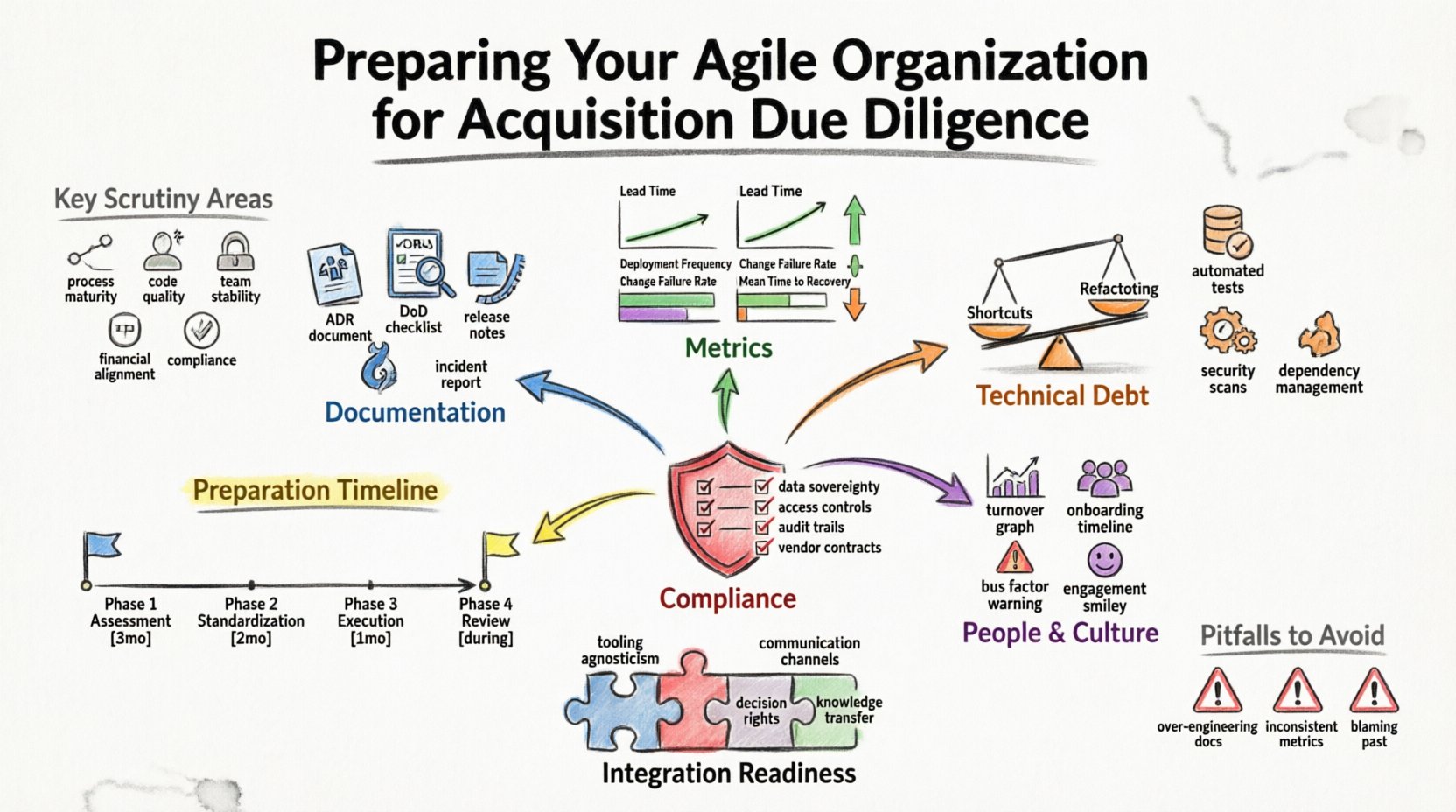
📋 Key Areas of Scrutiny
- Process Maturity: Is the agile practice genuine or merely a label?
- Code Quality: Are there hidden technical debts that could stall future development?
- Team Stability: Are key engineers dependent on specific individuals?
- Financial Alignment: Does the cost of development align with the value delivered?
- Compliance: Are data and security protocols maintained despite rapid iteration?
📄 Documentation: The Agile Paradox
One of the most common misconceptions is that agile means “no documentation.” In reality, agile requires appropriate documentation. For due diligence, you need to provide evidence of decision-making without burdening the team with excessive paperwork.
Acquirers need to see traceability. They want to understand why a feature was built, how it was tested, and what the performance baseline is. This does not require formal requirements documents spanning hundreds of pages. It requires accessible, searchable records within your standard tools.
🛠 Essential Documentation Assets
Ensure the following artifacts are current and accessible in your project management system:
- Architecture Decision Records (ADRs): Brief documents explaining why specific technical choices were made. This proves architectural foresight.
- Definition of Done (DoD): A clear checklist that must be met before work is considered complete. This ensures quality standards are understood.
- Release Notes: Summaries of what was shipped in each iteration. This demonstrates delivery cadence.
- Backlog Grooming Notes: Evidence that requirements are being refined and prioritized regularly, not just dumped into a queue.
- Incident Reports: Records of outages or bugs and how they were resolved. This shows operational maturity.
📊 Metrics and Value Delivery
Traditional due diligence often looks at budget adherence against a plan. Agile organizations focus on value delivery and flow efficiency. You must translate these concepts into language that financial auditors and legal teams can digest.
Do not simply present raw velocity numbers. Velocity is relative to the team and changes over time. Instead, focus on metrics that indicate predictability and throughput.
📈 Critical Metrics to Highlight
| Metric | What It Measures | Why It Matters for Acquirers |
|---|---|---|
| Lead Time | Time from request to deployment | Indicates speed to market and operational efficiency. |
| Deployment Frequency | How often code goes to production | Shows stability of the release pipeline and risk tolerance. |
| Change Failure Rate | Percentage of deployments causing failure | Measures quality assurance and system resilience. |
| Mean Time to Recovery | Time to restore service after failure | Highlights incident response capabilities and robustness. |
When presenting these figures, provide context. Explain trends over the last 12 months. A steady lead time suggests stability. A decreasing change failure rate suggests improving quality. These narratives build confidence in the engineering organization.
🏗 Technical Architecture and Debt
Technical debt is often a hidden liability in acquisitions. In an agile environment, teams often prioritize speed to ship features. Over time, shortcuts accumulate. Due diligence will involve code reviews and architecture assessments.
You must be honest about the current state of the codebase. Hiding technical debt can lead to valuation adjustments or deal breakers later. However, presenting debt as a managed risk rather than a crisis is the right approach.
🧹 Managing Technical Liability
- Inventory the Debt: Create a list of known technical debts categorized by severity and impact.
- Plan for Remediation: Show that a portion of every sprint is allocated to refactoring and maintenance. This proves a sustainable engineering culture.
- Automated Testing Coverage: Provide reports on unit test, integration test, and end-to-end test coverage. High coverage reduces risk.
- Security Scans: Include results from automated security vulnerability scans (SAST/DAST) to show proactive security management.
- Dependency Management: List third-party libraries and frameworks. Ensure they are supported and not vulnerable to known exploits.
👥 People, Culture, and Retention
Human capital is often the most valuable asset in an agile organization. Acquirers will scrutinize team structure, retention rates, and key person dependencies. Agile relies on collaboration and tacit knowledge. If critical knowledge is held by one individual, the value of the acquisition diminishes.
🤝 Organizational Health Indicators
- Turnover Rates: Document historical turnover. High turnover can signal cultural issues or burnout.
- Onboarding Time: How long does it take for a new engineer to become productive? This measures documentation quality and team support.
- Bus Factor: Assess how many critical systems would fail if a specific team member left. Mitigate this through cross-training and pair programming.
- Compensation Structures: Ensure salary bands are competitive and documented. Equity grants and bonus structures must be clear.
- Engagement Surveys: Internal feedback scores can demonstrate a healthy work environment, which is attractive to buyers looking for long-term stability.
⚖️ Compliance and Legal Considerations
Agile teams often move quickly, which can lead to compliance oversights. During due diligence, legal teams will check for adherence to regulations relevant to your industry, such as GDPR, HIPAA, or SOC2.
Data privacy is particularly sensitive. Ensure that user data is handled correctly in your development, testing, and production environments. Do not use production data in lower environments without masking or anonymization.
🛡 Compliance Checklist
- Data Sovereignty: Where is data stored physically? Does this align with acquirer requirements?
- Access Controls: Who has access to production systems? Are permissions reviewed regularly?
- Audit Trails: Can you track who made changes to the code and when? CI/CD logs serve this purpose.
- Vendor Management: If you use third-party SaaS tools, are the contracts assignable? Can the acquirer take over those subscriptions?
📅 The Preparation Timeline
Preparation should not happen the week before the meeting. It requires months of readiness. Rushing to organize files creates disorganization. A phased approach ensures stability.
🗓 Phased Approach to Readiness
- Phase 1: Assessment (3 Months Out)
- Audit current documentation and tools.
- Identify gaps in metrics and reporting.
- Begin remediation of critical technical debt.
- Phase 2: Standardization (2 Months Out)
- Standardize reporting formats for stakeholders.
- Consolidate access permissions and credentials.
- Conduct internal dry runs of the due diligence process.
- Phase 3: Execution (1 Month Out)
- Prepare the data room structure.
- Train the team on what questions to expect.
- Lock down critical systems to prevent unauthorized changes.
- Phase 4: Review (During Process)
- Monitor questions and identify recurring themes.
- Adjust responses to clarify ambiguities.
- Ensure consistent messaging across leadership.
🚧 Common Pitfalls to Avoid
Even with preparation, teams often stumble during the due diligence process. Awareness of common mistakes helps you navigate the scrutiny phase smoothly.
❌ Mistakes to Watch For
- Over-Engineering Documentation: Creating documents solely for the audit looks suspicious. It suggests the real process is hidden. Stick to agile documentation standards.
- Inconsistent Metrics: If the engineering team reports one velocity and the finance team uses another, trust is eroded. Align on a single source of truth.
- Blaming the Past: Do not blame previous leadership for technical debt. Acknowledge it and show the plan to fix it.
- Unprepared Stakeholders: If developers are surprised by the questions, it indicates a lack of internal alignment. Prepare technical leads to answer questions.
- Ignoring Cultural Fit: Agile culture clashes with rigid corporate structures. Highlight how your adaptability will benefit the acquirer’s innovation goals.
🔗 Integration and Post-Merger Reality
Due diligence is not just about the sale; it is about the future. Acquirers want to know if your agile practices will survive the integration. Will you be forced into a waterfall model? Will your metrics change?
Demonstrate that your agile practices are resilient. Show that they are not dependent on specific tools but on principles of collaboration, feedback, and continuous improvement. This reassures the buyer that the value you create is structural, not superficial.
🔄 Integration Readiness
- Tooling Agnosticism: Ensure your processes can work with the acquirer’s existing stack.
- Communication Channels: Establish how teams will communicate post-merger. Asynchronous communication is key for distributed agile teams.
- Decision Rights: Clarify who has the authority to make product decisions. Ambiguity here slows down delivery.
- Knowledge Transfer: Plan for the handover of critical context. Use wikis and recorded sessions to reduce dependency on individuals.
📝 Final Considerations
Preparing an agile organization for acquisition requires a shift in mindset. You are not hiding your agility; you are validating it. By focusing on transparency, measurable value, and stable processes, you turn the unique challenges of agile into strengths.
Remember that the acquirer is buying a team, not just code. Your culture, your metrics, and your documentation are the proof points of that team’s capability. Treat the due diligence process as an opportunity to showcase the discipline behind your speed. This builds trust and can lead to a smoother valuation and a more successful long-term integration.
Take the time to get these details right. The effort spent in preparation pays dividends in reduced friction, higher valuation confidence, and a clear path forward for the organization. The intersection of agility and corporate scrutiny is manageable with the right preparation.
Ensure your leadership team is aligned. Ensure your engineering teams understand the goal. Ensure your data is clean. When these elements come together, the due diligence process becomes a validation of your organizational maturity rather than an interrogation of your past.
Stay calm, stay accurate, and focus on the value you deliver. This approach secures the future of your work and your team.