
In the fast-paced environment of modern software development, the most valuable resource is not code or capital—it is focus. Teams often find themselves drowning in a sea of requests, ideas, and user stories. The challenge is not a lack of work, but rather a lack of clarity on what constitutes the most critical work. Effective prioritization of backlogs is the mechanism that transforms a chaotic list of tasks into a strategic roadmap for high impact feature delivery.
This guide explores the methodologies, frameworks, and strategic thinking required to manage product backlogs effectively. By aligning development capacity with business value, organizations can ensure that every sprint contributes meaningfully to long-term goals. We will examine how to structure decision-making processes, engage stakeholders, and measure outcomes without relying on specific tooling or hype.
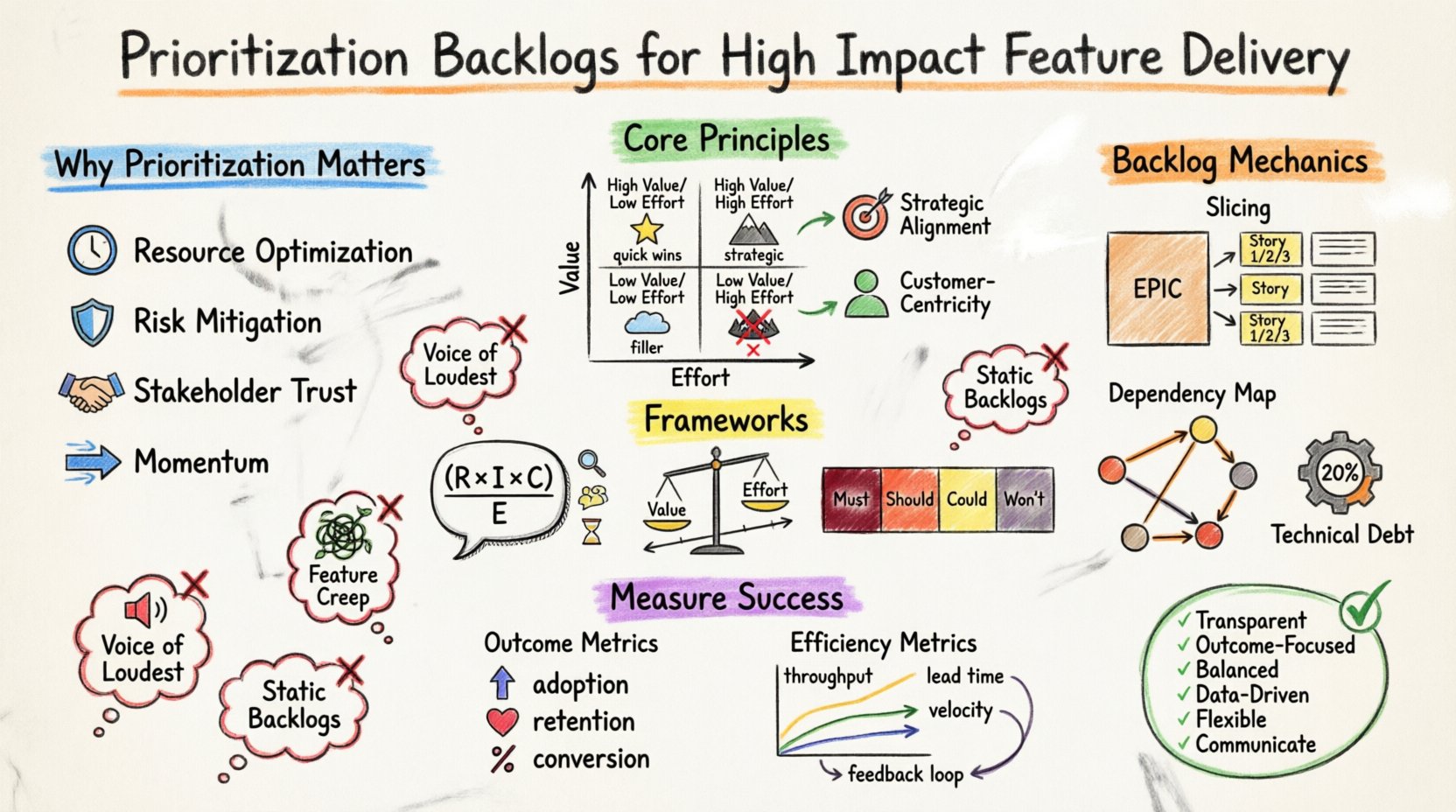
🎯 Why Prioritization Matters in Agile Environments
Agile methodologies emphasize adaptability and customer-centricity. However, without a structured approach to prioritization, adaptability can lead to reactivity. Teams may end up working on whatever request arrived most loudly, rather than what provides the most value.
- Resource Optimization: Development capacity is finite. Prioritization ensures that limited hours and effort are directed toward initiatives that yield the highest return.
- Risk Mitigation: By ordering work strategically, teams can address high-risk or high-dependency items early, reducing the chance of late-stage blockers.
- Stakeholder Trust: When teams consistently deliver high-value features, trust from business leaders and customers increases. This transparency is built on a clear rationale for what is built and what is deferred.
- Momentum and Flow: A well-prioritized backlog reduces context switching. Developers can focus on a coherent set of objectives, maintaining a steady flow of work.
🧠 Core Principles of High Impact Work
To prioritize effectively, one must understand the definition of “impact.” Impact is not merely shipping code; it is about achieving a desired outcome. Several core principles guide the selection of features:
1. Value vs. Effort
This is the foundational matrix of prioritization. Every item in the backlog should be evaluated based on the value it delivers to the customer or business relative to the effort required to build it.
- High Value, Low Effort: These are quick wins. They should be prioritized early to build momentum and demonstrate progress.
- High Value, High Effort: These are major strategic initiatives. They require significant planning and resources but offer the greatest return.
- Low Value, Low Effort: These are filler tasks. They can be completed when capacity allows, but they should not block high-value work.
- Low Value, High Effort: These are traps. They consume resources without delivering meaningful results and should be deprioritized or eliminated.
2. Strategic Alignment
Every feature must tie back to the overarching goals of the organization. If a feature does not support a key business objective or strategic pillar, it belongs in a lower tier of the backlog. This alignment ensures that the team is not just building software, but building a business.
3. Customer-Centricity
The end user is the ultimate judge of value. Prioritization should heavily weigh feedback from actual usage data, support tickets, and direct customer interviews. Internal assumptions must be validated against real-world behavior.
⚖️ Frameworks for Decision Making
While frameworks are tools for thinking, not rigid rules, they provide a common language for discussing trade-offs. Below are three widely used methods for prioritizing backlogs.
RICE Scoring
RICE is a quantitative model that helps compare disparate initiatives on a common scale. It calculates a score based on four factors:
- Reach: How many users will this feature affect in a given period?
- Impact: How much will this improve the experience or outcome for each user? (e.g., Massive, High, Medium, Low, Minimal)
- Confidence: How sure are we about our estimates for Reach and Impact? (e.g., 100%, 80%, 50%)
- Effort: How much time and resources will this require? (e.g., person-weeks)
The formula is typically: (Reach × Impact × Confidence) / Effort. A higher score indicates a better candidate for the backlog.
Weighted Shortest Job First (WSJF)
Often used in larger scale environments, WSJF prioritizes jobs that deliver the most value in the shortest time. It considers:
- Business Value: The total benefit to the customer or organization.
- Time Criticality: How urgent is it to do this now? Does value decay over time?
- Risk Reduction / Opportunity Enablement: Does this job reduce risk or enable future opportunities?
By dividing the total weight of value by the job size, teams can identify which items provide the fastest return on investment.
MoSCoW Method
A simpler, qualitative approach suitable for specific releases or sprints:
- Must Have: Critical for the release. Without these, the product cannot function as intended.
- Should Have: Important but not vital. Can be delayed if necessary.
- Could Have: Desirable but not essential. Nice to have if time permits.
- Won’t Have: Agreed to be excluded for the current cycle.
Comparison of Prioritization Frameworks
| Framework | Best Used For | Complexity | Focus |
|---|---|---|---|
| RICE | Strategic roadmap planning | Medium | Quantitative scoring |
| WSJF | Large scale, multi-team delivery | High | Economic efficiency |
| MoSCoW | Sprint planning, release cuts | Low | Binary necessity |
| Value vs. Effort | Quick team alignment | Low | Relative comparison |
🛠️ The Mechanics of Backlog Refinement
Prioritization is not a one-time event; it is a continuous process. Regular refinement ensures that the backlog remains relevant and ready for execution.
1. Slicing and Dicing
Large epics or initiatives should be broken down into smaller, actionable user stories. This process, known as slicing, allows for more accurate estimation and faster delivery. Small slices reduce risk and provide frequent feedback loops.
2. Dependency Mapping
Features rarely exist in a vacuum. Identifying dependencies between tasks is crucial for sequencing. If Feature A depends on Feature B, Feature B must be prioritized higher to prevent bottlenecks. Dependencies can be internal (within the team) or external (other teams, third-party services).
3. Technical Debt Management
Ignoring technical debt leads to slowed velocity and increased bugs over time. A portion of the backlog must be dedicated to maintenance and refactoring. This is not “waste”; it is infrastructure investment that preserves long-term capacity.
- The 20% Rule: Some teams allocate 20% of capacity to debt reduction in every cycle.
- Refactoring Stories: Treat debt reduction as a story with defined acceptance criteria.
- Definition of Done: Include code quality checks in the completion criteria to prevent new debt.
🤝 Managing Stakeholder Expectations
One of the hardest parts of prioritization is saying no. Stakeholders often feel that their requests are being ignored. Transparency is the antidote to frustration.
1. Visualizing the Trade-offs
Show stakeholders the entire backlog. When they see the volume of work and the constraints of capacity, they understand why some items are deferred. Visual queues help explain that choosing one thing means choosing not to choose another.
2. Regular Syncs
Hold periodic meetings where the backlog is reviewed. This is not a status update meeting, but a strategic alignment meeting. Discuss what is changing in the market and how that shifts priorities. This keeps everyone on the same page regarding the “why” behind the decisions.
3. Data-Driven Conversations
Move the conversation away from opinions. Use data to support prioritization decisions. If a request is based on a single customer, but data shows 90% of users do not need it, use that metric to guide the decision.
📊 Measuring Delivery Success
How do you know if your prioritization strategy is working? You must measure outcomes, not just outputs.
1. Outcome Metrics
- Adoption Rates: Are users actually using the new features?
- Retention: Does the feature keep users coming back?
- Conversion: Does it drive the desired business action?
2. Efficiency Metrics
- Throughput: How many items are completed per cycle?
- Lead Time: How long does it take from idea to production?
- Velocity Trends: Is the team becoming more consistent in delivery?
3. Feedback Loops
Establish mechanisms to gather feedback immediately after release. If a high-priority feature fails to meet expectations, the prioritization logic needs to be re-evaluated. Continuous learning is essential for improving future estimates.
⚠️ Common Pitfalls to Avoid
Even with the best intentions, teams often stumble when managing backlogs. Awareness of these traps can help prevent them.
- Voice of the Loudest: Prioritizing based on who shouts the loudest rather than who provides the most data. Ensure quiet voices are heard through surveys and data.
- Feature Creep: Adding more items to the current sprint without removing others. This leads to burnout and unfinished work.
- Estimation Rigidity: Treating estimates as promises rather than forecasts. Estimates are subject to change as understanding deepens.
- Ignoring Context: Prioritizing features without considering the technical or organizational context. A feature that looks good on paper might be impossible to implement due to legacy constraints.
- Static Backlogs: Treating the backlog as a fixed plan. It must be a living document that evolves with market conditions.
🔄 Continuous Improvement of the Process
The way a team prioritizes today might not work tomorrow. Regularly review the prioritization process itself. Ask the team: “Are we spending too much time arguing? Are we delivering value? Is the backlog clear?”
Adapt the frameworks to fit the team’s maturity. A new team might start with MoSCoW for simplicity, while a mature team might utilize WSJF for complex portfolio management. The goal is always to maximize the return on development effort.
🔑 Summary of Best Practices
- Keep it Transparent: Make the backlog visible to all stakeholders.
- Focus on Outcomes: Prioritize value, not just activity.
- Balance Work: Mix new features with maintenance and debt reduction.
- Use Data: Let metrics guide decisions, not just gut feelings.
- Stay Flexible: Be ready to change priorities as new information emerges.
- Communicate Early: Discuss trade-offs before the work begins.
By implementing these strategies, teams can move from a state of reactive firefighting to proactive value delivery. The backlog becomes a strategic asset, guiding the organization toward its highest impact goals. It is not about doing more things; it is about doing the right things.