
Retrospectives are the heartbeat of an Agile team. They provide a dedicated space to reflect on the past cycle, identify areas for growth, and plan adjustments for the future. However, running the same meeting format repeatedly can lead to stagnation. Teams often find themselves repeating the same phrases without generating actionable change. To foster genuine continuous improvement, it is necessary to introduce variety into the retrospective process.
This guide explores effective retrospective formats designed to uncover hidden issues and drive real team improvement. By selecting the right structure for the right context, teams can maintain engagement and ensure every session yields tangible results.
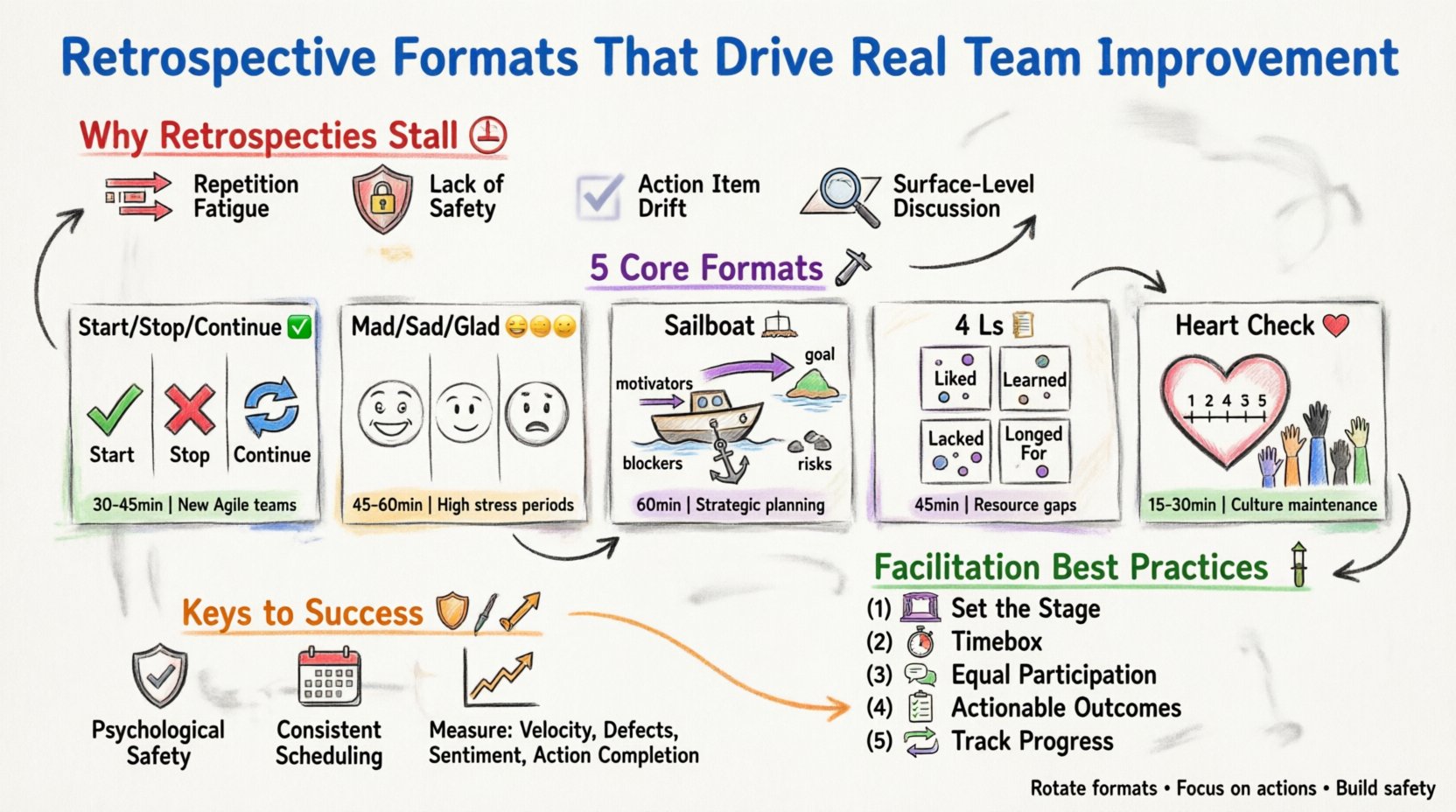
Why Standard Retrospectives Often Stall 🛑
Many teams fall into a pattern where the retrospective becomes a routine check-box exercise. Without a clear focus or a novel approach, participants may feel their input does not lead to meaningful change. This phenomenon often stems from:
- Repetition Fatigue: Using the same board or template every sprint leads to disengagement.
- Lack of Psychological Safety: Team members may hesitate to share honest feedback if the environment feels unsafe.
- Action Item Drift: Identifying problems is easy; solving them is hard. Without a mechanism to track progress, action items fade.
- Surface-Level Discussion: Teams often discuss symptoms rather than root causes.
To counteract these issues, changing the format can reset expectations and stimulate new thinking. Different formats target different aspects of team dynamics, from emotional well-being to process efficiency.
Core Retrospective Formats for Varied Needs 🛠️
Below are detailed formats that can be implemented without specialized software. Each includes steps, benefits, and ideal scenarios.
1. Start, Stop, Continue ✅
This is a classic format that remains effective because of its simplicity. It categorizes feedback into three distinct buckets, forcing the team to consider both positive reinforcement and necessary corrections.
How to Run It
- Start: What new practices or behaviors should the team begin doing?
- Stop: What activities are hindering progress or wasting time?
- Continue: What is working well and should be maintained?
Steps
- Draw three columns on a whiteboard or flip chart.
- Allow 5 minutes for silent writing of sticky notes.
- Group similar notes together.
- Vote on the top three items in each category.
- Discuss the top voted items and assign owners for action.
Best For
- Teams new to Agile processes.
- Situations requiring a quick pivot in workflow.
- When the team needs clear direction on priorities.
2. Mad, Sad, Glad 😠😢😃
This format focuses on the emotional state of the team. It acknowledges that technical issues are often rooted in how people feel. Addressing emotions can prevent burnout and improve collaboration.
How to Run It
- Mad: What frustrated you this sprint?
- Sad: What disappointed you or felt like a loss?
- Glad: What made you happy or proud?
Steps
- Set the three columns.
- Have team members write notes anonymously if needed.
- Read them aloud as a group.
- Focus on the “Mad” and “Sad” items to find solutions, while celebrating the “Glad” items to boost morale.
Best For
- Teams experiencing high stress or conflict.
- Post-major incident reviews.
- Building empathy and understanding among members.
3. The Sailboat 🚢
This visual metaphor helps the team understand their current velocity and the forces affecting their journey. It is excellent for identifying obstacles and motivators.
How to Run It
- Wind: What pushes the team forward (motivation, good tools)?
- Anchor: What holds the team back (bureaucracy, technical debt)?
- Island: What is the goal or destination?
- Rocks: What are the risks or dangers ahead?
Steps
- Draw a boat with a sail and an anchor on the board.
- Label the destination (Island).
- Have members place sticky notes on the relevant parts of the diagram.
- Discuss the “Rocks” first to mitigate risks before planning.
Best For
- Long-term projects with shifting goals.
- Teams needing a strategic overview rather than tactical fixes.
- Visual learners.
4. The 4 Ls (Liked, Learned, Lacked, Longed For) 📝
This format expands the standard reflection to include what the team wishes had existed. It encourages forward-looking thinking.
How to Run It
- Liked: What went well?
- Learned: What new insights were gained?
- Lacked: What was missing (tools, info, support)?
- Longed For: What would the team love to have in the future?
Steps
- Set up four quadrants.
- Use different colored markers for each quadrant.
- Review the “Lacked” and “Longed For” sections to identify resource gaps.
- Convert “Liked” items into standard operating procedures.
Best For
- Teams looking to innovate or adopt new technologies.
- End-of-quarter reviews.
- Identifying training or resource needs.
5. Health Check ❤️
This format is purely focused on the well-being of the team. It is crucial for sustainable velocity and preventing burnout.
How to Run It
- Rate the team’s health on a scale of 1 to 5.
- Discuss factors contributing to the score.
- Identify one specific action to improve the score by one point.
Steps
- Team members vote privately on a score.
- Reveal votes simultaneously.
- If scores vary widely, discuss the discrepancy openly.
- Commit to a specific well-being initiative.
Best For
- Teams showing signs of fatigue.
- Regular check-ins to maintain culture.
- Remote or hybrid teams needing connection.
Comparing Formats at a Glance 📊
| Format | Primary Focus | Duration | Best Scenario |
|---|---|---|---|
| Start, Stop, Continue | Process Efficiency | 30-45 mins | General Sprint Review |
| Mad, Sad, Glad | Emotional State | 45-60 mins | High Stress Periods |
| Sailboat | Strategic Vision | 60 mins | Quarterly Planning |
| 4 Ls | Growth & Resources | 45 mins | Resource Gaps Identified |
| Health Check | Team Well-being | 15-30 mins | Culture Maintenance |
Facilitation Best Practices for Improvement 🎤
Choosing a format is only half the battle. How the meeting is facilitated determines the outcome. A skilled facilitator ensures that the conversation remains productive and focused on improvement.
1. Set the Stage Clearly
Begin by stating the purpose of the session. Remind the team that the goal is improvement, not blame. Establish ground rules such as “one conversation at a time” and “focus on the process, not the person.”
2. Use Timeboxing
Agile relies on time constraints to maintain focus. Assign strict time limits to each activity within the retrospective. This prevents endless debate on a single point and forces prioritization.
3. Ensure Equal Participation
Not everyone speaks up naturally. Use techniques like silent writing or round-robin sharing to ensure quieter voices are heard. This leads to a more comprehensive view of the team’s reality.
4. Focus on Actionable Outcomes
A retrospective without action items is merely a complaint session. Every identified issue should result in a specific task. Assign an owner and a deadline for each action item.
5. Track Progress
At the start of the next retrospective, review the action items from the previous session. Did they get done? If not, why? This accountability loop is critical for driving real change.
Common Pitfalls to Avoid 🚧
Even with the right format, teams can stumble. Being aware of common traps helps in navigating them.
- Blame Games: If the team starts pointing fingers, the facilitator must intervene immediately. Redirect the conversation to systemic issues rather than individual errors.
- Ignoring Small Wins: Focusing only on problems demoralizes the team. Ensure positive feedback is recorded and celebrated equally.
- Skipping Follow-Up: If action items are not tracked, trust in the process erodes. Make sure the next meeting starts with a review of past commitments.
- Using the Wrong Format: Do not use a strategic format like the Sailboat for a tactical bug-fix review. Match the format to the current team need.
Building Psychological Safety 🛡️
The foundation of any successful retrospective is psychological safety. Team members must feel safe to admit mistakes without fear of punishment. Without this safety, the “Mad, Sad, Glad” or “4 Ls” formats will yield superficial results.
Strategies to Build Safety
- Leader Vulnerability: Leaders should admit their own mistakes first. This signals that honesty is valued.
- Anonymous Inputs: Allow members to submit notes anonymously during the initial brainstorming phase.
- Separate People from Problems: Frame issues as “the process failed” rather than “John failed.”
- Consistent Follow-Through: When the team sees that their feedback leads to change, they are more likely to speak up again.
Integrating Retrospectives into the Workflow ⏱️
Retrospectives should not feel like an extra burden. They are an investment in efficiency. To integrate them smoothly:
- Reserve the Time: Block the time on the calendar as a recurring event. Do not cancel it unless there is an emergency.
- Keep it Consistent: Run it at the same time and place (virtual or physical) each sprint. Consistency builds a habit.
- Rotate Facilitation: Allow different team members to lead the session. This distributes ownership and develops leadership skills across the team.
Measuring Success Without Hype 📈
How do you know if the retrospective is driving improvement? Look for tangible shifts in the team’s output and sentiment.
- Velocity Stability: Does the team maintain a more consistent flow of work?
- Reduced Defects: Are fewer bugs making it to production due to process changes?
- Team Sentiment: Are members reporting higher satisfaction in health checks?
- Action Completion: Is the team completing the action items they commit to?
Success is not about a perfect meeting. It is about the cumulative effect of small, consistent improvements over time. By rotating through these formats and maintaining a focus on action, teams can create a culture of continuous improvement.