
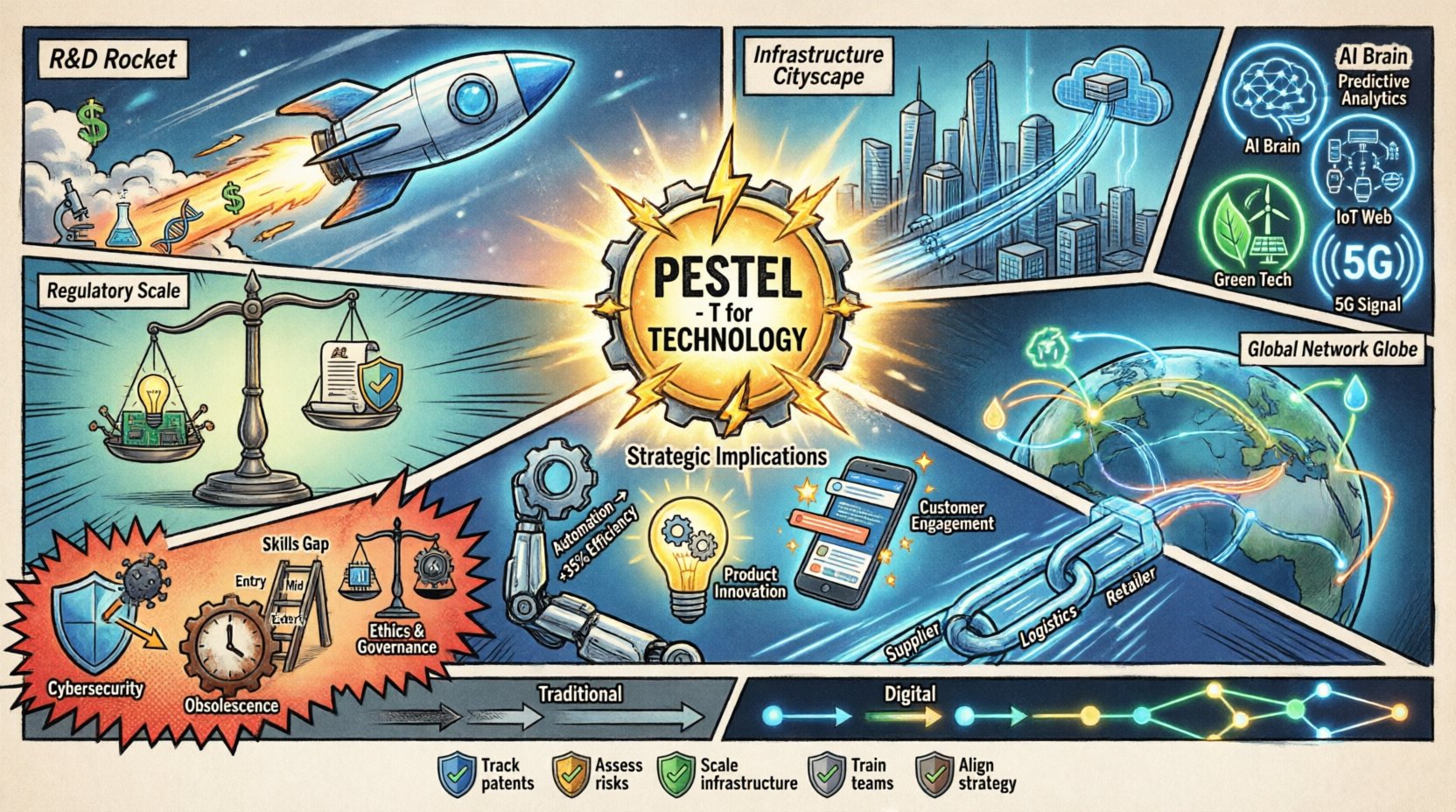
Business environments are dynamic, shaped by forces that exist outside the control of any single organization. To navigate these complexities, leaders rely on structured analytical models. One of the most robust frameworks available is PESTEL. While Political, Economic, Social, and Environmental factors often dominate discussions, the Technological component is increasingly becoming the most volatile and influential element in strategic planning. Understanding technological factors in PESTEL analysis is essential for maintaining competitive advantage.
This article provides a comprehensive examination of how technology shapes the external business landscape. We will explore the specific drivers, the operational impacts, the inherent risks, and the methods for integrating these insights into long-term strategy. The goal is to provide a clear, actionable understanding of the digital ecosystem without relying on hype.
Defining Technological Factors in Business Analysis 🧭
When analyzing the external environment, the “T” in PESTEL refers to the broader context of technological innovation and infrastructure. This is not limited to the software or hardware a specific company uses. Instead, it encompasses the macro-level shifts that affect how industries function. These factors dictate the pace of change, the cost of operations, and the potential for new market entry.
Key elements include:
- Rate of Technological Change: How quickly do innovations become obsolete?
- Innovation Level: Is the industry ripe for disruption?
- Automation: To what extent can processes be mechanized?
- Research & Development (R&D): What is the level of investment in new solutions?
- Connectivity: How well are systems linked across the supply chain?
These elements determine the threshold for entry into a market. High technological requirements often act as a barrier to entry, protecting established players. Conversely, rapid technological shifts can dismantle these barriers, allowing new competitors to emerge overnight.
Core Drivers of Technological Change ⚙️
Several underlying forces drive the technological landscape. Recognizing these drivers helps organizations anticipate shifts rather than react to them. These drivers are interconnected, often amplifying each other’s effects.
1. Research and Development Investment
Public and private spending on R&D is a primary indicator of future technological capability. High investment sectors, such as biotechnology or renewable energy, typically see rapid evolution. When funding flows into research, the time from concept to commercialization shortens. Organizations must monitor government grants and private venture capital flows to understand where innovation is heading.
2. Infrastructure Development
Technology requires a foundation. This includes physical infrastructure like fiber optic networks, data centers, and power grids. It also includes digital infrastructure like cloud computing platforms and internet protocols. Weak infrastructure can stifle growth in developing markets, while robust infrastructure accelerates adoption in mature ones.
3. Regulatory Environment
Government policies regarding data privacy, intellectual property, and cybersecurity directly influence technological adoption. Stricter regulations can slow down innovation but increase trust. Looser regulations might speed up deployment but introduce higher risk. Understanding the legal framework is a critical part of the technological assessment.
4. Globalization of Knowledge
Information flows freely across borders. Innovations developed in one region can be implemented in another almost instantly. This global connectivity means that a breakthrough in one location creates immediate pressure on competitors worldwide. It reduces the advantage of geographical isolation.
Strategic Implications for Organizations 🏢
Once identified, technological factors must be translated into strategic actions. Ignoring these factors leads to obsolescence. Integrating them leads to resilience and growth.
Operational Efficiency
Automation and process optimization tools allow companies to reduce waste and improve speed. By analyzing the technological landscape, firms can identify areas where manual labor can be replaced with automated systems. This reduces long-term costs and minimizes human error. However, it also requires a workforce capable of managing these systems.
Product Development
Technology influences what products are possible. New materials, manufacturing techniques, and digital integrations change the value proposition of goods. Companies that align their product roadmaps with emerging technologies can capture new market segments. Those that fail to adapt risk selling outdated solutions.
Customer Engagement
The way customers interact with businesses has shifted. Digital channels provide data on preferences and behaviors. Leveraging this data allows for personalized experiences. It also changes the expectation of service speed and accessibility. Organizations must meet these expectations to retain customers.
Supply Chain Management
Technology enables real-time tracking and transparency. Blockchain and IoT sensors can verify the origin and condition of goods. This reduces fraud and improves logistics efficiency. A robust technological supply chain is more resilient to disruptions than a traditional one.
Emerging Risks and Mitigation Strategies 🛡️
Technology is not purely beneficial. It introduces significant risks that must be managed. A thorough PESTEL analysis must weigh the opportunities against these threats.
- Cybersecurity Threats: As connectivity increases, the attack surface expands. Data breaches can destroy reputation and incur heavy fines. Mitigation involves investing in security protocols and employee training.
- Technological Obsolescence: Capital invested in current technology may become worthless quickly. Organizations must plan for regular upgrades and avoid over-committing to single proprietary systems.
- Skills Gap: New technology requires new skills. If the workforce cannot adapt, the technology cannot be utilized effectively. Continuous learning programs are necessary.
- Ethical Concerns: Automation can lead to job displacement. Artificial intelligence raises questions about bias and decision-making. Organizations must navigate these ethical considerations to maintain social license to operate.
Future Outlook and Continuous Monitoring 🔮
The technological landscape is not static. Trends shift rapidly. What is cutting-edge today may be standard practice tomorrow. Continuous monitoring is required to keep the PESTEL analysis relevant.
Key Trends to Watch
- Artificial Intelligence: Moving beyond automation to predictive analytics and decision support.
- Internet of Things (IoT): Connecting physical objects to the internet for data collection and control.
- Green Technology: Innovations focused on sustainability and energy efficiency.
- 5G and Beyond: Faster connectivity enabling new applications in remote areas.
Integration Checklist
To ensure technological factors are properly integrated into strategy, leaders should ask:
- Are we tracking relevant industry news and patent filings?
- Do we have a dedicated team to assess technological risks?
- Is our infrastructure scalable for future growth?
- Are we investing in employee training for new tools?
- How does our technology strategy align with our overall business goals?
Comparison: Traditional vs. Digital Environments 📊
Understanding the shift from traditional models to digital-first models helps contextualize the importance of this factor. The table below highlights key differences.
| Feature | Traditional Environment | Digital Environment |
|---|---|---|
| Information Flow | Linear, slow, siloed | Networked, instant, integrated |
| Customer Interaction | Face-to-face, periodic | 24/7, data-driven, personalized |
| Barriers to Entry | Capital intensive | Knowledge and agility intensive |
| Product Lifecycle | Long, stable | Short, iterative |
| Innovation Source | Internal R&D | Internal and External (Open Innovation) |
Final Considerations for Strategic Planning
Conducting a thorough analysis of technological factors requires more than just listing current tools. It demands a forward-looking perspective. Leaders must consider how external technological shifts will alter the competitive landscape over the next five to ten years.
Success lies in balance. Over-investing in technology without a clear business case wastes resources. Under-investing leads to vulnerability. The PESTEL framework serves as a structured way to evaluate this balance.
By systematically evaluating the technological environment, organizations can make informed decisions. They can allocate capital wisely, manage risks proactively, and position themselves to capitalize on emerging opportunities. The technology sector is no longer a support function; it is a central pillar of business strategy.
Staying informed is a continuous process. It requires regular updates to the analysis and a willingness to pivot when the environment changes. Those who treat technology as a fixed variable will find themselves left behind. Those who treat it as a dynamic force will find it shapes their future.
The integration of technological insights into strategic planning ensures that organizations remain relevant. It transforms external uncertainty into manageable variables. This deep dive into PESTEL’s technological component provides the foundation for that transformation.