Creating a Professional Resume in Minutes with AI-Powered Site Builder

Discover how Visual Paradigm’s AI-powered site builder creates professional resumes in seconds from simple text prompts.

Visual Paradigm’s AI-Powered Site Builder is revolutionizing the way professionals create their online presence, from landing pages to comprehensive portfolios. The tool’s core strength lies in its ability to transform a simple text prompt into a fully designed, multi-section website in seconds. This capability is vividly demonstrated in the provided image, which showcases a professional resume generated from the prompt “Resume for a senior marketing manager with 10 years experience.” The result is a polished, modern digital profile for “Alex Johnson,” complete with a professional headshot, a compelling summary, contact information, and a section for skills and expertise. This is not just a template; it is a dynamic, AI-generated webpage that can be customized and published instantly. For professionals seeking a modern, professional online identity, this AI-powered site builder offers a powerful solution that eliminates the traditional barriers of design and development.

At the heart of this transformation is the AI Generator, a feature that allows users to define their website’s purpose with a simple text description. The user inputs a clear prompt, and the AI instantly constructs a complete page layout. The generated content, as seen in the image, is not generic; it is tailored to the specific role and experience level mentioned in the prompt. This intelligent approach ensures that the initial draft is highly relevant, providing a strong foundation for further personalization. The process is intuitive and efficient, allowing users to focus on refining their content rather than struggling with the mechanics of design. This powerful combination of AI and a visual, block-based editor makes the creation of professional websites accessible to anyone, regardless of their technical skills.

This is a screenshot of Visual Paradigm's AI-Powered Site Builder. It shows the web page generated from the prompt 'Resume fo

How the AI-Powered Site Builder Works

The process of creating a website with the AI-Powered Site Builder is designed to be as simple as possible, leveraging the power of artificial intelligence to handle the most complex part of the process: the initial design. The workflow begins with the user defining their goal in a text box. The AI then analyzes this prompt and generates a complete, multi-section webpage. This is not a simple template; the AI understands the context and creates a layout that is appropriate for the content. For instance, a resume prompt generates a page with a professional header, a profile section, a detailed bio, and a skills section, all arranged in a visually appealing and logical manner. This eliminates the “blank page” problem that often hinders the creative process.

From Prompt to Publication: A Seamless Workflow

Once the AI has generated the initial design, the user is presented with a fully interactive, visual editor. The interface, as seen in the image, features a central canvas where the website is displayed and a sidebar with tools and options. The user can then begin to customize the site. Clicking on any element, such as the “Senior Marketing Manager” title or the “Results-driven marketing professional” text, opens a properties panel. This panel allows for direct editing of the text, uploading of images, and adjustment of styles. This “what you see is what you get” (WYSIWYG) experience ensures that changes are immediate and visible. The user can then add more blocks, such as a “Skills & Expertise” section or a “Contact” form, by dragging and dropping them from the sidebar. The entire process is designed to be intuitive and efficient, allowing users to build a professional website in minutes.

Key Benefits of the AI-Powered Site Builder

The AI-Powered Site Builder offers several significant advantages for users who need a professional website quickly and easily. The most prominent benefit is speed. Instead of spending hours or days designing a site from scratch, users can go from a simple idea to a fully designed, functional website in a matter of minutes. This is made possible by the AI’s ability to generate a complete layout and content based on a single prompt. This efficiency is particularly valuable for professionals who need to update their online presence frequently or for businesses that require new landing pages for marketing campaigns.

Accessibility and Professionalism

Another major benefit is accessibility. The tool requires no coding knowledge, making it accessible to a broad audience. The visual, block-based editor allows users to build complex pages by simply dragging and dropping pre-designed components, such as hero sections, galleries, and pricing tables. This approach democratizes web design, empowering entrepreneurs, freelancers, and small business owners to create professional websites without hiring a developer. The AI-generated content is also built on modern design principles, ensuring that the final product looks polished and professional right out of the box. Users can then customize the site to perfectly match their brand and personal style, giving them full control over the final outcome.

Practical Applications and Use Cases

The versatility of the AI-Powered Site Builder makes it suitable for a wide range of applications. The image of the resume demonstrates one powerful use case: creating a professional online profile for a job seeker. This tool is ideal for anyone looking to build a personal portfolio, a business website, or a marketing landing page. For example, a freelance graphic designer could use the tool to create a portfolio site showcasing their best work. A startup founder could generate a landing page for a new product launch. A small business owner could build a simple website to attract local customers. The AI generator can be prompted with a description of the desired site, and it will create a tailored layout. The user then has the freedom to customize every detail, from the text and images to the color scheme and overall structure.

Creating a Multi-Page Website

While the image shows a single-page resume, the tool’s capabilities extend beyond a single page. Users can create multi-page websites by adding new pages to their project. For instance, a professional might create a main “Home” page with a resume and a separate “About” page with a detailed biography. The “Pages” tab in the sidebar allows users to manage all pages within a single project, making it easy to structure a complete website. This feature is essential for creating a comprehensive online presence that can guide visitors through a narrative, from a brief introduction to a detailed portfolio.

Conclusion

The AI-Powered Site Builder from Visual Paradigm represents a significant leap forward in website creation. It empowers users to generate professional, responsive websites quickly and easily, without requiring any technical skills. The tool’s ability to transform a simple text prompt into a fully designed, multi-section webpage is a testament to the power of AI in simplifying complex tasks. The example of the senior marketing manager’s resume demonstrates the tool’s effectiveness in creating a polished and professional digital profile. For anyone looking to establish a strong online presence, this tool offers a fast, efficient, and accessible solution.

Ready to create your own professional website? Try the AI-Powered Site Builder today and see how quickly you can turn your ideas into a live, professional website.

Try Now

Related Links

Optimizing Employee Engagement Platform Rollouts with Visual Paradigm’s AI-Powered Stakeholder Management Tool

Optimize employee engagement platform rollouts using Visual Paradigm’s AI tool. A 7-step guide to stakeholder management and organizational change.

Successful organizational change, such as the implementation of a company-wide digital engagement platform, depends less on the technology itself and more on the human dynamics surrounding it. Utilizing a professional stakeholder management software is no longer optional for project leaders who aim to minimize resistance and maximize adoption. Visual Paradigm’s AI-powered stakeholder management tool offers a systematic, 7-step methodology to navigate these complex interpersonal landscapes. By automating the identification and analysis phases, project managers can move from abstract concepts to actionable engagement strategies in a matter of minutes, ensuring that every individual—from executive sponsors to union representatives—is appropriately managed.

The process begins with the contextualization of the project. Within the interface, the user defines the scope, objectives, and specific nuances of the initiative. For instance, in an “Employee Engagement Platform Rollout,” the tool prompts the user to describe the platform’s features, such as surveys and recognition tools, and the necessity for change management support. This initial input serves as the foundational data for the artificial intelligence to generate a tailored management plan.

This is the screenshot of Visual Paradigm's AI-Powered Stakeholder Management Tool. It is now at AI generation screen, where

A Structured Approach to Project Governance

Precision in project documentation is the hallmark of a disciplined manager. The first step of the workflow, the Project Overview, ensures that all foundational data is captured before moving into complex analysis. This step records the project name, the objective, and the designated manager, providing a clear reference point for all subsequent strategic decisions. It is essential to establish these parameters early to maintain alignment throughout the project lifecycle.

This is the screenshot of Visual Paradigm's AI-Powered Stakeholder Management Tool. The initial data is generated by AI and i

Key Takeaways for Effective Stakeholder Management

  • Systematic 7-Step Workflow: Guides users from initial identification through to execution and final reporting.

  • AI-Driven Strategy Generation: Quickly produces a comprehensive draft of stakeholders, interests, and engagement levels based on project context.

  • Privacy-Centric Data Handling: All project data is saved locally as .json files, ensuring sensitive organizational information remains off the cloud.

  • Dynamic Communication Planning: Facilitates the creation of tailored messaging schedules and risk mitigation strategies.

  • Professional Reporting: Generates a consolidated summary suitable for executive review and team alignment.

Identifying and Categorizing the Human Element

Once the project parameters are set, the next critical phase is Stakeholder Identification. This step involves listing every individual or group that may affect or be affected by the initiative. In the context of an engagement platform, this includes roles such as the Chief Human Resources Officer, the Director of Operations, and Department Heads. An easy-to-use stakeholder management app must allow for detailed profiling, including contact information and specific notes regarding each person’s unique perspective or concerns.

This is the screenshot of Visual Paradigm's AI-Powered Stakeholder Management Tool. It is now at step 2 - Professional online

Identification alone is insufficient; one must apply a rigorous Stakeholder Analysis to prioritize engagement efforts. This is typically achieved by evaluating two primary variables: Power (Influence) and Interest. Stakeholders with high power and high interest, such as the Head of IT or the CHRO, require “close management,” whereas those with lower influence may simply need to be “kept satisfied” or “informed.” This categorization ensures that limited communication resources are allocated where they will have the most significant impact on project success.

This is the screenshot of Visual Paradigm's AI-Powered Stakeholder Management Tool. It is now at step 3 - Professional online

Strategic Engagement and Risk Mitigation

With the analysis complete, the focus shifts to the Stakeholder Engagement Plan. This is where strategic intent is converted into a tactical communication plan. Each stakeholder is assigned a specific communication objective, a preferred method (such as quarterly reviews or town halls), and a frequency. This level of detail prevents communication gaps that often lead to project delays. For example, a Technical Status Update might be scheduled weekly for the IT department to ensure platform stability, while a broader Town Hall might occur quarterly for the general employee population.

This is the screenshot of Visual Paradigm's AI-Powered Stakeholder Management Tool. It is now at the upper part of step 4 - P

Furthermore, a proactive approach requires the identification of potential risks and the development of mitigation strategies. Resistance is a natural byproduct of change; however, it can be managed. If the AI identifies a risk such as “employee backlash over data usage,” the tool allows the manager to document a specific mitigation strategy, such as publishing transparency reports or clearly communicating data privacy policies. This forward-thinking approach is what distinguishes a professional stakeholder management software from a simple spreadsheet.

This is the screenshot of Visual Paradigm's AI-Powered Stakeholder Management Tool. It is now at the lower part of step 4 - P

Tracking Execution and Ensuring Accountability

Strategy remains theoretical until it is executed. The Engagement Execution step serves as a ledger for all interactions. By logging the date, the stakeholder involved, the action taken, and the resulting outcome, project managers maintain a transparent audit trail of their engagement efforts. This historical record is invaluable for adjusting strategies mid-project if a particular stakeholder’s sentiment shifts or if unexpected obstacles arise during the rollout.

This is the screenshot of Visual Paradigm's AI-Powered Stakeholder Management Tool. It is now at step 5 - Professional online

To ensure that these tasks are not merely recorded but effectively managed, the tool includes an Appendices section featuring a RACI matrix (Responsible, Accountable, Consulted, Informed). In the rollout of an engagement platform, it is vital to know exactly who is “Accountable” for finalizing platform requirements versus who merely needs to be “Informed” of the pilot program launch. Defining these roles eliminates ambiguity and prevents the “diffusion of responsibility” that often plagues large-scale corporate initiatives.

This is the screenshot of Visual Paradigm's AI-Powered Stakeholder Management Tool. It is now at step 6 - Professional online

Consolidating Intelligence into a Final Report

The culmination of this 7-step process is the Final Report. This document consolidates every identification, analysis, communication schedule, and execution log into a professional, easy-to-read format. It serves as the definitive source of truth for the project’s stakeholder strategy. Because this best online stakeholder management app prioritizes data sovereignty, the final report can be printed or saved as a PDF from your browser, while the underlying data remains securely stored on your local machine.

This is the screenshot of Visual Paradigm's AI-Powered Stakeholder Management Tool. It is now at step 7. A report is produced

In summary, navigating the complexities of organizational change requires more than just intuition; it requires a structured methodology supported by intelligent tools. Visual Paradigm’s AI-powered stakeholder management tool streamlines the most labor-intensive aspects of project governance, allowing leaders to focus on what truly matters: building relationships and driving results. By following a guided 7-step workflow, you ensure that no stakeholder is overlooked and every risk is addressed before it becomes a crisis.

Ready to Master Your Stakeholder Relationships?

Effective management begins with the right framework. Whether you are a project manager, a business analyst, or a change leader, the ability to rapidly generate and execute a stakeholder engagement plan is a critical competency. We invite you to experience the efficiency of an AI-driven approach firsthand.

To begin your project:

  1. Access the tool via the Try Now link below.

  2. Enter your project name and objective in the “Project Overview.”

  3. Use the “Generate with AI” feature to produce your initial identification and analysis.

  4. Refine the data and save your progress locally to maintain full privacy.

Learn more about the methodology: Visual Paradigm Stakeholder Management Guide

Start your project today: Try the AI-Powered Stakeholder Management Tool Now

Related Links

From Concept to Live Site: A Comprehensive Guide to AI Website Builders

The evolution of web development has reached a pivotal moment where the barrier to entry for creating professional digital presence has virtually vanished. Modern AI-powered builders have redefined the workflow, shifting the focus from code syntax to creative vision. This guide explores the sophisticated process behind AI website generation, detailing how raw concepts are transformed into fully hosted, responsive websites through a streamlined, four-stage workflow.

AI-Powered website builder

1. The Power of Natural Language Generation

The traditional starting point of web design—a blank canvas and a cursor—has been replaced by an intelligent conversational interface. The process initiates with a single natural language description. Users input a brief overview of their business, brand vision, or project goals, and the AI engine interprets this semantic data to construct a foundational architecture.

Generating a website using Visual Paradigm's AI Powered Website Builder

Instead of manually selecting templates, the AI performs several complex tasks simultaneously:

  • Custom Layout Design: The system analyzes the industry context implies by the prompt to apply appropriate aesthetics, handling technical design elements such as typography, color theory, and whitespace management automatically.
  • Structural Generation: In a single iteration, the AI creates a multi-page hierarchy, populating the site with essential sections such as “About,” “Services,” and “Contact” pages tailored to the user’s specific domain.
  • Contextual Content Creation: Advanced Large Language Models (LLMs) draft human-like copy and compelling headlines, effectively eliminating “writer’s block” by providing immediate, brand-relevant text.
  • Visual Asset Selection: The engine queries asset libraries to select and insert high-quality imagery that aligns with the context of the user’s description.
  • Drag and drop-website creator

2. The “Digital LEGO” Customization Phase

While the AI creates the initial 90% of the website, the remaining 10% is reserved for specific brand alignment and user preference. This phase utilizes a No-Code Interface that empowers users to refine the AI-generated output without requiring knowledge of HTML, CSS, or JavaScript. The interface operates on a “what you see is what you get” (WYSIWYG) principle.

Block-Based Modular Editing

The editor functions similarly to digital building blocks. Users can manipulate the layout using a drag-and-drop mechanism, rearranging pre-designed components—such as Hero headers, image galleries, and pricing tables—with the ease of assembling LEGO bricks. This modular approach ensures that design consistency is maintained even when sections are moved.

AI-Assisted Content Refinement

To further streamline the editing process, a “Magic Wand” tool is integrated directly into the text editor. This allows users to instantly iterate on the AI’s initial draft. With a click, text can be shortened, elaborated upon, or shifted in tone (e.g., from formal to casual), ensuring the voice of the website matches the brand identity perfectly.

3. Pre-Launch Quality Assurance

Before a website becomes public, it must undergo rigorous checks to ensure functionality and visual integrity across devices. The AI builder automates much of this Quality Assurance (QA) phase to prevent common deployment errors.

Key features of this stage include:

  • Responsive View Toggles: Users can instantly switch the editor viewport between desktop, tablet, and mobile configurations. This ensures that the layout responds correctly to different screen sizes and that user experience (UX) remains consistent for all visitors.
  • Intelligent Checklists: A “Ready to Publish” guide acts as an automated project manager, scanning the site for missing links, placeholder text, or incomplete sections, effectively preventing premature launches.

4. Frictionless Deployment and Hosting

The final hurdle in traditional web development—server management and DNS configuration—is completely abstracted in this workflow. The system offers a one-click solution that bridges the gap between the editor and the live web.

Immediate Infrastructure Access

Upon clicking publish, the static assets and content are pushed to high-speed servers. This eliminates the need for users to configure external hosting providers or manage FTP credentials. The result is immediate availability via a unique, shareable URL (e.g., yourname.visual-paradigm.com/sitename).

Iterative Updates

The platform supports a continuous delivery model. Users can continue to experiment with new layouts or content updates in the editor without affecting the live site. Once changes are finalized, the “Re-publish” feature instantly syncs the new version to the live URL, ensuring controlled and risk-free updates.

Summary

Utilizing an AI website builder is comparable to using a GPS for a road trip. In the past, travelers had to map out every turn, monitor the engine, and navigate manually. Today, you simply input the destination. The system handles the complex navigation, routing, and mechanics, leaving the user with the sole task of enjoying the journey and selecting the scenic stops along the way.

Posted on Categories AI

A Comprehensive Guide to Visual Paradigm’s Hybrid Database Engineering Ecosystem

Visual Paradigm offers a unified database engineering ecosystem designed to bridge the gap between abstract business requirements and production-ready implementation. By combining traditional technical rigor with the speed of generative AI, the platform accelerates development while ensuring strict data integrity. This guide explores how these distinct feature sets work in tandem to optimize the database lifecycle.

1. AI-Powered Features: The Innovation Hub

The AI capabilities within Visual Paradigm are engineered to eliminate “blank canvas” syndrome and manage the complex logic inherent in database design. These tools serve as the creative engine of the ecosystem.

Instant Text-to-ERD Generation

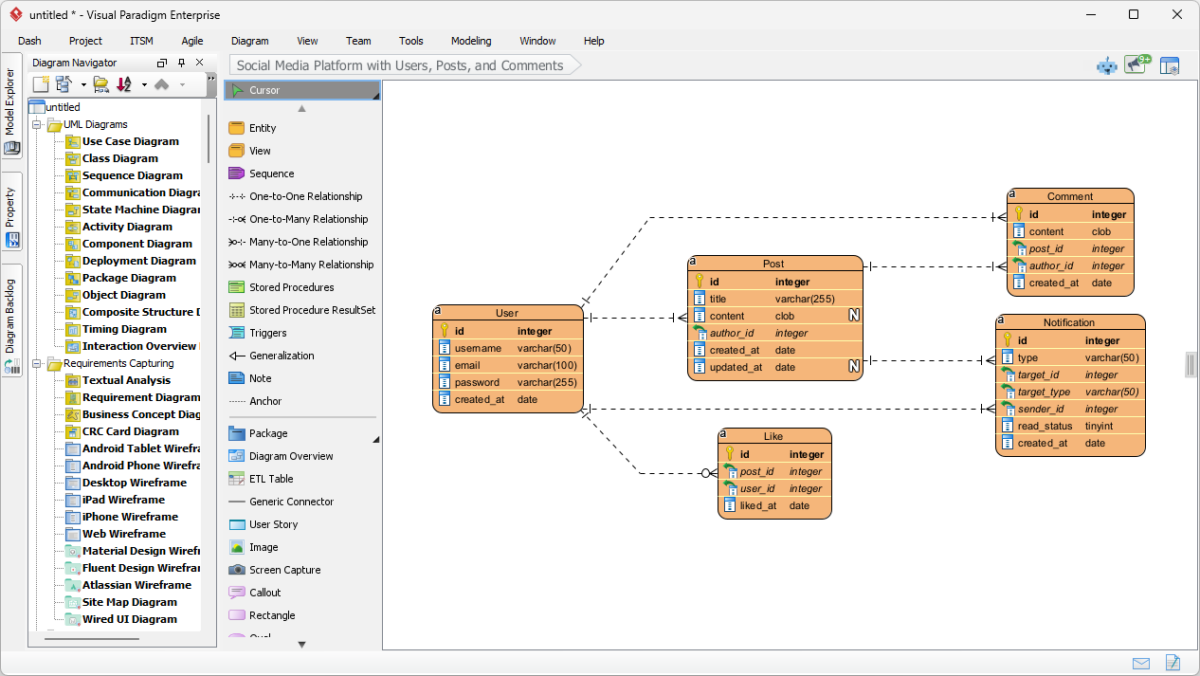
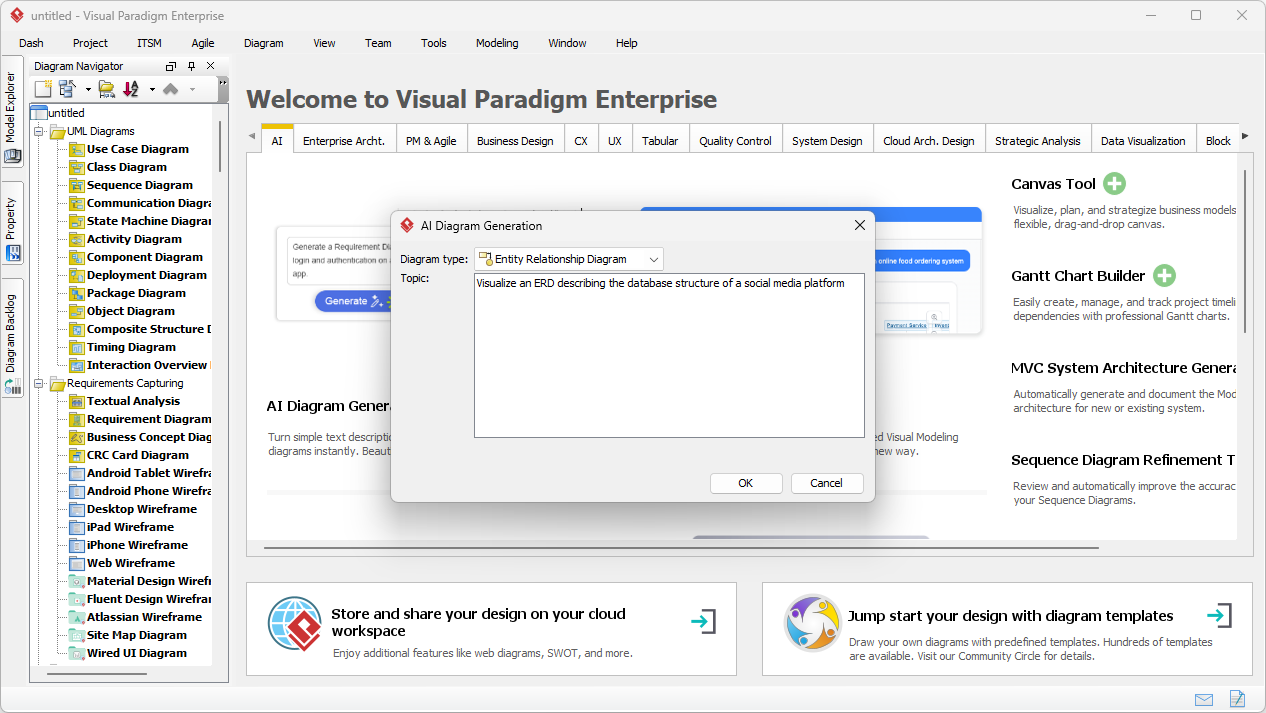
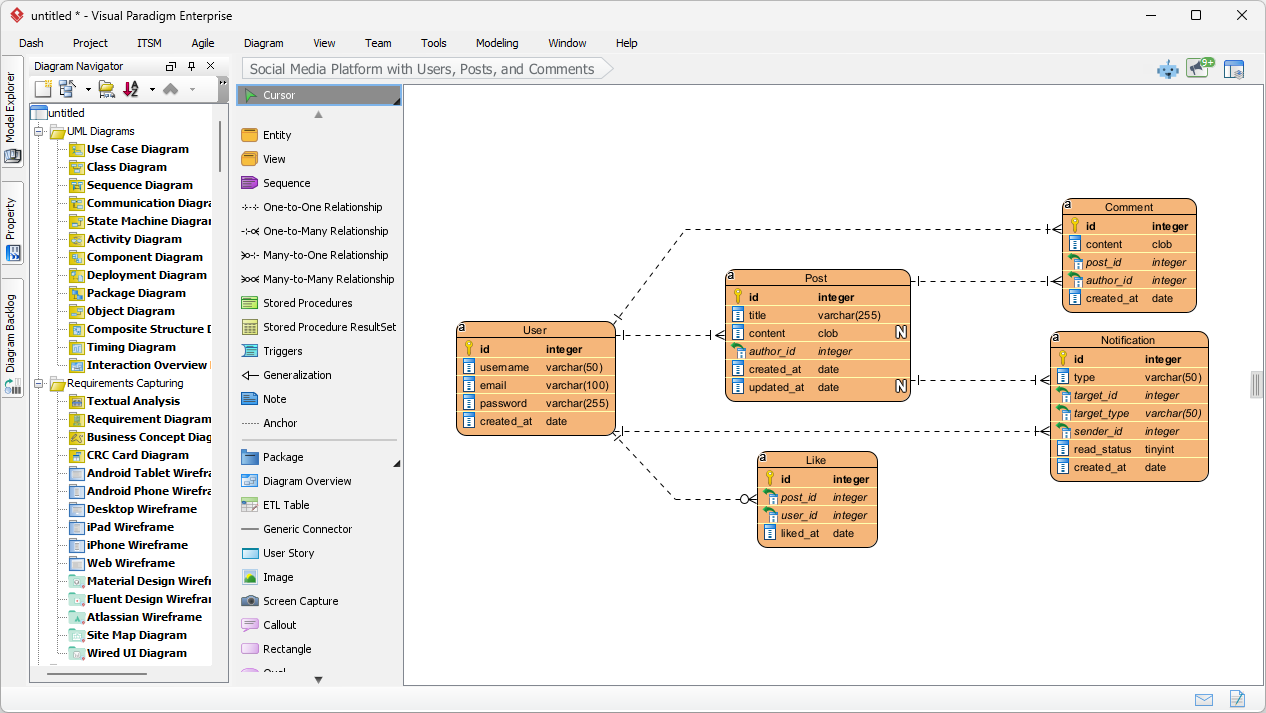
One of the most immediate benefits of the AI suite is the ability to bypass manual drawing tools during the ideation phase. Users can describe data requirements in plain English, and the AI Diagram Generator instantly produces a structurally sound Entity-Relationship Diagram (ERD). This generation includes relevant entities, attributes, and relationships, providing an immediate starting point for development.

The 7-Step DB Modeler Journey

For a more structured approach, the specialized web application guides users through a comprehensive lifecycle. This process ensures no step is overlooked:

  • Problem Input: Users input requirements using natural language.
  • Domain Model: The AI generates a conceptual view.
  • ER Diagram: The model evolves into logical and physical representations.
  • Schema Generation: The system produces PostgreSQL DDL automatically.
  • Intelligent Normalization: The structure is optimized for data integrity.
  • Live Testing: Users can validate the design immediately.
  • Final Documentation: Comprehensive records are generated for stakeholders.

Intelligent Normalization

A critical feature for database efficiency is the AI’s ability to automate the progression from First Normal Form (1NF) to Third Normal Form (3NF). This process optimizes the schema to eliminate redundancy. Unlike static validation tools, the AI provides educational rationales for every structural change, helping designers understand the “why” behind best practices.

Conversational Co-Pilot and Interactive Playground

Available in both cloud and desktop environments, the Conversational Co-Pilot allows for conversational editing. Users can refine diagrams with commands such as “Add payment gateway” or ask analytical questions about use cases. Furthermore, once a schema is generated, the Interactive SQL Playground seeds a live, in-browser database with realistic sample data. This allows developers to validate queries and performance before deployment without requiring local installation.

2. Traditional Database Engineering: The Foundation

While AI accelerates creation, the traditional features of Visual Paradigm provide the “deep engineering” tools required to maintain and deploy enterprise-grade systems.

Multi-Level ERD Architecture

Visual Paradigm supports three stages of architectural maturity to satisfy different stakeholders:

  • Conceptual: Focuses on high-level business objects.
  • Logical: Defines columns and relationships independent of a specific DBMS.
  • Physical: detailed technical blueprints tailored for specific DBMS platforms like MySQL or Oracle.

Model Transitor & Traceability

To prevent disjointed documentation, the Model Transitor tool maintains automatic synchronization and traceability between conceptual, logical, and physical models. This ensures that changes made in the high-level business view are accurately reflected in the technical implementation, preventing scope creep and implementation errors.

Round-Trip Engineering

The platform excels in keeping the model and the actual database in sync through robust engineering cycles:

  • Forward Engineering: Generates initialization and patch scripts (DDL) to create or update database schemas while preserving existing data.
  • Reverse Engineering: Imports existing legacy databases via JDBC or DDL files directly into visual ERDs for analysis and revision.

Advanced Management Tools

For complex implementations, the platform supports specialized database elements including Stored Procedures, Triggers, and Database Views. It also includes Table Record Editors for manual entry of specific sample data.

3. The Synergy: How They Work Together

The true power of Visual Paradigm lies in the seamless integration of these two worlds, moving effectively from a “sketch” to a “system”.

Prototyping to Production

The workflow typically begins with the AI Chatbot or DB Modeler providing a rapid prototype from textual ideas. The user then imports this model into the Desktop environment to perform heavy-duty engineering tasks, such as generating Hibernate ORM code or synchronizing the database design with UML Class Diagrams.

Automation Meets Control

AI handles the “heavy lifting” of layout via the Smart Sweeper and normalization logic. Concurrently, traditional tools allow for inline shape editing and fine-grained control over specific data types, lengths, and constraints, ensuring the final product meets exact specifications.

Unified Workspace

Users with a desktop license and an active maintenance plan benefit from hybrid access. This allows cloud-based AI applications to be launched directly within the desktop interface, ensuring that visual designs, AI-generated insights, and physical database code stay in perfect synchronization.

Analogy for Understanding

To visualize this ecosystem, think of building a high-performance database like manufacturing a custom car in an automated factory. The AI acts as the intelligent design assistant that takes your verbal description to draw the initial sketch and calculate the most efficient engine tuning (normalization). The traditional features represent the mechanical engineering floor, providing the heavy machinery to build the actual engine, test stress loads, and manufacture the final product to meet strict legal safety codes.

Posted on Categories AI

A comprehensive guide to Entity-Relationship Diagram (ERD) modeling

ERDs remain one of the most important tools for designing relational databases, communicating data requirements, and avoiding costly redesigns later.

1. What is an ERD and Why Do We Use It?

An Entity-Relationship Diagram (ERD) is a visual model that shows:

  • The things we want to store (entities)
  • The properties of those things (attributes)
  • How those things are connected (relationships)
  • How many of each thing can be connected (cardinality / multiplicity)

Main purposes in 2025–2026:

  • Communicate structure between developers, analysts, product managers, and domain experts
  • Serve as single source of truth before writing DDL (CREATE TABLE …)
  • Catch logical mistakes early (redundancy, missing constraints, wrong cardinalities)
  • Support microservices / domain-driven design boundary identification
  • Generate documentation automatically in many modern tools

2. Core Notations Used Today

Three main families are still actively used:

Notation Popularity (2025) Readability Best For Symbols for cardinality
Crow’s Foot Highest Very high Most teams, tools (Lucidchart, dbdiagram, Draw.io, QuickDBD, etc.) Crow’s feet, bars, circles, dashes
Chen Medium Medium Academia, some conceptual modeling Numbers (1, N), diamonds heavy
IDEF1X Low Medium Some government / legacy systems Specific box-in-box notation

Crow’s Foot is the de-facto industrial standard in 2025–2026 → we will use it in this guide.

3. Basic Building Blocks (Crow’s Foot)

Concept Symbol Description Example
Strong Entity Rectangle Exists independently, has its own primary key Customer, Order, Product
Weak Entity Double rectangle Existence depends on owner entity; partial key + owner’s key = full key OrderLine (depends on Order)
Attribute Oval (connected to entity) Property of an entity name, price, email
Primary Key Underlined attribute Uniquely identifies entity instance customer_id, isbn
Multivalued Attr Double oval Can have multiple values (usually becomes separate table) phone_numbers, tags
Derived Attr Dashed oval Can be calculated from other attributes age (from birth_date)
Composite Attr Oval containing other ovals Attribute made of several sub-attributes full_address → street, city, zip

4. Relationships & Cardinality (The Heart of ERD)

Relationship = diamond (sometimes just a line in modern minimalist style)

Cardinality answers two questions for each side of the relationship:

  • Minimum number of related instances? (0 or 1)
  • Maximum number of related instances? (1 or many = N)
Symbol (Crow’s Foot) Minimum Maximum Meaning (from this side) Common name Example sentence
Circle (○) 0 Optional Zero A customer may have placed zero orders
Short bar ( ) 1 Mandatory One (exactly)
Crow’s foot (> ) 0 N Zero or many Optional many A customer can place many orders
Bar + crow’s foot (> ) 1 N One or many Mandatory many
Double bar ( ) 1 1 Exactly one

Common patterns (written left → right):

  • 1:1 || — || Person ↔ Passport (current)
  • 1:0..1 || — ○| Department ↔ Manager (some depts have no manager)
  • 1:N || — >| Author → Book
  • 1:0..N || — ○> Customer → Order
  • M:N >| — >| Student ↔ Course (many-to-many)

5. Participation Constraints

  • Total participation = double line from entity to relationship (every instance must participate)
  • Partial participation = single line (some instances may not participate)

Examples:

  • Every Order must have at least one OrderLine → total participation (double line) + 1..N
  • Not every Customer has placed an Order → partial + 0..N

6. Weak Entities & Identifying Relationships

Weak entity:

  • Cannot exist without its owner (strong entity)
  • Its primary key = owner’s PK + partial key (discriminator)

Symbol:

  • Double rectangle
  • Identifying relationship = double diamond or bold line
  • Usually 1:N identifying relationship (owner → many weak entities)

Classic example:

Order contains OrderLine
(double rect + bold line)
PK: order_id PK: (order_id, line_number)

7. Step-by-Step ERD Modeling Process (Practical 2025–2026 Workflow)

  1. Understand the domain deeply Talk to stakeholders → collect nouns & verbs

  2. List candidate entities (nouns) → Filter real-world objects that need to be stored independently

  3. List attributes for each entity → Mark primary keys (underlined) → Identify candidate keys / natural keys → Spot multivalued, composite, derived attributes

  4. Find relationships (verbs) → Ask: “Which entities are directly associated?” → Avoid transitive relationships (they usually hide missing entities)

  5. Determine cardinality & participation for each direction → Write 4–6 sentences using the template: “Each A can/must be associated with zero/one/many B.” “Each B can/must be associated with zero/one/many A.”

  6. Handle M:N relationships Almost always resolve them into junction table (weak or strong entity) Add attributes if the relationship itself has properties (e.g. enrollment_date, grade)

  7. Identify weak entities Ask: “Can this entity exist without the other?”

  8. Add supertype/subtype (if needed — inheritance) Use circle with d (disjoint) / o (overlapping)

  9. Review for common smells

    • Fan trap / chasm trap
    • Too many M:N without attributes → missing entity?
    • Redundant relationships
    • Missing mandatory participation
    • Entities with only foreign keys → probably weak entity
  10. Validate with stakeholders using concrete examples

8. Modern Best Practices & Tips (2025–2026)

  • Prefer minimalist style (no diamonds — just labeled lines)
  • Use verb phrases on relationship lines (places, contains, taught_by)
  • Color-code domains / bounded contexts in large models
  • Keep logical ERD separate from physical (data types, indexes come later)
  • Version control the .drawio / .dbml / .erd file
  • Use tools that can generate SQL / Prisma / TypeORM schema (dbdiagram.io, erdgo, QuickDBD, Diagrams.net + plugins)
  • For very large systems → modular ERDs per bounded context

Quick Reference – Most Common Patterns

  • Customer 1 —— 0..* Order
  • Order 1 —— 1..* OrderLine
  • Product * —— * Category → resolve to junction + attributes
  • Employee 1 —— 0..1 Department (manager)
  • Department 1 —— 0..* Employee (members)
  • Person 1 —— 0..1 Car (current_car)

Recommended AI ERD Tool

Visual Paradigm offers a comprehensive ecosystem for ERD visual modeling, combining desktop-grade engineering power with cloud-based agility, AI acceleration, and team collaboration features. This makes it suitable for individual modelers, agile teams, enterprise architects, and database professionals working on everything from quick prototypes to complex legacy system re-engineering.

The ecosystem primarily consists of two main platforms that complement each other:

  • Visual Paradigm Desktop (downloadable application for Windows, macOS, Linux) — focused on deep, professional database engineering.
  • Visual Paradigm Online (browser-based, no installation required) — optimized for fast, collaborative, AI-assisted diagramming.

Both support core ERD notations (including Crow’s Foot and Chen), conceptual/logical/physical levels, and full traceability between model layers.

Key Ways the Ecosystem Helps in the ERD Visual Modeling Process

  1. Intuitive & Fast Diagram Creation
    • Drag-and-drop interface with resource-centric modeling (no constant toolbar switching).
    • Automatic foreign key column generation when creating relationships.
    • Support for all standard ERD elements: strong/weak entities, identifying/non-identifying relationships, multivalued/derived/composite attributes, stored procedures, triggers, views, unique constraints, etc.
    • Sub-diagrams help break large enterprise schemas into logical views.
  2. Full Lifecycle Support: Conceptual → Logical → Physical
    • One-click derivation: generate logical ERD from conceptual, physical from logical (with automatic traceability and navigation via Model Transitor).
    • Maintain consistency across abstraction levels — changes in one level can propagate intelligently.
  3. AI-Powered Acceleration (especially strong in VP Online)
    • DB Modeler AI and AI Diagram Generator — describe your data requirements in plain English (e.g., “We have customers who place orders containing products from multiple categories”), and the AI instantly generates a normalized, professional ERD complete with entities, relationships, and keys.
    • Supports Chen notation for ERD in the AI generator.
    • Ideal for rapid prototyping or when starting from vague business requirements.
  4. Database Engineering & Synchronization
    • Forward engineering — generate complete, error-free DDL scripts (or directly create/update databases) for major DBMS: MySQL, PostgreSQL, Oracle, SQL Server, SQLite, Amazon Redshift, etc.
    • Reverse engineering — import existing databases and instantly reconstruct visual ERDs (extremely helpful for legacy systems or documentation recovery).
    • Patch / diff tool — compare model vs. live database, generate delta scripts to apply changes safely without data loss.
    • Enter sample data directly in ERD entities → export to database for quick seeding.
  5. Team Collaboration & Versioning
    • Real-time concurrent editing (multiple users on the same ERD simultaneously).
    • Built-in conflict detection and smart resolution.
    • Full revision history, commit/update, revert changes.
    • Commenting directly on diagram elements for feedback.
    • Publish & share — generate web links, embed diagrams, export to PDF/image/HTML for stakeholders who don’t have licenses.
    • Centralized cloud repository (VPository) keeps everyone aligned across dev/test/prod environments.
  6. Integration Across the Broader Modeling Ecosystem
    • Link ERD entities to other diagrams: reference a data entity in DFDs, UML class diagrams, wireframes, BPMN processes, etc.
    • Generate ORM code (Hibernate, etc.) from ERD → bridge visual model to application layer.
    • Visual Diff — compare different versions or model vs. database schema.
    • Export professional data dictionary / specifications for documentation & handover.

Quick Comparison: When to Use Which Part of the Ecosystem

Need / Scenario Recommended Platform Key Strengths in ERD Context
Deep reverse engineering, patching prod DB, ORM generation Desktop Full engineering suite, offline work, advanced synchronization
Quick sketches, AI-assisted design from text, zero setup Online AI generation, browser access, lightweight
Real-time team modeling sessions Online (or Desktop + Teamwork Server) Simultaneous editing, commenting, conflict resolution
Enterprise-scale schemas with sub-models Desktop Better performance for very large models
Stakeholder reviews & sharing Both (publish feature) Web links, embeds, PDF exports
Free / non-commercial use Community Edition (Desktop) or Free VP Online account Full ERD editing, limited advanced engineering

In summary, Visual Paradigm’s ecosystem removes friction at every stage of ERD modeling — from initial brainstorming (AI + quick drag-drop), through collaborative refinement and validation, to final implementation and maintenance (round-trip engineering). It is particularly strong when your workflow involves both visual communication and actual database delivery.

ERD Articles

Bridging the Gap: Why Traditional Features Are Critical for AI-Powered Visual Modeling

In the rapidly evolving landscape of software engineering, Artificial Intelligence has emerged as a powerful catalyst for efficiency. However, a significant gap remains between the generative capabilities of general AI and the rigorous demands of professional systems development. Visual Paradigm addresses this challenge by integrating AI-powered outputs with traditional visual modeling features. This synergy is essential to ensuring that AI-generated diagrams transition from simple prototypes into rigorous, production-ready engineering models.

Without the foundational support of traditional modeling tools, AI-generated diagrams risk becoming “toy cases”—static visualizations that lack the technical depth, editability, and traceability required for real-world software development. This guide explores why traditional features are the critical backbone of AI modeling and how they transform raw ideas into actionable blueprints.

1. Moving Beyond Static Images to Editable Blueprints

A primary limitation of general AI tools, such as standard Large Language Models (LLMs), is their tendency to produce static text or non-interactive images. While these outputs may look correct superficially, they often lack utility in a dynamic development environment. In contrast, Visual Paradigm’s AI generates native, fully editable models.

Real-world requirements are rarely finalized in a single prompt. If a user cannot manually refine the AI’s output using traditional modeling tools—such as moving shapes, renaming elements, or changing styles—the AI result remains restricted by the AI’s initial interpretation. Traditional features empower the user to take ownership of the design.

  • Example: A user might generate a Chen ERD using AI to get a head start. Using traditional drag-and-drop ease and inline shape editing, they can manually add double rectangles for weak entities or adjust specific cardinality labels that require human business logic, effectively polishing the rough draft into a final specification.

2. Standards Compliance and Technical Rigor

AI is excellent at interpreting intent and generating creative solutions, but it can struggle with the strict symbolic standards required for professional documentation. Professional engineering requires “textbook-perfect” notation to ensure clarity across distributed teams. Traditional modeling features are the safeguards that enforce these rules.

Traditional support ensures that AI-generated drafts adhere to specific standards like Gane-Sarson, Yourdon & Coad, or ArchiMate. This prevents the “hallucination” of non-standard symbols that might confuse developers or stakeholders.

  • Example: While the AI may suggest the general flow of an Online Food Ordering System, the traditional Data Flow Diagram (DFD) tool ensures that information flows correctly between customers and platforms using standardized symbols that a developer can actually use for coding.

3. Model Traceability and Lifecycle Management

One of the most important traditional features available in robust modeling suites is the Model Transitor, which maintains synchronization between different levels of abstraction. Without traceability, a conceptual model generated by AI has no formal link to the logical or physical models used for implementation.

This lack of connection is often what relegates an AI output to the status of a “toy.” If a model cannot be evolved into an actual database schema without manual reconstruction, its value is limited to brainstorming. Traditional features allow for the derivation of models, keeping various layers of the architecture in sync.

  • Example: A user can generate a Conceptual ERD via AI, then use traditional features to derive a Logical ERD and finally a Physical ERD. This keeps all three in perfect sync so that changes in the business view are automatically tracked through to the technical blueprint.

4. Round-Trip Engineering: Code and Database Integration

The ultimate test of a technical diagram is its utility in the build process. Traditional “deep engineering” features like Forward and Reverse Engineering allow AI designs to interact with real codebases. A diagram is only useful if it can be turned into a system, and traditional features bridge the gap between abstract design and executable code.

These features allow AI-generated ERDs to be converted into specific DDL statements (such as for PostgreSQL) or used to patch existing legacy databases while keeping data intact. This moves the workflow from “drawing pictures” to “architecting systems.”

  • Example: After the AI DB Modeler generates a normalized schema for a Hospital Management System, traditional engineering tools allow the user to Reverse Engineer an existing legacy database into the diagram. This allows for a direct comparison between the AI’s optimized version and the current production environment.

5. Advanced Organizational Tools for Complex Models

As systems grow in scope, AI-generated diagrams can become cluttered and unwieldy. An AI might generate 50 entities for a massive enterprise system, resulting in an unreadable “messy” diagram. Traditional features like Sub-Diagrams and the Smart Sweeper are necessary to manage this complexity.

Traditional tools allow users to break massive diagrams into manageable sub-views or use automated layout tools to align shapes instantly, ensuring readability and maintainability over the project’s lifespan.

Summary: The Difference Between a Sketch and a Blueprint

To understand the synergy between AI and traditional modeling, consider the following analogy:

Using a general AI for modeling is like having a knowledgeable friend describe a house to you; they can tell you where the rooms go, but they can’t give you a blueprint the city will approve. Using Visual Paradigm’s integrated system is like having a certified architect and an automated robot builder working in tandem. The AI draws the initial sketch, but the traditional features provide the legal blueprints, ensure the plumbing meets code (normalization), and provide the actual machinery to build the house (code generation).

Posted on Categories AI

A Comprehensive Guide to Visual Paradigm AI DB Modeler

In the modern era of software engineering, bridging the gap between abstract business requirements and concrete technical implementation remains one of the most significant challenges. The Visual Paradigm AI DB Modeler addresses this by transforming database design into a structured, automated engineering process. By leveraging artificial intelligence, this tool facilitates the journey from plain language concepts to production-ready SQL schemas, emphasizing “architectural maturity” at every stage of the lifecycle.

The Core Philosophy: A 7-Step Guided Workflow

Unlike traditional modeling tools that require manual drag-and-drop from the start, the AI DB Modeler utilizes a linear, seven-step workflow. This process ensures that data integrity, relationship logic, and physical constraints are handled systematically.

Phase 1: Requirement Analysis and Conceptual Modeling

The design process begins with understanding the user’s intent. This phase focuses on high-level abstraction before diving into technical details.

  • Step 1: Problem Input: Users interact with the system using natural language. By inputting a simple description, such as “Design a hospital management system,” the AI analyzes the request and expands it into a comprehensive set of technical requirements, ensuring no critical functionality is overlooked.
  • Step 2: Domain Class Diagram: Once requirements are established, the AI translates them into a visual blueprint known as the Domain Model Diagram. This is rendered using editable PlantUML syntax, which allows architects to visualize objects and attributes instantly without the need for manual drawing.

Phase 2: Logical and Physical Design Automation

Moving from concept to execution requires rigorous structural definition. The tool automates the “heavy lifting” of database architecture during this phase.

  • Step 3: ER Diagram Creation: The conceptual model is converted into a database-specific Entity-Relationship Diagram (ERD). Crucially, the AI automatically defines the relationships between entities, handling Primary Keys (PKs), Foreign Keys (FKs), and complex cardinalities (such as 1:1, 1:N, or M:N) to ensure referential integrity.
  • Step 4: Initial Schema Generation: With the logical structure in place, the tool translates the visual ERD into executable SQL DDL statements. These scripts are compatible with PostgreSQL and include all necessary table definitions, column types, and constraints.

Phase 3: Optimization and Educational Guidance

One of the standout features of the AI DB Modeler is its approach to database normalization, a process often considered complex and error-prone for human designers.

  • Step 5: Intelligent Normalization: The AI acts as an expert DBA, guiding the schema through First (1NF), Second (2NF), and Third Normal Forms (3NF). This process eliminates data redundancy and anomalies.
  • Educational Rationales: The tool does more than just fix the schema; it educates the user. It provides detailed explanations for every structural change made during the normalization process, offering transparency on how data integrity is being preserved.

Phase 4: Validation and Documentation

Before any code is deployed to a production environment, the design must be rigorously tested and documented.

  • Step 6: Interactive SQL Playground: The tool features an in-browser SQL client for immediate validation. To make this testing meaningful, the environment is automatically seeded with realistic, AI-generated sample data. This allows users to run queries, verify performance, and test logic without installing local software.
  • Step 7: Final Report and Export: The lifecycle concludes with the generation of a professional report. Available in PDF, JSON, or Markdown formats, this documentation includes diagrams, SQL scripts, and design rationales, making it ideal for project hand-offs or archiving.

Advanced Assistance Features

Beyond the core workflow, the platform includes several auxiliary features designed to streamline the user experience and enhance collaboration.

  • Conversational Refinement: Users can utilize an integrated AI Chatbot to modify diagrams using natural language commands. Instructions like “Add payment gateway” or “Rename Customer to Buyer” are executed instantly.
  • Model Traceability: The platform ensures consistency across the entire project. It maintains automatic synchronization between conceptual, logical, and physical models, so a change at the abstract level is immediately reflected in the SQL code.
  • Multi-Language Support: To support global teams, the AI is capable of processing prompts and generating diagram content in over 40 languages.

Understanding the Process: An Analogy

To fully grasp the capabilities of the AI DB Modeler, it is helpful to visualize it as an automated car factory.

When you provide a high-level description of the car you want, you are completing Step 1. The AI then draws an artist’s sketch of the vehicle (Step 2) before engineering detailed mechanical blueprints that show how every part connects (Step 3). Next, it writes the manufacturing code for the assembly robots (Step 4) and fine-tunes the engine to ensure maximum fuel efficiency (Step 5). Finally, before the car is built, the system allows you to take it for a “virtual test drive” with simulated passengers to ensure it runs perfectly (Step 6).

Conclusion

The Visual Paradigm AI DB Modeler represents a shift in how databases are architected. By automating the transition from requirements to normalized SQL schemas, it reduces the technical barrier to entry while ensuring that the final output adheres to strict industry standards for data integrity and performance.

Posted on Categories AI

A Comprehensive Guide to the Visual Paradigm AI Al-in-One Visual Modeling Platform

The landscape of visual modeling and technical diagramming has undergone a significant transformation with the introduction of the Visual Paradigm AI ecosystem. Moving beyond traditional manual drafting, this platform has evolved into a comprehensive, AI-powered environment. It seamlessly integrates generative AI across desktop applications, web-based tools, and specialized assistants, designed to convert simple natural language prompts into professional, fully editable models in mere seconds.

This guide explores the structure of this ecosystem, detailing its four primary engagement methods and the specific benefits it offers to developers, architects, and business analysts.

The Four Pillars of the AI Ecosystem

The Visual Paradigm ecosystem bridges the gap between abstract ideas and technical implementation through four distinct but interconnected components.

1. AI-Powered Desktop (Embedded Generator)

At the heart of the ecosystem is the flagship desktop application, which now features an embedded AI Diagram Generator. This tool is engineered to accelerate enterprise-grade modeling directly within the user’s primary workspace.

  • Instant Technical Diagrams: Users can generate complex models by describing requirements in plain English. The system supports high-level diagrams such as Data Flow Diagrams (DFD), Chen Notation ERDs, and SysML Internal Block Diagrams.
  • Standards Compliance: Unlike generic image generators, this tool ensures that results are structurally sound and compliant with strict industry standards (such as Gane-Sarson or Yourdon & Coad notations). This allows professionals to focus on system logic rather than the manual placement of shapes.

2. AI Chatbot (The Conversational Co-Pilot)

The AI Chatbot serves as a versatile, conversational assistant designed for rapid prototyping and iterative refinement. It acts as a real-time consultant for your modeling needs.

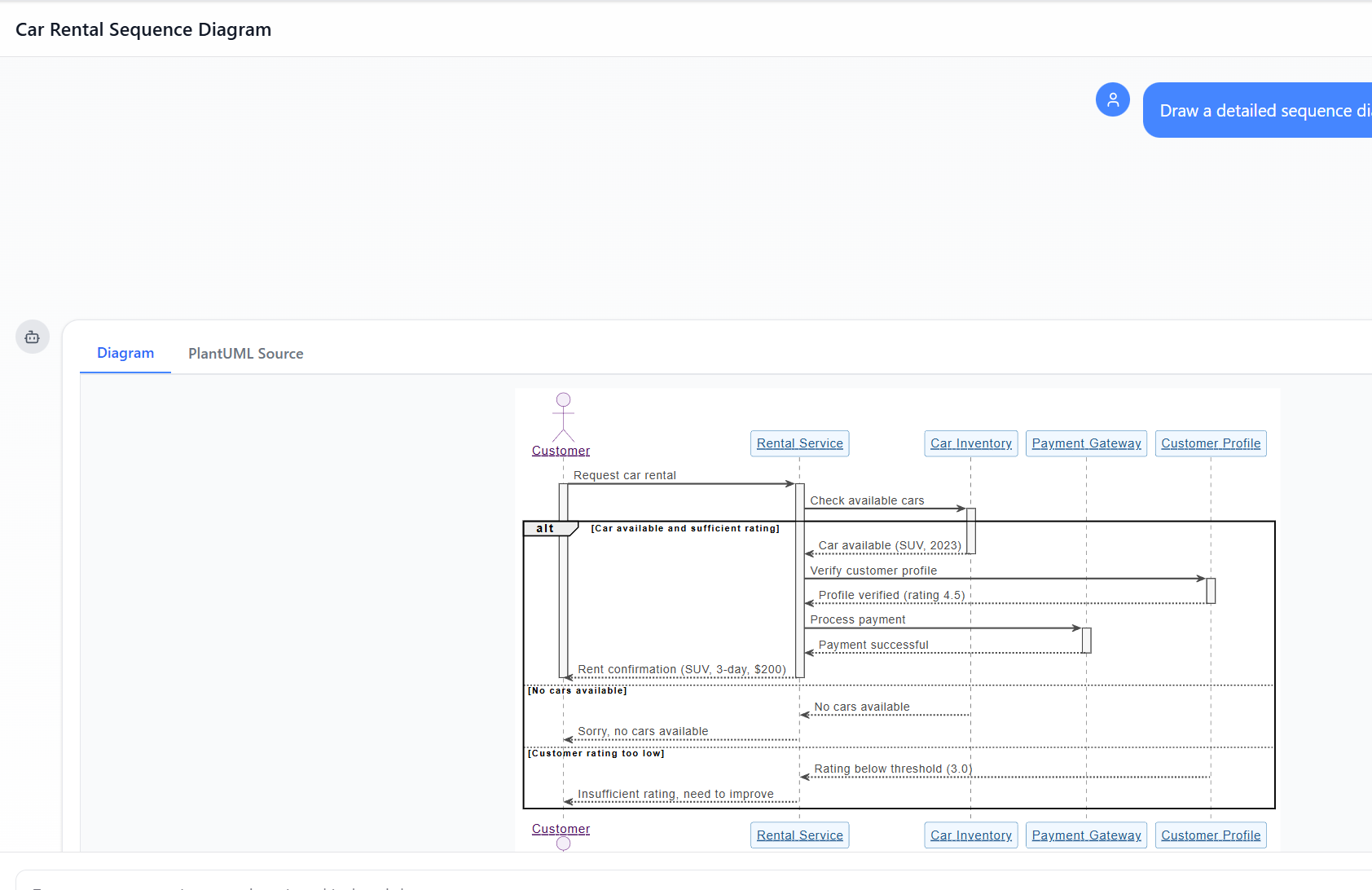
  • Conversational Editing: The chatbot’s core strength lies in its ability to refine diagrams through dialogue. Users can simply “talk” to the model—for example, instructing it to “Add a payment gateway”—to add elements or refactor relationships without manual dragging and dropping.
  • Extensive Versatility: It supports a vast array of over 40 diagram types. This includes technical schemas like UML (Class, Sequence, Activity), SysML, and ArchiMate, as well as strategic business frameworks like SWOT or PESTLE analysis.
  • Analytical Insights: Beyond drawing, the chatbot can analyze the model, answering questions about use cases or generating automated project summaries.

3. Specialized AI Web Applications

For specific, high-complexity tasks, Visual Paradigm Online offers domain-specific web applications that guide users through rigorous technical processes.

  • DB Modeler AI: This tool transforms natural language into production-ready SQL schemas via a 7-step guided workflow. It uniquely features intelligent normalization, optimizing databases from 1NF to 3NF while providing educational rationales for every change. It also includes an interactive SQL playground seeded with AI-generated data for immediate testing.
  • AI C4 Studio: This application automates the creation of C4 views (Context, Container, and Component diagrams) using PlantUML rendering, streamlining the visualization of software architecture.
  • Use Case to Activity Diagram Generator: This tool intelligently parses narrative requirements to visualize UML activity workflows, ensuring a clear translation from text to process.

4. Unified Hybrid Workflow

The ecosystem is designed to offer the best of both worlds: the speed of the cloud and the depth of desktop engineering.

  • Integrated Access: Users can launch specialized web apps and the AI Chatbot directly from the desktop environment.
  • Seamless Import: Diagrams prototyped in the cloud can be imported directly into the desktop workspace. Once imported, they can be used for advanced engineering tasks, such as code generation, reverse engineering, and version control.
  • Global Accessibility: To support international teams, the AI supports over 40 languages, ensuring that both the interface and the generated content feel native to the user.

Why Choose Visual Paradigm AI?

Adopting the Visual Paradigm AI ecosystem represents a shift from manual drawing to an automated engineering process. It is akin to having a certified architect and an automated construction crew at your disposal. Below are the primary benefits of this approach.

Instant Productivity and Speed

The most immediate advantage is the elimination of the “blank canvas” syndrome. The AI jumpstarts the design process, moving from a concept to a complete visualization in seconds.

  • No Manual Drawing: The platform removes the tedious aspects of diagramming, such as shape selection, layout adjustments, and spacing.
  • Focus on Logic: Through conversational editing, users can focus on the high-level logic of the system rather than the mechanics of the software.

Architectural Rigor and Data Integrity

Visual Paradigm distinguishes itself from general generative AI by ensuring technical accuracy and adherence to standards.

  • Intelligent Normalization: In database design, the AI automatically optimizes schemas and explains the architectural shifts necessary to eliminate redundancy.
  • Textbook-Perfect Notations: Whether utilizing ArchiMate or Chen Notation, the AI ensures that all symbols and relationships meet strict professional standards.
  • Traceability: The system maintains synchronization between conceptual, logical, and physical models, allowing for seamless navigation through the design’s evolution.

Live Validation and Testing

A standout feature of the ecosystem is the ability to validate designs before any implementation code is written.

  • Interactive SQL Playground: Users can test their database schemas in a live, in-browser environment without local software installation.
  • Realistic Data Seeding: The AI populates models with realistic sample data, enabling users to run custom queries and verify performance under simulated real-world conditions.

Conclusion

The Visual Paradigm AI ecosystem acts as a highly skilled architectural firm. The AI Chatbot serves as the lead consultant for brainstorming, the AI-Powered Desktop acts as the drafting department producing instant blueprints, and the Specialized Web Apps function as structural engineers ensuring code compliance. By combining these tools, Visual Paradigm offers a superior solution for developers and architects seeking to enhance productivity, ensure data integrity, and validate their systems with precision.

Posted on Categories AI

How to Choose the Right Visual Paradigm AI Tool: A Comprehensive Guide

Navigating the Visual Paradigm AI Ecosystem

Choosing the right product within the Visual Paradigm AI ecosystem is a strategic decision that depends heavily on a user’s specific workflow requirements. The spectrum of tools ranges from rapid, conversational prototyping to deep, enterprise-grade engineering. To select the optimal tool, users must consider three primary factors: the technical depth required for the task, the specific domain of the project (such as database design versus high-level system architecture), and the preferred working environment (cloud-based flexibility versus desktop power).

This guide breaks down the distinct roles of the Visual Paradigm AI suite to help you match the right tool to your engineering needs.

1. The Engineer’s Workbench: Visual Paradigm Desktop

For professionals requiring “deep engineering” and rigorous control over complex systems, Visual Paradigm proposes the Desktop application. This tool is the heavyweight champion of the ecosystem, designed for environments where precision and legacy integration are paramount.

Best For

The Desktop client is the ideal choice for enterprise architects and software developers who need offline capabilities, code engineering, and extensive forward/reverse engineering of legacy systems. It bridges the gap between conceptual modeling and implementation.

AI Feature Integration

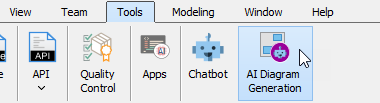
Far from being a legacy tool, the desktop version has evolved to embed a powerful AI Diagram Generator. This feature allows users to instantly create 11 specialized diagram types. Supported diagrams include:

Hybrid Access

Visual Paradigm Desktop offers a hybrid experience. Users with a Professional or Enterprise license and an active maintenance plan can access cloud-based AI tools, such as the DB Modeler AI and AI Chatbot, directly within the desktop interface, ensuring that heavy engineering does not come at the cost of modern AI conveniences.

2. The Conversational Co-Pilot: AI Chatbot

The AI Chatbot serves as the ideal starting point for users facing “blank canvas” syndrome. It is designed to move a user from a raw idea to a visual model with unprecedented speed, acting as a collaborative partner.

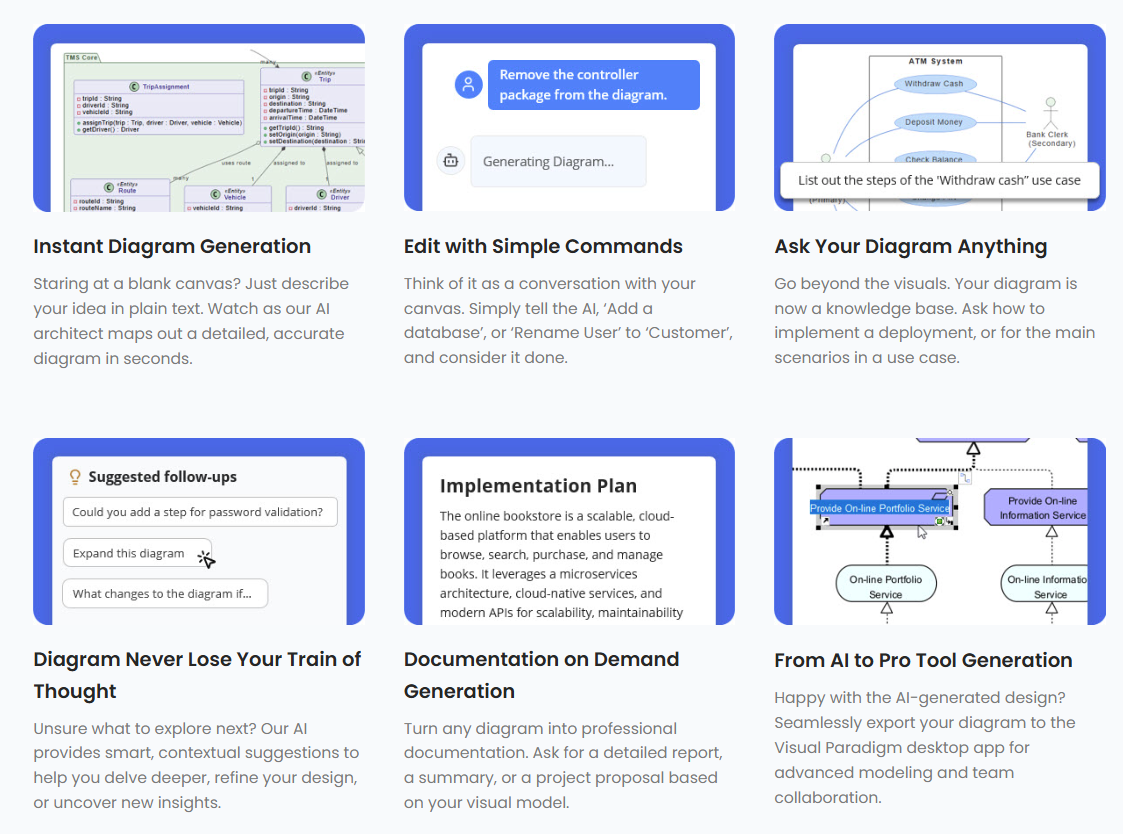
AI Chatbot | Diagramming & Modeling with Visual Paradigm

Best For

This tool is recommended for the rapid prototyping of a “vast universe” of diagrams. It excels in generating general software and business models, including:

Key Capabilities: Interactive Refinement

The Chatbot’s defining strength lies in interactive refinement. Unlike static generators, it allows users to “talk” to their diagrams. Through natural language commands, users can add elements, rename classes, or refactor relationships without ever touching a manual drawing tool.

Analytical Insights

Beyond visual generation, the Chatbot is proposed for users who need to analyze their models. It can answer technical questions regarding the diagram (e.g., “What are the main use cases?”) and generate professional documentation on demand, making it a powerful tool for clarity and communication.

3. The End-to-End Specialist: DB Modeler AI

For users specifically interested in database development, Visual Paradigm proposes the DB Modeler AI. This is a specialized web application designed to strictly bridge the gap between requirements gathering and production-ready SQL code.

ERD modeler

Best For

This tool is tailored for developers, students, and architects starting a new database project who require a technically sound, optimized schema from the ground up.

The 7-Step Workflow

DB Modeler AI is the only choice for users requiring Intelligent Normalization. It guides the user through a structured workflow that progresses from 1NF to 3NF, providing educational rationales for every structural decision made by the AI.

Validation and Testing

A critical feature of the DB Modeler is the ability to test designs immediately. It includes an Interactive SQL Playground seeded with realistic, AI-generated sample data, allowing developers to query and validate their schema before deploying it.

4. Specialized Web Studios

When a user’s interest is limited to a specific niche, Visual Paradigm proposes specialized “Studios” that focus on single-purpose efficiency.

The Ultimate Guide to C4 Model Visualization with Visual Paradigm's AI  Tools - ArchiMetric

  • AI C4 Studio: Recommended for software architects who need to generate Context, Container, and Component views specifically using PlantUML syntax.
  • Use Case to Activity Diagram Generator: Proposed for analysts who need to transform narrative textual requirements into functional UML activity workflows.
  • AI-Powered Markmap Studio: Targeted at users who need to instantly turn scattered thoughts into structured mind maps during brainstorming sessions.

Comparative Selection Guide

To summarize the ecosystem, the following table matches common use cases with the recommended Visual Paradigm product:

Use Case Recommended Product
New Database Project DB Modeler AI
Quick UML/Business Prototyping AI Chatbot
Enterprise Architecture / Offline Work VP Desktop (w/ AI integration)
Architecture Documentation (C4) AI C4 Studio
Requirements to Workflow Use Case to Activity Diagram Generator

Conceptualizing the Difference: A Construction Analogy

Choosing between these tools is comparable to selecting the right assistance for a construction project. Understanding the nature of your “building” helps determine which tool is required:

  • The AI Chatbot is the Expert Consultant: Imagine a consultant standing next to you. You sketch ideas on a napkin together, and when you ask them to “move that wall,” they do it instantly. It is collaborative, fast, and flexible.
  • The DB Modeler AI is the High-End Engineering Simulator: This tool ensures the infrastructure—the plumbing and electrical work (data structure)—meets every building code (normalization) before you break ground. It focuses on structural integrity and compliance.
  • The VP Desktop AI is the Automated Factory: This is where the heavy machinery lives. It is used to actually build the final structure, manage massive complexity, and sync the design with real-world materials through reverse and forward engineering.
Posted on Categories AI

Visual Paradigm AI Ecosystem: A Comprehensive Guide to Intelligent Modeling

The Evolution of Visual Modeling

Visual Paradigm has evolved far beyond traditional diagramming tools, establishing itself as a comprehensive AI-powered visual modeling ecosystem. By integrating generative AI across its desktop application, web-based tools, and specialized assistants, the platform has fundamentally changed how architects, developers, and business analysts approach design.

This ecosystem blends the robustness of traditional desktop modeling with the speed and innovation of cloud-based AI. The result is a workflow that accelerates diagram creation, database design, and software architecture visualization—transforming simple text prompts into professional, editable models in seconds. This guide explores the four primary ways to engage with Visual Paradigm’s AI capabilities.

1. The AI-Powered Desktop: Enterprise-Grade Acceleration

For users requiring deep, offline modeling capabilities, the Visual Paradigm flagship desktop application now embeds powerful AI features directly into the familiar workspace. This integration is designed for enterprise architects and software developers who need to generate complex structures instantly without sacrificing the advanced editing tools of a desktop environment.

From Text to Technical Diagrams

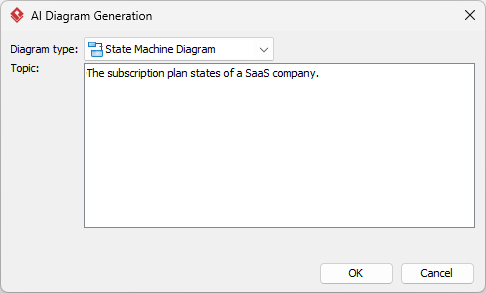
The core of this update is the AI Diagram Generator. Users can describe systems, architectures, or requirements in natural language, and the AI produces presentation-ready drafts complete with accurate relationships and elements. This feature supports a vast array of technical standards, including:

  • C4 Model Hierarchies: Generating System Context, Containers, and Component diagrams.
  • UML & SysML: Creating standard software and systems engineering models.
  • ArchiMate: Developing enterprise architecture viewpoints.

Once generated, these diagrams are not static images. They are fully editable models that can be refined using the desktop’s advanced features, such as code engineering, reverse engineering, and collaborative team tools. Users with active maintenance (particularly Professional or Enterprise editions) gain the added benefit of accessing cloud AI features directly within this environment.

2. The AI-Powered Chatbot: A Conversational Assistant

The Visual Paradigm AI Chatbot represents a shift toward conversational modeling. Accessible via the web or integrated into the desktop app, this tool acts as a dedicated assistant that overcomes the “blank canvas” syndrome common in the early stages of design.

By interpreting plain English prompts, the chatbot can generate complete diagrams across dozens of standards. It is particularly effective for:

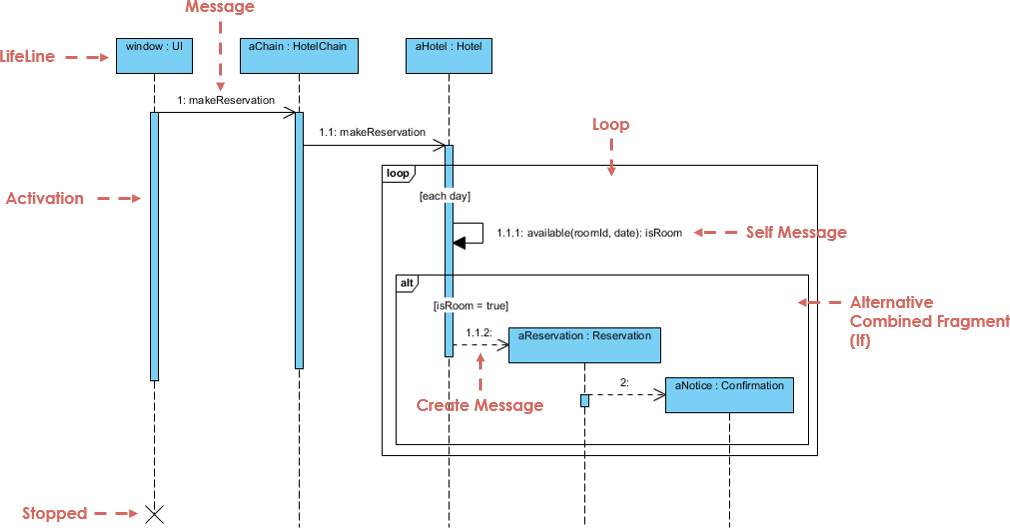
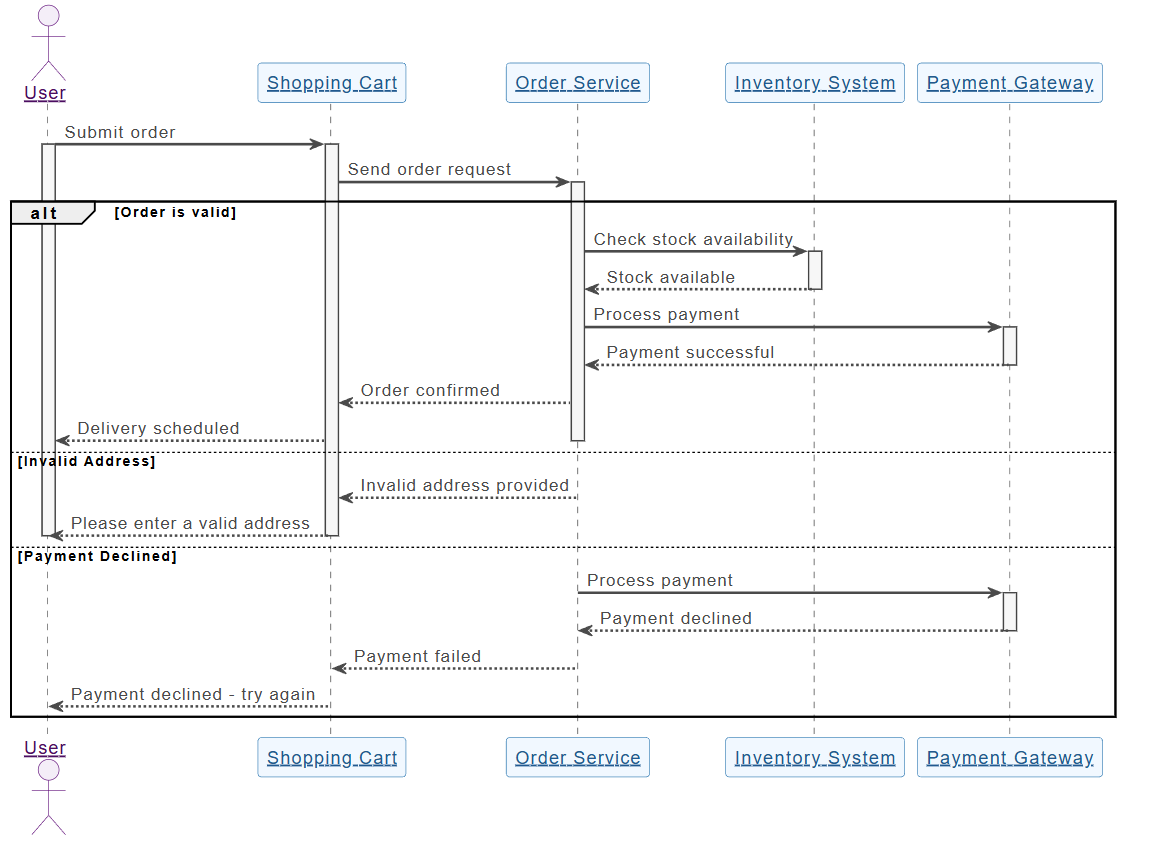
  • Software Engineering: UML Sequence, Use Case, and Class diagrams.
  • Business Strategy: SWOT analysis, PESTLE, and Business Canvas models.
  • System & Enterprise Modeling: SysML and ArchiMate diagrams.

Iterative Refinement and Documentation

The chatbot’s strength lies in its interactive nature. Users can refine diagrams through follow-up commands, ask the AI for contextual suggestions, and request on-demand professional documentation or reports based on the generated models. Furthermore, the workflow supports direct export to the desktop app, allowing teams to move from a quick chat-based prototype to a rigorous engineering model seamlessly.

3. VP Online Suite: Specialized AI Web Applications

Visual Paradigm Online offers a suite of specialized, zero-install web applications designed for browser-based, collaborative workflows. These tools focus on specific domains, providing guided processes that streamline complex technical tasks.

AI DB Modeler (DBModeler AI)

This tool is invaluable for developers bootstrapping databases or students learning relational design. It transforms natural language descriptions into production-ready schemas. Key capabilities include:

  • Domain Modeling: Utilizing PlantUML for initial structure.
  • ER Diagram Generation: Automatically defining keys and relationships.
  • SQL Output: Generating SQL scripts and providing an interactive playground with AI-generated test data.

AI C4 Studio

Targeting software architects, the AI C4 Studio automatically generates complete C4 views—including Context, Container, and Component diagrams—from text prompts. It utilizes PlantUML rendering to ensure outputs are editable and shareable, facilitating rapid iteration and better architecture communication among teams.

4. Unified Access: The Hybrid Workflow

One of the ecosystem’s most significant advantages is the seamless integration between web and desktop environments. Visual Paradigm ensures that the speed of web AI does not come at the cost of the desktop’s depth.

With a compatible license (Professional/Enterprise edition plus VP Online subscription), users can launch all AI-powered web apps—including the Chatbot, DB Modeler, and C4 Studio—directly from within the Visual Paradigm Desktop application. This hybrid approach allows for a fluid workflow where:

  1. Prototyping occurs via AI generation in the cloud.
  2. Synchronization brings models effortlessly into the desktop workspace.
  3. Refinement takes place using heavy-duty desktop tools for version control, code generation, and reporting.

Summary of AI Capabilities

Feature Primary Use Case Key Benefit
AI Desktop Deep Engineering & Architecture Combines AI speed with advanced code/reverse engineering tools.
AI Chatbot Brainstorming & Quick Prototypes Conversational interface that cures “blank canvas” syndrome.
VP Online Web Apps Collaborative, Domain-Specific Tasks Zero-install tools for DB design and C4 modeling with PlantUML support.

Whether you are a solo developer prototyping a new idea, or an enterprise architect managing complex systems, Visual Paradigm’s AI ecosystem provides the flexibility to generate, refine, and document models faster and more intuitively than ever before.

Posted on Categories AI