


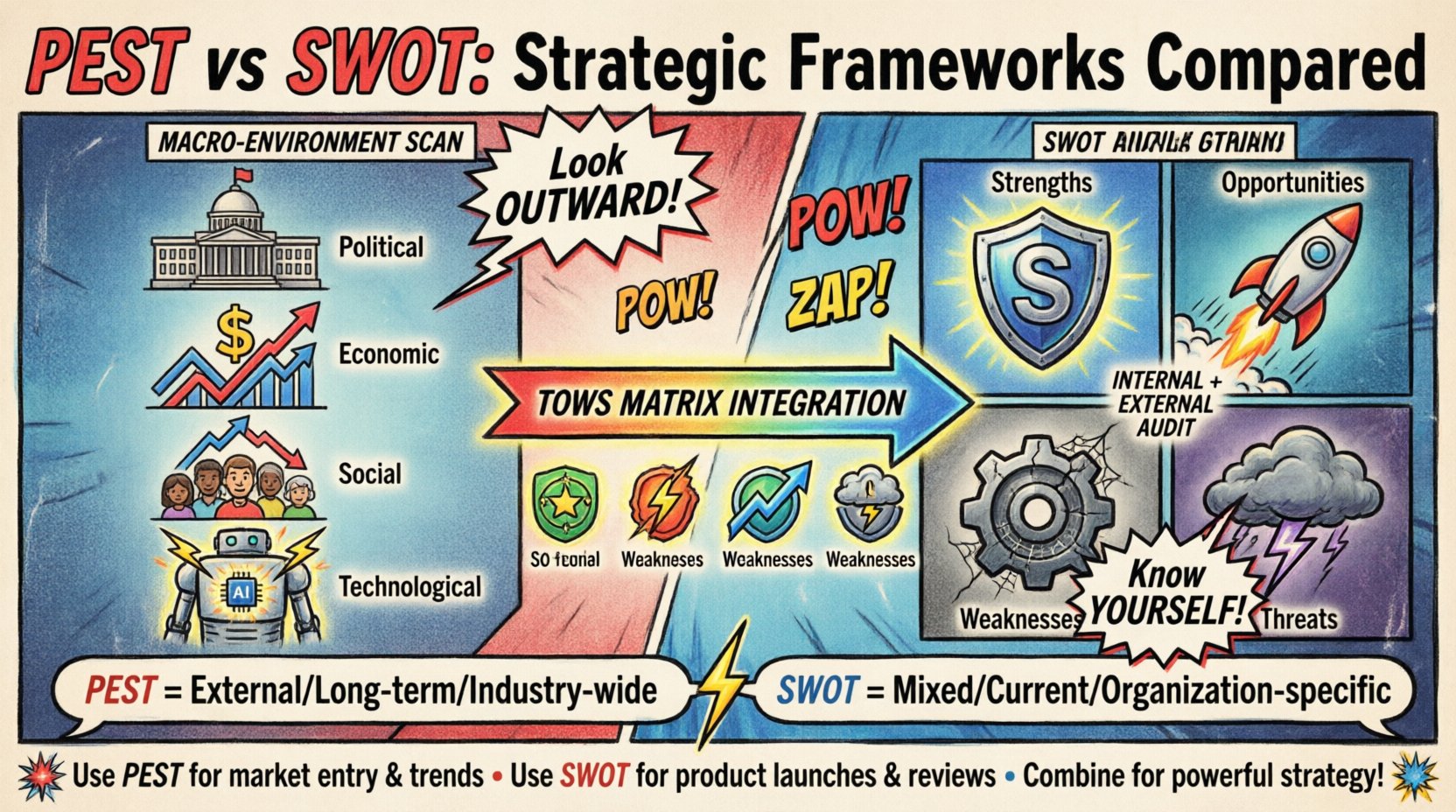
Strategic planning requires clarity. In the complex landscape of business decision-making, leaders often rely on established models to simplify uncertainty. Two of the most enduring frameworks for this purpose are PEST analysis and SWOT analysis. While they serve similar high-level goals, they approach problem-solving from different angles. Understanding the structural and functional differences between them is essential for effective organizational planning.
This guide provides a detailed examination of both methodologies. We will explore their origins, their specific components, and how they function within a broader strategic context. By the end of this article, you will understand when to deploy each tool and how they can complement one another.
Understanding PEST Analysis 🌍
PEST analysis stands for Political, Economic, Social, and Technological. It is a framework specifically designed to scan the macro-environmental factors that influence an organization. Unlike tools that look inward, PEST looks outward. It is primarily used during the early stages of strategic planning or when launching a new product in a different market.
The core philosophy behind PEST is that external forces often dictate internal success. A company can have the best product, but if the political climate shifts or economic conditions worsen, performance may suffer. Therefore, analyzing these external variables helps mitigate risk.
The Four Pillars of PEST
- Political Factors 🏛️: These relate to government intervention. This includes tax policies, labor laws, trade restrictions, tariffs, and political stability. For instance, a change in environmental regulations could increase operational costs for a manufacturing firm.
- Economic Factors 💰: These encompass growth rates, exchange rates, inflation, and interest rates. Economic conditions dictate consumer purchasing power. During a recession, demand for luxury goods typically drops, whereas demand for essential services remains stable.
- Social Factors 👥: These involve demographics, cultural aspects, and lifestyle trends. Population growth rates, age distribution, and health consciousness are key examples. A company selling fitness equipment would look closely at aging populations and health trends.
- Technological Factors 📱: These cover innovations, automation, and research and development activity. Rapid technological change can render products obsolete. The rise of mobile computing, for example, fundamentally changed how retail businesses interact with customers.
It is worth noting that many practitioners expand this acronym to PESTLE. This addition includes Legal and Environmental factors. While PEST is the foundational model, PESTLE offers a more granular view of compliance and sustainability issues.
Understanding SWOT Analysis 📊
SWOT analysis stands for Strengths, Weaknesses, Opportunities, and Threats. This framework is more comprehensive regarding the organization’s current state. It combines internal analysis (Strengths and Weaknesses) with external analysis (Opportunities and Threats). It is a versatile tool used for market entry, product development, and general business health checks.
The strength of SWOT lies in its simplicity. It forces stakeholders to confront reality. It requires honesty about internal capabilities while acknowledging external possibilities. However, because it mixes internal and external factors, it can sometimes lead to confusion if not structured carefully.
The Four Quadrants of SWOT
- Strengths 💪: These are internal attributes that give the organization an advantage. Examples include a strong brand reputation, proprietary technology, or a highly skilled workforce. These are things the organization controls.
- Weaknesses ⚠️: These are internal attributes that place the organization at a disadvantage. Examples include poor cash flow, outdated machinery, or high employee turnover. Identifying these allows for targeted improvement.
- Opportunities 🚀: These are external factors that the organization could exploit to its advantage. Examples include a competitor exiting the market, a new technology becoming affordable, or a shift in consumer behavior favoring your product.
- Threats 🛡️: These are external factors that could cause trouble for the business. Examples include new regulations, changing competitor strategies, or economic downturns. These require defensive planning.
SWOT is often presented as a 2×2 matrix. This visual aid helps teams categorize information quickly. However, the matrix is merely a starting point. The real value comes from the strategies developed based on the intersections of these factors.
Structural Differences Between PEST and SWOT 🔄
While both frameworks aim to improve decision-making, their structural approaches differ significantly. PEST is exclusively external. SWOT is mixed. This distinction determines when each tool is most appropriate.
Consider the scope of analysis. PEST analyzes the horizon. It looks at the environment surrounding the business. SWOT analyzes the business itself within that environment. It looks at the body and the surroundings.
| Feature | PEST Analysis | SWOT Analysis |
|---|---|---|
| Primary Focus | Macro-environmental (External) | Mixed (Internal & External) |
| Scope | Industry-wide or Global | Organization-specific |
| Time Horizon | Long-term trends | Current and Near-term |
| Control | Factors outside control | Internal factors are controllable |
| Complexity | Requires broad research | Requires self-assessment |
| Output | Risk identification | Strategic alignment |
This table highlights the fundamental divergence. PEST is about understanding the playing field. SWOT is about understanding the team playing on it.
When to Use PEST vs SWOT 🤔
Selecting the right tool depends on the specific question you are trying to answer. There is no single correct answer, but there are clear contexts where one outperforms the other.
Scenarios for PEST Analysis
- Market Entry: Before entering a new country, you need to understand the regulatory and cultural landscape. PEST provides the macro view required here.
- Long-term Planning: When setting a 5-year or 10-year strategy, economic and technological trends are more relevant than current staff morale.
- Industry Disruption: If a new technology is emerging, PEST helps analyze how it will reshape the industry structure before it impacts your specific company.
Scenarios for SWOT Analysis
- Product Launch: You need to know if your product fits your current capabilities and if the market is ready for it.
- Performance Review: When assessing why a division is underperforming, internal weaknesses are often the culprit.
- Mergers and Acquisitions: Due diligence requires understanding the target company’s strengths and weaknesses relative to your own.
Integrating Both Frameworks 🧩
Using PEST and SWOT in isolation limits their potential. The most robust strategic plans often integrate both. This integration creates a bridge between the external environment and internal capability.
The TOWS Matrix Approach
A common method for combining these frameworks is the TOWS matrix. This takes the data from PEST (which identifies Opportunities and Threats) and matches it with the data from internal analysis (Strengths and Weaknesses). This generates four distinct strategic directions:
- SO Strategies: Use strengths to take advantage of opportunities.
- ST Strategies: Use strengths to reduce the impact of threats.
- WO Strategies: Overcome weaknesses by taking advantage of opportunities.
- WT Strategies: Minimize weaknesses and avoid threats.
This approach ensures that external data is not just collected but acted upon. It moves the analysis from observation to action.
Implementation Steps 🛠️
To execute this integration effectively, follow a structured process. Avoid skipping steps, as this leads to incomplete data.
- Gather External Data: Conduct the PEST analysis first. Collect data on regulations, economic indicators, and social trends. Use public reports, government publications, and industry news.
- Assess Internal Capabilities: Conduct the internal audit. Identify what your organization does well and where it falls short. Be objective. Avoid self-praise.
- Map the Connections: Place your PEST findings into the Opportunities and Threats quadrants of your SWOT. Place your internal audit into the Strengths and Weaknesses quadrants.
- Generate Strategies: Brainstorm how to connect the quadrants. Ask specific questions. How can our Strength (S) help us capture this Opportunity (O)?
- Prioritize: Not all strategies are equal. Rank them based on impact and feasibility. Focus resources on the high-priority items.
Common Pitfalls to Avoid ⚠️
Even with the right framework, teams often make mistakes that reduce the value of the analysis. Awareness of these common errors can save significant time and effort.
- Being Too Generic: Vague statements like “Economy is bad” or “We are good” are useless. Specificity is key. Instead of “Economy is bad,” use “Inflation is projected to rise 3%, increasing raw material costs.”
- Confusing Internal and External: A common error is listing an economic downturn as a Weakness. Economic downturns are external (Threats). Inefficiency is internal (Weakness). Keep the lines clear.
- Ignoring the Timeline: SWOT is often treated as a static snapshot. However, business environments change rapidly. A PEST analysis from last year may no longer be relevant today.
- Groupthink: If the team is homogenous, they may miss critical threats or opportunities. Include diverse perspectives from different departments and levels of the organization.
- Stopping at Analysis: The greatest failure is producing a list and filing it away. The output must be an action plan. Without execution, the analysis is academic.
Deep Dive: Nuances of External Analysis 🔍
When focusing on the external environment, it is crucial to understand the difference between PEST and other models. PEST is not the only way to look outward. Porter’s Five Forces, for example, looks at industry competition specifically. PEST looks at the broader context.
One nuance in PEST is the interconnectivity of the factors. Political decisions often drive Economic outcomes. Social shifts often drive Technological adoption. A change in voting patterns (Political) might lead to tax reforms (Economic), which changes consumer spending habits (Social). Recognizing these links adds depth to the analysis.
Similarly, in SWOT, the dynamic nature of factors is important. A Strength today can become a Weakness tomorrow. For example, a large workforce was once a strength for manufacturing. Today, high labor costs can be a liability. Regular reviews of the SWOT matrix are necessary to ensure it remains accurate.
Data Sources and Research Methods 📚
Quality analysis depends on quality data. When conducting these frameworks, rely on credible sources. Avoid speculation unless it is clearly labeled as a hypothesis.
- For Political Factors: Government white papers, legislative records, and news from political analysts.
- For Economic Factors: Central bank reports, inflation data, and GDP growth statistics from international bodies.
- For Social Factors: Census data, demographic studies, and cultural trend reports from research firms.
- For Technological Factors: Patent filings, tech journals, and innovation roadmaps from industry leaders.
For internal data, rely on financial statements, employee surveys, and customer feedback. Combining quantitative data with qualitative insights creates a balanced view.
Final Thoughts on Strategic Clarity 🧭
Strategic planning is not about predicting the future with certainty. It is about preparing for multiple possibilities. Both PEST and SWOT contribute to this preparation. PEST ensures you understand the terrain. SWOT ensures you understand your vehicle.
Using these tools correctly requires discipline. It requires the willingness to acknowledge weaknesses and the humility to accept that external forces are often beyond control. When used together, they provide a robust foundation for decision-making.
Organizations that invest time in these frameworks tend to navigate market shifts more effectively. They are not caught off guard by regulatory changes or economic downturns. They have a map and a vehicle. This alignment between internal capability and external reality is the essence of sustainable growth.
As you move forward with your planning, remember that these frameworks are living documents. They should be revisited regularly. The market changes, your organization changes, and your strategies must evolve to match. Continuous improvement in how you analyze your environment is the only way to maintain a competitive edge.
Whether you are a startup founder or a seasoned executive, the principles remain the same. Clarity leads to better decisions. Better decisions lead to better outcomes. Use these frameworks to build that clarity.