
Engineering productivity is often eroded not by the complexity of code, but by the fragmentation of attention. Daily standup meetings, intended to synchronize teams, frequently devolve into status reporting sessions that consume valuable deep work time. The objective is not to eliminate communication, but to refine the mechanism through which information flows. By restructuring these rituals, teams can protect focus time while maintaining necessary alignment.
This guide explores actionable strategies to optimize the daily standup. We will examine the cost of inefficiency, define core principles for time-boxed interactions, and analyze formats that prioritize engineering output over administrative overhead. The goal is to reclaim hours previously lost to unproductive dialogue.
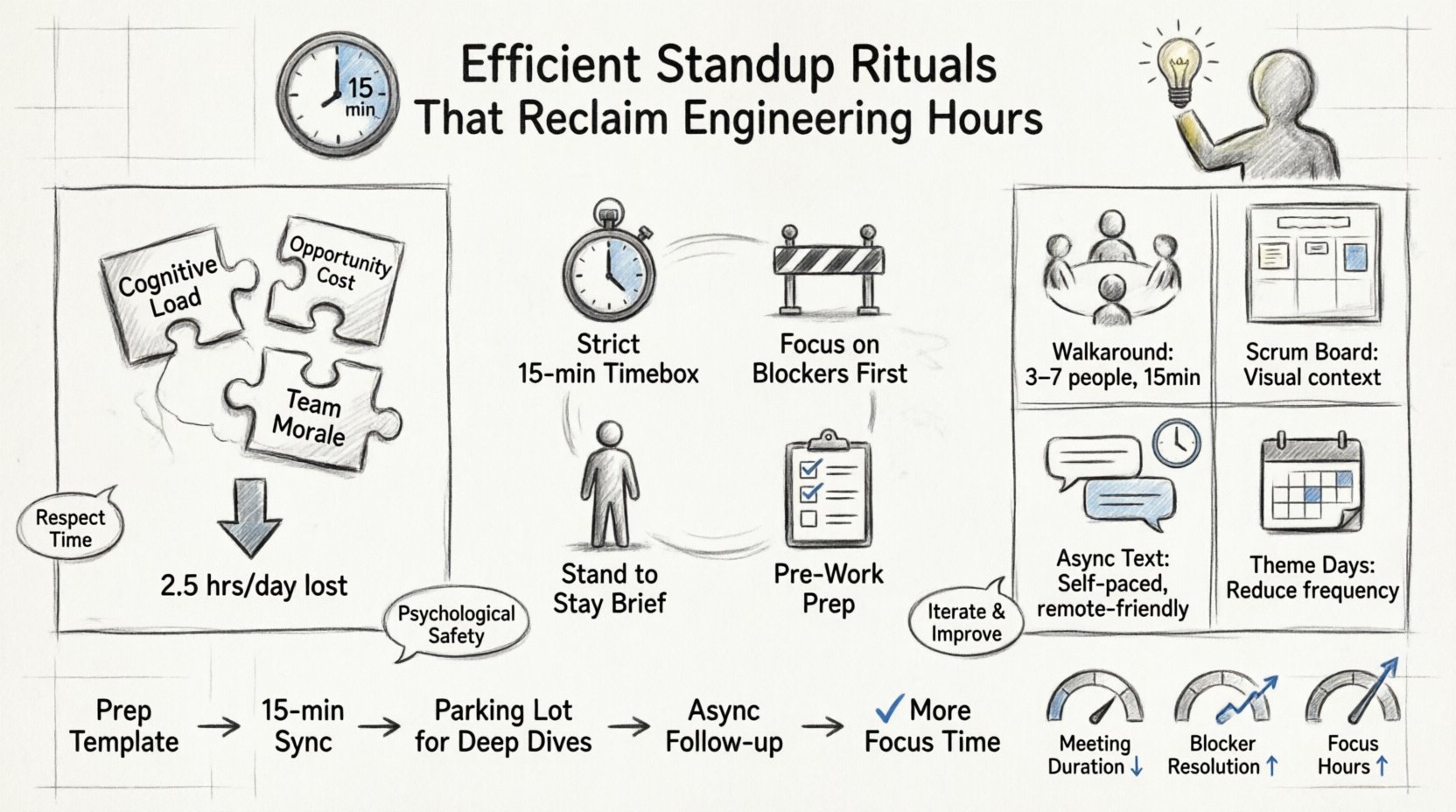
📉 The Hidden Cost of Inefficient Meetings
Before implementing changes, it is necessary to understand the magnitude of the problem. The average engineer spends a significant portion of their workday in meetings or context switching between tasks. When a standup exceeds its allotted time, the impact compounds.
- Cognitive Load: Interrupting a flow state to attend a meeting requires time to re-enter deep work mode.
- Opportunity Cost: Every minute spent discussing status is a minute not spent on implementation or design.
- Team Morale: Lengthy meetings signal a lack of respect for individual time and contribute to burnout.
Data suggests that the average knowledge worker loses over 2.5 hours daily to unproductive meetings. In engineering teams, where focus is a primary currency, this loss is critical. Reducing this time does not mean reducing communication; it means increasing the signal-to-noise ratio of that communication.
⚙️ Core Principles for Time-Boxed Standups
To reclaim engineering hours, the standup must adhere to strict principles. These rules are not arbitrary; they are designed to minimize cognitive drag and maximize clarity.
1. Strict Time Boxing
A standard duration of 15 minutes is the industry norm for a reason. It forces brevity. If a team cannot cover necessary updates in this window, the process is flawed. Use a visible timer. When the timer ends, the meeting ends. This creates a psychological boundary that encourages preparation.
2. Focus on Blockers
The primary value of a standup is identifying impediments, not reciting a to-do list. If a team member is working smoothly, their status is less critical than if they are blocked. The conversation should pivot immediately to resolution strategies for those who are stuck.
3. Standing Position
While not strictly necessary for remote teams, the physical act of standing (or maintaining a specific posture in virtual settings) discourages lingering. It signals that the event is temporary and functional, not a social gathering.
4. Pre-Work Requirements
Participants should prepare their updates before the meeting starts. This shifts the cognitive load from the meeting time to the preparation phase, allowing the meeting itself to be a rapid synchronization point rather than a brainstorming session.
🔄 Standup Formats and Structures
Different teams require different approaches. A monolithic approach rarely fits all. Below is a comparison of common formats used to optimize synchronization.
| Format | Best For | Time Allocation | Key Benefit |
|---|---|---|---|
| Walkaround | Small teams (3-7 members) | 15 mins total | Ensures equal speaking time |
| Scrum Board Review | Teams using Kanban/Agile boards | 10-15 mins | Visual context reduces verbal explanation |
| Async Text | Distributed/Remote teams | N/A (Self-paced) | Eliminates synchronous meeting time entirely |
| Theme Days | Large orgs with multiple squads | Variable | Reduces frequency for individual contributors |
Walkaround Format: Each member speaks in turn. The facilitator ensures no one speaks for more than one minute. This prevents the “storyteller” from dominating the session.
Scrum Board Review: The team gathers around a physical or digital board. Updates are made by moving cards or updating status. The discussion happens around the specific items, not abstract plans. This grounds the conversation in reality.
Async Text: Team members post updates in a dedicated channel by a specific time. The standup becomes a review of the text, with only blockers requiring a synchronous call. This is often the most effective method for reclaiming engineering hours.
📝 Preparation: The Pre-Meeting Phase
The efficiency of the meeting is determined before it begins. Preparation is the single most effective lever for reducing duration.
- Template Usage: Provide a standard template for updates. For example: “Yesterday I did X. Today I will do Y. I am blocked by Z.” This structure reduces cognitive effort for the speaker.
- Status Updates via Tool: If a ticketing system exists, the status should be updated there before the meeting. The standup should not be the place to change statuses.
- Blocker Identification: If you do not have a blocker, do not spend time explaining your task in detail. A simple “No blockers” suffices.
- Agenda Setting: If the meeting includes specific topics (e.g., release planning), list them in advance. Do not introduce new topics during the sync.
When engineers prepare their thoughts, they often realize they do not need to discuss the item at all. This self-filtering process naturally reduces the meeting load.
🚫 Handling Blockers and Side Conversations
The most common reason standups drag on is the handling of blockers. If a discussion regarding a technical hurdle begins, it must be stopped immediately.
- The Parking Lot: Create a dedicated space for issues that need discussion. If a problem arises, note it and schedule a separate session.
- Two-Person Rule: Only the two people directly involved in the blocker should discuss it. Others should step away or listen silently.
- Facilitator Intervention: The facilitator must have the authority to cut off tangents. “That is a good topic, let’s take it offline.”
By enforcing this rule, the team learns to distinguish between synchronization (the standup) and problem-solving (the breakout session). This distinction is vital for maintaining the integrity of the time box.
📱 Asynchronous Alternatives
In modern distributed environments, synchronous meetings are not always the optimal choice. Asynchronous standups can reclaim significant hours.
How It Works
Instead of gathering at a specific time, team members update their status within a set window (e.g., 9:00 AM to 10:00 AM). The updates are read by the team. The meeting is only called if a blocker is identified that requires immediate attention.
Benefits
- Time Zone Agnostic: Works for globally distributed teams.
- Deep Work Protection: No fixed time slot is reserved for communication.
- Written Record: Updates are documented automatically, reducing the need for follow-up emails.
Implementation
Use a dedicated messaging channel. Encourage the use of bullet points. Require that updates include the “Next Step” to ensure forward momentum. Avoid the use of voice messages in text channels, as they reintroduce the need for real-time attention.
📊 Measuring Success and Metrics
To ensure these rituals are working, teams should track specific metrics. These metrics should focus on engineering output, not meeting attendance.
- Meeting Duration: Track the average time per standup. The target is consistently under 15 minutes.
- Blocker Resolution Time: How long does it take to resolve a blocker identified in the standup? If this increases, the standup is failing.
- Focus Time Availability: Survey the team on how many uninterrupted hours they have daily. This should increase as meeting time decreases.
- Engagement: Are team members arriving on time? Are they prepared? Low engagement often indicates the ritual is no longer valuable.
🛠️ Facilitation and Roles
A successful standup requires a facilitator. This role rotates to ensure shared ownership and to prevent a single point of failure.
- Rotating Facilitator: Assign the role daily or weekly. This distributes the responsibility of managing the time and flow.
- Timekeeper: In some teams, a dedicated person watches the clock. This removes the pressure from the speaker to self-regulate.
- Note Taker: Assign someone to record action items. This prevents the “I said we would fix that” debate later.
The facilitator is not the manager. They are a servant to the process. Their goal is to ensure the ritual serves the team, not the other way around.
🧠 Cultural Considerations
Changing the standup requires a shift in culture. Engineers may feel anxious about speaking concisely. They may fear that brevity implies a lack of work.
- Psychological Safety: Ensure team members feel safe admitting blockers without fear of retribution. If blockers are hidden, the standup becomes a performance review rather than a sync.
- Respect for Time: Treat every minute as valuable. Punctuality is a sign of respect.
- Continuous Improvement: Regularly review the standup process itself. Ask the team if the current format is working. Adjust as necessary.
Culture is not built in a day. It is built through repeated actions that reinforce new behaviors. When a team consistently finishes on time, it reinforces the norm that efficiency is valued.
🔄 Iterating on the Process
There is no perfect standup. The process must evolve as the team grows or changes context.
- Quarterly Reviews: Every quarter, review the meeting structure. Is it still serving the purpose?
- Feedback Loops: Use anonymous feedback to gauge sentiment. If engineers feel the meeting is a waste of time, investigate immediately.
- Experimentation: Try different formats for a month. If a new approach yields better results, adopt it.
Flexibility is key. What works for a startup team of five may not work for a scaled engineering organization of fifty. The underlying principle remains the same: minimize friction and maximize output.
🛑 Common Pitfalls to Avoid
Avoiding common mistakes is as important as implementing best practices.
- Allowing Long Explanations: Engineers often explain the “how” in detail. This belongs in technical design docs, not the standup.
- Skipping the Meeting: If a member is on vacation or sick leave, do not skip the update. Have a proxy or require a written note.
- Repeating History: Do not rehash decisions made in previous meetings. Reference the decision, do not debate it again.
- Ignoring Non-Verbal Cues: Watch for body language. If someone looks disengaged, they may be distracted by other work. Address this outside the meeting.
🚀 Final Considerations
Reclaiming engineering hours is about respecting the craft. Code is written in long, uninterrupted blocks of time. Protecting those blocks is a leadership responsibility. By optimizing the standup ritual, teams can shift from a culture of availability to a culture of output.
Start with one change. Reduce the time box. Enforce the blocker rule. Implement async options. Measure the impact. Iterate based on data. The result is a team that is more focused, more productive, and more satisfied.
The daily standup is a tool, not a burden. Use it to clear the path for the work that matters. When the meeting is efficient, the team is free to execute.