


The evolution of web development has reached a pivotal moment where the barrier to entry for creating professional digital presence has virtually vanished. Modern AI-powered builders have redefined the workflow, shifting the focus from code syntax to creative vision. This guide explores the sophisticated process behind AI website generation, detailing how raw concepts are transformed into fully hosted, responsive websites through a streamlined, four-stage workflow.
1. The Power of Natural Language Generation
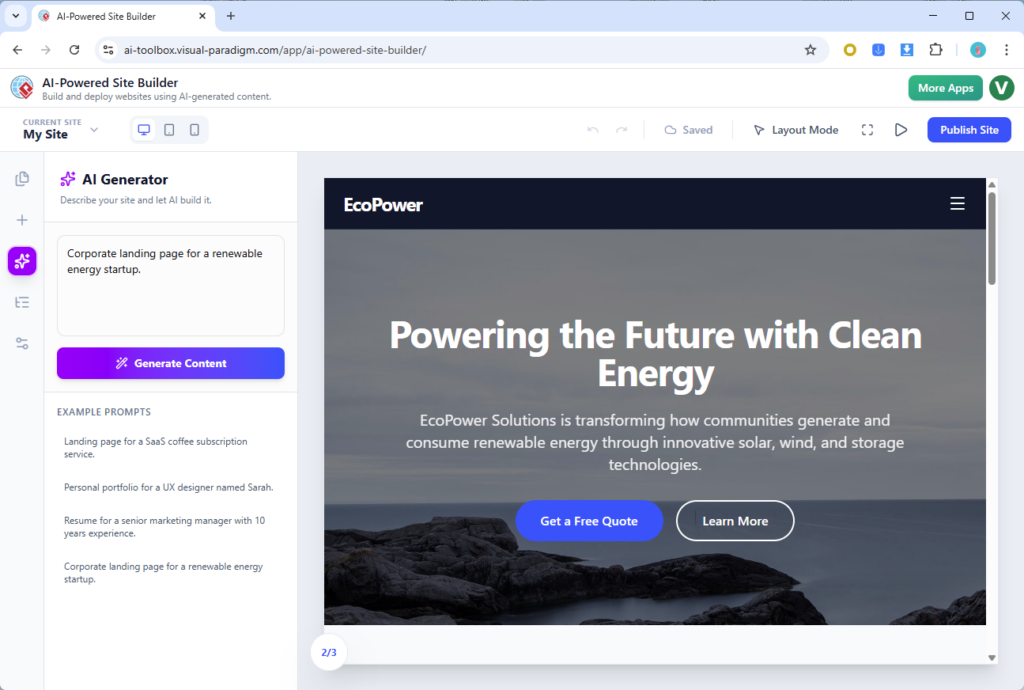
The traditional starting point of web design—a blank canvas and a cursor—has been replaced by an intelligent conversational interface. The process initiates with a single natural language description. Users input a brief overview of their business, brand vision, or project goals, and the AI engine interprets this semantic data to construct a foundational architecture.
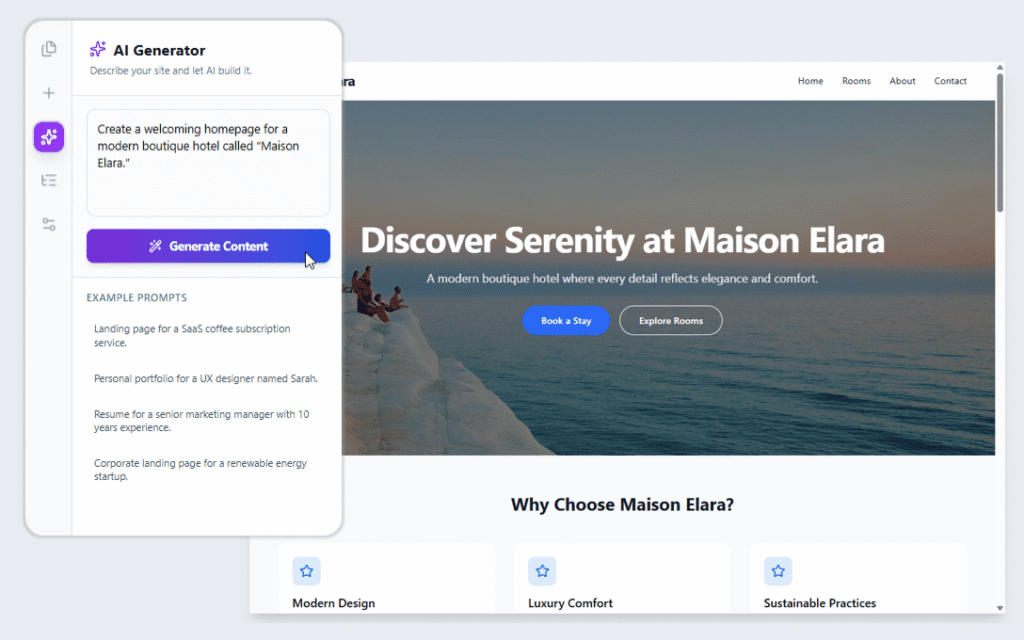
Instead of manually selecting templates, the AI performs several complex tasks simultaneously:
- Custom Layout Design: The system analyzes the industry context implies by the prompt to apply appropriate aesthetics, handling technical design elements such as typography, color theory, and whitespace management automatically.
- Structural Generation: In a single iteration, the AI creates a multi-page hierarchy, populating the site with essential sections such as “About,” “Services,” and “Contact” pages tailored to the user’s specific domain.
- Contextual Content Creation: Advanced Large Language Models (LLMs) draft human-like copy and compelling headlines, effectively eliminating “writer’s block” by providing immediate, brand-relevant text.
- Visual Asset Selection: The engine queries asset libraries to select and insert high-quality imagery that aligns with the context of the user’s description.
2. The “Digital LEGO” Customization Phase
While the AI creates the initial 90% of the website, the remaining 10% is reserved for specific brand alignment and user preference. This phase utilizes a No-Code Interface that empowers users to refine the AI-generated output without requiring knowledge of HTML, CSS, or JavaScript. The interface operates on a “what you see is what you get” (WYSIWYG) principle.
Block-Based Modular Editing
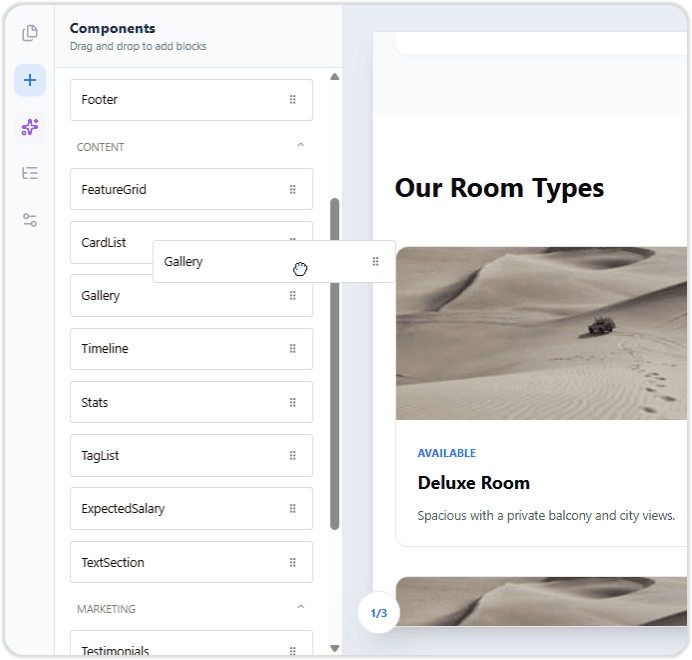
The editor functions similarly to digital building blocks. Users can manipulate the layout using a drag-and-drop mechanism, rearranging pre-designed components—such as Hero headers, image galleries, and pricing tables—with the ease of assembling LEGO bricks. This modular approach ensures that design consistency is maintained even when sections are moved.
AI-Assisted Content Refinement
To further streamline the editing process, a “Magic Wand” tool is integrated directly into the text editor. This allows users to instantly iterate on the AI’s initial draft. With a click, text can be shortened, elaborated upon, or shifted in tone (e.g., from formal to casual), ensuring the voice of the website matches the brand identity perfectly.
3. Pre-Launch Quality Assurance
Before a website becomes public, it must undergo rigorous checks to ensure functionality and visual integrity across devices. The AI builder automates much of this Quality Assurance (QA) phase to prevent common deployment errors.
Key features of this stage include:
- Responsive View Toggles: Users can instantly switch the editor viewport between desktop, tablet, and mobile configurations. This ensures that the layout responds correctly to different screen sizes and that user experience (UX) remains consistent for all visitors.
- Intelligent Checklists: A “Ready to Publish” guide acts as an automated project manager, scanning the site for missing links, placeholder text, or incomplete sections, effectively preventing premature launches.
4. Frictionless Deployment and Hosting
The final hurdle in traditional web development—server management and DNS configuration—is completely abstracted in this workflow. The system offers a one-click solution that bridges the gap between the editor and the live web.
Immediate Infrastructure Access
Upon clicking publish, the static assets and content are pushed to high-speed servers. This eliminates the need for users to configure external hosting providers or manage FTP credentials. The result is immediate availability via a unique, shareable URL (e.g., yourname.visual-paradigm.com/sitename).
Iterative Updates
The platform supports a continuous delivery model. Users can continue to experiment with new layouts or content updates in the editor without affecting the live site. Once changes are finalized, the “Re-publish” feature instantly syncs the new version to the live URL, ensuring controlled and risk-free updates.
Summary
Utilizing an AI website builder is comparable to using a GPS for a road trip. In the past, travelers had to map out every turn, monitor the engine, and navigate manually. Today, you simply input the destination. The system handles the complex navigation, routing, and mechanics, leaving the user with the sole task of enjoying the journey and selecting the scenic stops along the way.
-
AI-Powered Site Builder Release: Announcement of the new AI Site Builder tool for rapid website creation.
-
AI-Powered Website Builder Tool: A generative AI tool that enables users to create websites quickly and efficiently.
-
New AI-Powered Website Builder Release: Announcement of the latest release featuring an AI-driven website creation tool.