


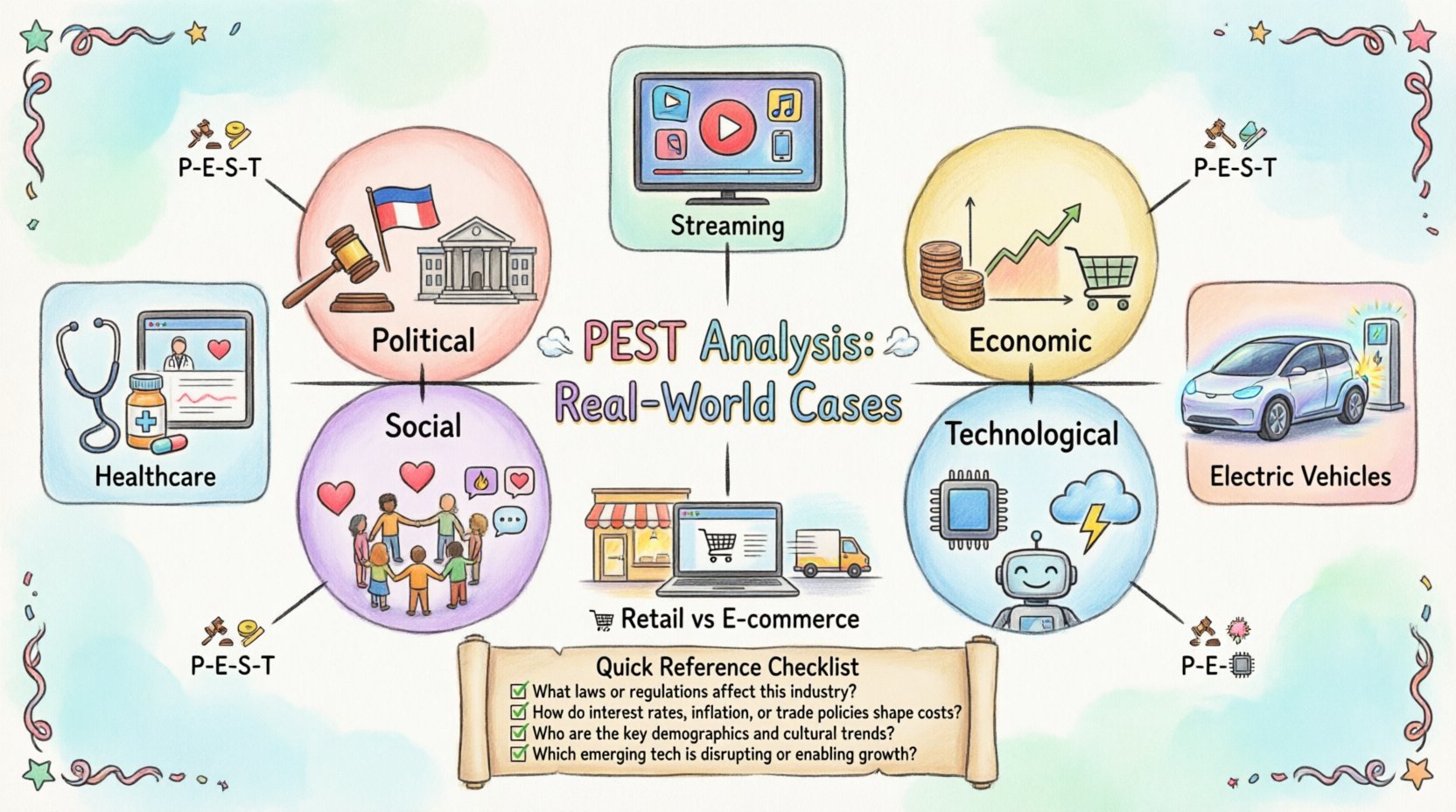
Strategic planning requires a clear view of the external landscape. Companies often focus heavily on internal capabilities, yet market shifts occur outside the four walls of the office. This is where the PEST analysis becomes indispensable. By examining Political, Economic, Social, and Technological factors, organizations can anticipate changes and adapt their strategies accordingly. This guide explores detailed PEST analysis examples to help you understand how to apply this framework effectively.
Understanding the Framework 🧩
Before diving into specific cases, it is essential to grasp what each component represents. The PEST acronym stands for:
- Political: Government policies, trade restrictions, tax laws, and labor laws.
- Economic: Growth rates, exchange rates, inflation, and interest rates.
- Social: Demographics, cultural trends, health consciousness, and lifestyle changes.
- Technological: Innovation, automation, research and development, and the rate of technological change.
When conducted correctly, this framework moves beyond simple observation. It forces decision-makers to question assumptions about the market environment. Below, we examine four distinct industry scenarios to illustrate how these factors interact.
Example 1: The Streaming Media Industry 📺
The shift from physical media to digital streaming represents a massive transformation driven by external forces. Consider a hypothetical streaming service entering a saturated market.
Political Factors
- Content Regulation: Governments may impose quotas on local content to protect domestic culture.
- Copyright Laws: Stricter intellectual property enforcement can impact licensing costs and availability.
- Trade Agreements: International treaties affect the ability to operate across borders and transfer data.
Economic Factors
- Disposable Income: In times of recession, consumers may cancel subscriptions to reduce spending.
- Advertising Revenue: Economic downturns often reduce ad spend, impacting ad-supported tiers.
- Production Costs: Inflation can drive up the cost of creating original content.
Social Factors
- Viewer Habits: Audiences prefer binge-watching over weekly releases.
- Diversity and Representation: There is increasing demand for diverse casting and storytelling.
- Family Viewing: The shift towards individual viewing screens reduces traditional family movie nights.
Technological Factors
- Internet Speed: 5G rollout allows for higher quality streaming with less buffering.
- Algorithms: AI-driven recommendation engines keep users engaged longer.
- Device Compatibility: Support for smart TVs, mobile devices, and gaming consoles is critical.
Key Takeaway: A streaming service cannot succeed by just buying content. It must navigate political regulations, economic pressures on the consumer, social shifts in consumption, and rapid technological upgrades.
Example 2: The Automotive Sector (Electric Vehicles) 🚗
The transition to electric vehicles (EVs) is one of the most prominent PEST-driven transformations in modern history. Traditional manufacturers face significant external pressures.
Political Factors
- Subsidies: Government tax credits for purchasing EVs make them more attractive than combustion engines.
- Phasing Out Combustion: Several nations have set dates to ban the sale of new gas-powered cars.
- Import Tariffs: Trade wars can impact the cost of importing batteries or components.
Economic Factors
- Battery Costs: The price of lithium and cobalt fluctuates, affecting vehicle pricing.
- Oil Prices: High fuel prices accelerate consumer interest in electric alternatives.
- Interest Rates: High rates make financing a new car more expensive, potentially slowing adoption.
Social Factors
- Environmental Awareness: Consumers are increasingly concerned about carbon footprints.
- Range Anxiety: Fear of running out of power remains a barrier for some buyers.
- Status Symbol: EVs are often viewed as a status symbol for early adopters.
Technological Factors
- Charging Infrastructure: The availability of fast-charging stations is vital for adoption.
- Autonomous Driving: Self-driving technology is often bundled with EV sales.
- Battery Efficiency: Improvements in energy density extend range and reduce cost.
Key Takeaway: In the auto industry, political incentives and technological infrastructure are just as important as the engineering of the car itself.
Example 3: Traditional Retail vs. E-Commerce 🛍️
Brick-and-mortar stores face different challenges compared to online-only retailers. A PEST analysis highlights why physical retail has struggled in recent decades.
Political Factors
- Zoning Laws: Local regulations determine where physical stores can be built.
- Minimum Wage: Labor costs for in-store staff are rising due to legislative changes.
- Data Privacy: Laws regarding consumer data collection impact online marketing strategies.
Economic Factors
- Retail Rent: Commercial real estate costs in city centers are high.
- Supply Chain Disruptions: Global logistics issues affect inventory availability for both models.
- Consumer Confidence: Economic uncertainty leads to reduced discretionary spending.
Social Factors
- Convenience Culture: Consumers prefer shopping from home with one-click delivery.
- Experiential Shopping: Physical stores must offer experiences to compete with online convenience.
- Trust Issues: Online scams make some consumers hesitant to buy without seeing the product.
Technological Factors
- Mobile Payments: Contactless payment options are now expected in-store.
- Inventory Management: Software integration between warehouses and stores is essential.
- Social Media: Marketing on platforms like Instagram drives traffic to both channels.
Example 4: Healthcare and Pharmaceuticals 🏥
The healthcare sector is highly regulated, making the Political and Social factors particularly dominant.
Political Factors
- Reimbursement Policies: Insurance coverage rules dictate what treatments are viable.
- Patent Laws: Intellectual property rights determine how long a drug can be sold exclusively.
- Healthcare Reform: Changes in national health systems alter demand for services.
Economic Factors
- Healthcare Spending: Government budgets for public health influence funding.
- Purchasing Power: Out-of-pocket costs affect patient adherence to treatment plans.
- R&D Investment: High capital requirements for drug development impact smaller firms.
Social Factors
- Aging Population: Demographics shift demand towards geriatric care and chronic disease management.
- Health Consciousness: Consumers demand preventative care and wellness products.
- Access Equity: Societal pressure to ensure healthcare is accessible to all demographics.
Technological Factors
- Telemedicine: Remote consultations reduce the need for physical visits.
- Wearables: Devices that monitor health metrics provide real-time data.
- AI Diagnostics: Algorithms assist doctors in detecting diseases earlier.
How to Conduct Your Own Analysis 📝
Applying this framework requires a structured approach. Follow these steps to ensure your analysis yields actionable insights.
Step 1: Define the Scope
Clearly state the objective. Are you launching a new product? Entering a new country? Expanding into a new demographic? The scope determines which factors are relevant.
Step 2: Gather Data
- Review industry reports and government publications.
- Analyze competitor strategies and public filings.
- Conduct surveys to understand consumer sentiment.
- Monitor news cycles for emerging regulatory threats.
Step 3: Identify and Categorize
List every potential factor under the four headings. Be specific. Instead of writing “laws,” write “new data privacy laws affecting user tracking.”
Step 4: Prioritize
Not all factors are equal. Use a matrix to rank them by impact and likelihood. Focus your strategy on the high-impact, high-likelihood items.
Step 5: Develop Strategy
Translate findings into action. If a technological shift is imminent, invest in R&D. If a social trend is growing, adjust marketing messages.
Common Pitfalls to Avoid ⚠️
Even experienced strategists make mistakes when using this framework. Be aware of these common errors.
- Static Analysis: Conducting the analysis once and filing it away. External environments change rapidly. Update the data quarterly or annually.
- Too Vague: General statements like “economy is growing” are not useful. Specify which economic indicators matter to your sector.
- Ignoring Weak Signals: Focusing only on current trends and missing emerging technologies that could disrupt the market.
- Internal Bias: Focusing only on factors that support your existing plan rather than objective truth.
- Confusing Internal with External: Ensure you are analyzing the external environment, not your company’s internal strengths or weaknesses.
PEST vs. PESTLE 🔍
Often, you will see the acronym extended to PESTLE. The two additional letters stand for Legal and Environmental. While PEST is sufficient for many general cases, PESTLE offers more granularity.
- Legal: Specific laws regarding employment, health and safety, and consumer protection.
- Environmental: Climate change, sustainability, and waste management regulations.
For most strategic planning, PEST remains the standard. However, if your industry is heavily regulated or impacted by climate policy, the expanded version provides better clarity.
Quick Reference Table 📋
| Factor | Key Questions | Example Indicator |
|---|---|---|
| Political | Is the government stable? What are the tax policies? | New tariff on imported steel |
| Economic | Is the economy growing? What is the inflation rate? | Interest rate hike by central bank |
| Social | What are the cultural norms? Is population aging? | Shift towards remote work |
| Technological | Is there new tech that disrupts the market? | Launch of AI chatbots |
Frequently Asked Questions ❓
How often should I update the PEST analysis?
External factors evolve continuously. A full review should happen at least once a year. However, significant events like a new election or a major technological breakthrough should trigger an immediate re-evaluation.
Can I use this for a small business?
Absolutely. Small businesses are often more vulnerable to external shocks than large corporations. Understanding local political changes or economic shifts can be the difference between survival and closure.
What if the factors contradict each other?
This is common. For example, economic growth might be high, but political instability could pose risks. In this case, you must weigh the risks against the opportunities. Diversification is often the best strategy to mitigate conflicting signals.
Is PEST analysis enough on its own?
It is a powerful tool, but it works best when combined with other frameworks. SWOT analysis is a natural companion, allowing you to map external PEST factors against internal Strengths and Weaknesses.
Final Thoughts 💡
Strategic success depends on more than just having a good product. It requires an accurate understanding of the world in which that product exists. By utilizing PEST analysis examples as a template, you can build a robust defense against market volatility. Whether you are in tech, retail, or healthcare, the external environment dictates the rules of play. Stay informed, stay flexible, and let data guide your decisions.
Regularly revisiting these factors ensures your organization remains agile. The landscape will always change, but a structured approach to analyzing it will remain constant.