支持TOGAF ADM的ArchiMate综合教程

ArchiMate简介

ArchiMate是一种开放且独立的企业架构建模语言,支持对业务领域内及跨业务领域的架构进行描述、分析和可视化。它旨在为向利益相关者清晰且无歧义地传达复杂架构提供一种方式。当与TOGAF架构开发方法(ADM)结合使用时,ArchiMate尤其有用,能够提供一种标准化的方式来建模和沟通企业架构。
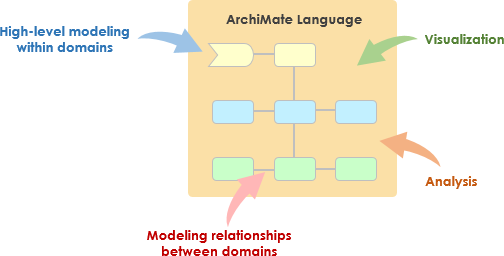
What is ArchiMate?

ArchiMate的核心概念

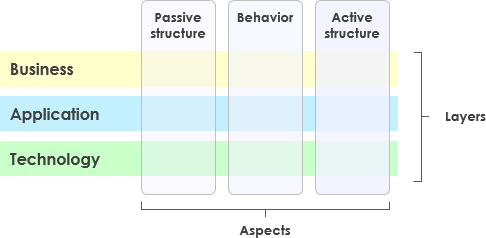
ArchiMate Core Framework

1. ArchiMate的层级

ArchiMate将企业架构划分为三个主要层级:

  • 业务层:关注支持组织目标的业务流程、服务和功能。
  • 应用层:处理支持业务层的应用服务、组件及其交互。
  • 技术层:涵盖技术基础设施,包括支持应用层的硬件、软件和网络组件。

2. 核心元素

ArchiMate定义了若干用于建模架构的核心元素:

  • 主动结构元素:表示执行行为的实体,如业务参与者、应用组件和设备。
  • 行为元素:表示架构内的流程、功能、服务和交互。
  • 被动结构元素:表示由行为元素使用或产生的信息或数据,如业务对象和数据对象。

3. 关系

ArchiMate定义了多种关系类型以连接各个元素:

  • 结构关系:例如组合、聚合和特化。
  • 依赖关系:例如关联、实现和被使用。
  • 动态关系: 例如触发和流程。

4. 视角

ArchiMate 提供了多个视角,用于从不同角度可视化架构:

  • 业务流程视角: 展示业务流程及其交互。
  • 应用协作视角: 展示应用程序如何协作以支持业务流程。
  • 技术实现视角: 展示技术组件如何实现应用组件。

ArchiMate 与 TOGAF ADM

TOGAF 架构开发方法(ADM)

TOGAF ADM 是一种全面的开发企业架构的方法论。它由多个阶段组成,每个阶段专注于架构开发过程中的特定方面。ArchiMate 通过提供一种标准化的方式来建模和可视化每个阶段的架构,从而支持 TOGAF ADM。
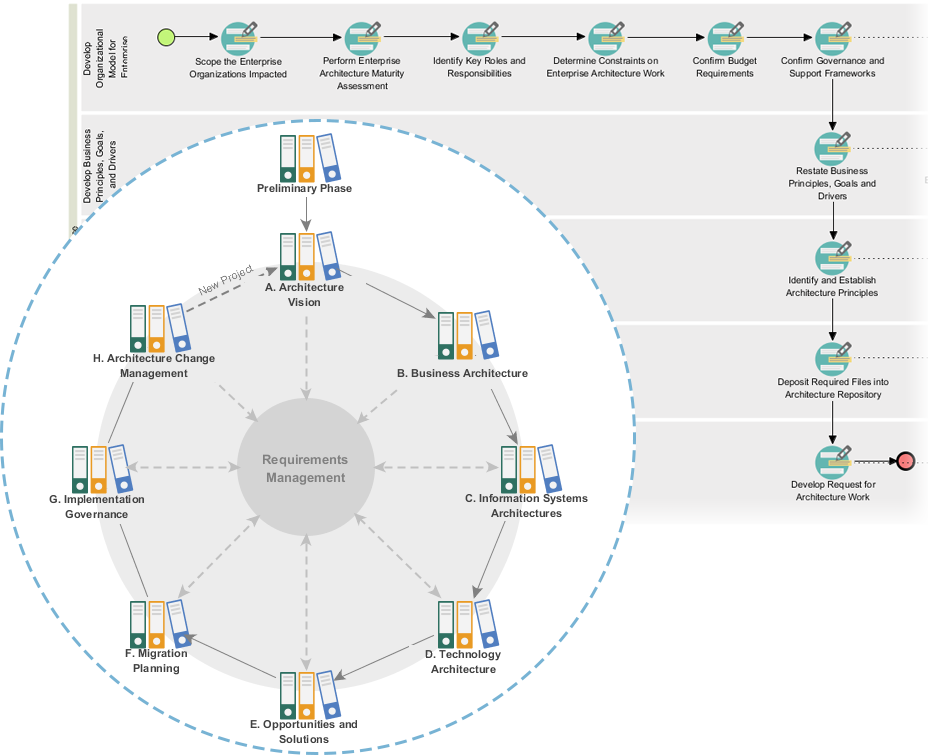
Powerful TOGAF ADM Toolset

TOGAF ADM 的阶段

  1. 初步阶段: 确立架构原则、框架和治理。
  2. 架构愿景: 定义范围、利益相关者、关注点和业务目标。
  3. 业务架构: 开发业务架构,包括业务流程和服务。
  4. 信息系统架构: 开发数据架构和应用架构。
  5. 技术架构: 开发技术架构。
  6. 机遇与解决方案: 识别并优先考虑架构项目。
  7. 迁移规划: 制定迁移和实施计划。
  8. 实施治理: 为架构的实施提供治理和支持。

ArchiMate模型示例

此图展示了医疗管理系统的一种分层架构,分为两个主要层级:应用层以及技术层以下是各组件及其交互的详细说明:
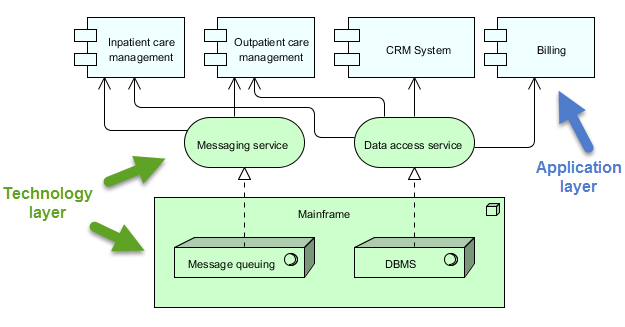
archimate diagram example

应用层(蓝色)

该层由各种直接与用户或其他系统交互以管理医疗服务的应用程序和系统组成。该层的关键组件包括:

  1. 住院护理管理:

    • 管理与住院患者相关的服务和流程。
  2. 门诊护理管理:

    • 管理前往医院接受治疗但未住院的患者的服务和流程。
  3. CRM系统(客户关系管理):

    • 管理与患者的互动,包括沟通、随访以及患者关系管理。
  4. 账单管理:

    • 处理财务相关事务,包括生成账单、处理付款以及管理财务记录。

技术层(绿色)

该层提供支持应用层应用程序的底层基础设施和服务。该层的关键组件包括:

  1. 消息服务:

    • 促进医疗管理系统内不同应用程序和系统之间的通信。
    • 确保消息可靠且按正确顺序传递。
  2. 数据访问服务:

    • 提供一种集中访问和管理整个系统数据的方式。
    • 确保数据能够高效且安全地被检索和存储。
  3. 主机:

    • 中央计算系统,用于托管核心服务和数据。
    • 包括两个主要组件:
      • 消息队列:管理消息的排队和处理,以确保可靠通信。
      • 数据库管理系统(DBMS):存储并管理各个应用程序使用的数据。

交互

  • 住院护理管理门诊护理管理客户关系管理系统,以及计费消息服务数据访问服务以执行各自的功能。
  • 消息服务数据访问服务依赖于主机提供核心服务,如消息队列和数据库管理。
  • 主机确保消息被正确处理,数据得到高效管理,从而支持整个系统运行。

该图描绘了一种通过将应用层功能与底层技术基础设施分离来管理医疗服务的结构化方法。这种分离使得系统设计更具模块性和可维护性,其中一层的更改对另一层的影响最小。消息服务数据访问服务充当中介,促进应用组件与主机系统之间的通信和数据管理。

推荐的ArchiMate企业架构工具

Visual Paradigm被广泛认为是企业架构(EA)项目中用于ArchiMate建模的最佳工具之一。以下是它被强烈推荐的一些原因:
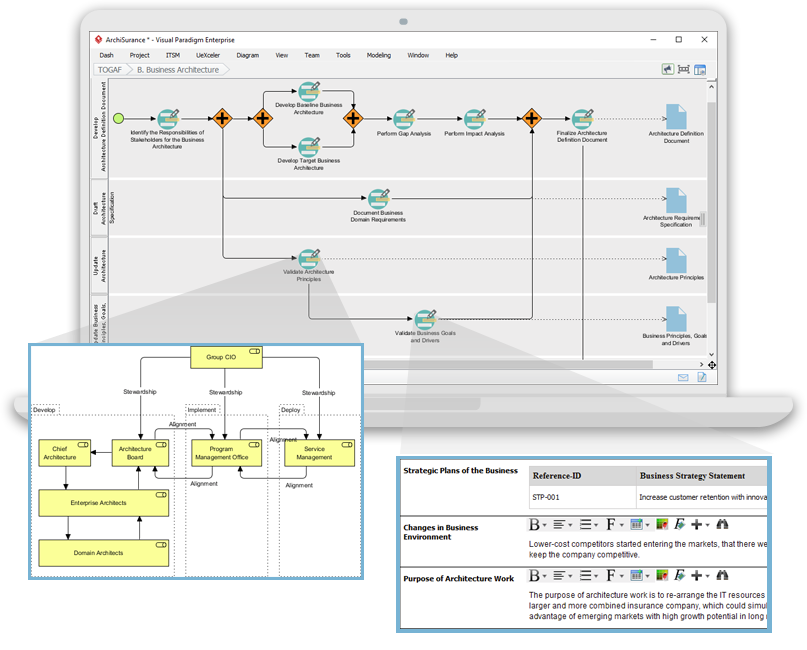
Navigating TOGAF: Your Guide to the ADM Process - Visual Paradigm Guides

1. 全面的ArchiMate支持

  • 完整的ArchiMate标准:Visual Paradigm支持最新的ArchiMate标准,包括ArchiMate 3.1,确保您可以使用所有官方的ArchiMate元素和关系进行建模。
  • 丰富的元素库:它提供了一个庞大的ArchiMate符号库,便于创建详细且准确的模型。

2. 用户友好的界面

  • 直观的设计:该工具提供易于导航的用户友好界面,即使是初次接触ArchiMate建模的用户也能轻松使用。
  • 拖放功能:拖放功能可实现快速高效的模型创建。

3. 高级建模功能

  • 分层视图:支持创建分层视图(如业务层、应用层、技术层),以提供企业架构的整体视图。
  • 跨层关系:可轻松定义并可视化架构中不同层级之间的关系。

4. 协作与共享

  • 团队协作:Visual Paradigm支持协作工作,允许多个用户同时在同一项目上工作。
  • 版本控制:集成的版本控制有助于管理变更并跟踪模型的演变过程。

5. 集成能力

  • 工具集成:可无缝集成其他工具和平台,如 JIRA、Confluence 和各种数据库,从而提升整体企业架构实践。
  • 导入/导出:支持以多种格式导入和导出模型,包括 ArchiMate 交换文件格式,确保与其他工具的兼容性。

6. 文档与报告

  • 自动生成文档:从您的 ArchiMate 模型自动生成全面的文档,节省时间并确保一致性。
  • 自定义报告:允许创建针对特定利益相关者需求的自定义报告。

7. 培训与支持

  • 丰富的资源:提供大量教程、指南和示例,帮助用户入门并掌握 ArchiMate 建模。
  • 客户支持:提供强大的客户支持,协助解决可能出现的任何问题或疑问。

8. 可扩展性

  • 可扩展的解决方案:适用于中小型和大型企业架构项目,是各类规模组织的多功能工具。

9. 合规性与标准

  • 行业标准:符合行业标准和最佳实践,确保您的企业架构模型合规且保持最新。

结论

ArchiMate 提供了一种强大且标准化的方式来建模企业架构,支持 TOGAF ADM 方法论。通过理解 ArchiMate 中的关键概念、层级、元素和关系,您可以有效地建模并将其复杂架构向利益相关者清晰传达。所提供的示例展示了如何使用 ArchiMate 来建模业务流程、应用协作和技术实现,支持 TOGAF ADM 的各个阶段。

ArchiMate 工具资源

  1. 免费在线 ArchiMate 图表工具

    • 描述: 使用支持 ArchiMate 3 可视化建模语言的免费工具在线创建 ArchiMate 图表。包含示例和模板,帮助您快速上手。
    • 网址免费在线 ArchiMate 图表工具 1
  2. 主页 – 免费 ArchiMate 资源

    • 描述: 提供一种可视化语言来建模和捕捉企业架构,提供一种可视化不同领域内部及之间关系的方法。
    • 网址主页 – 免费 ArchiMate 资源 2
  3. Visual Paradigm – UML、敏捷、PMBOK、TOGAF、BPMN 等更多

  4. 第 7 章. ArchiMate – Visual Paradigm 社区圈

  5. 什么是 ArchiMate?

    • 描述: 逐步学习指南,涵盖如何使用ArchiMate进行企业架构建模。
    • 网址什么是ArchiMate? 5
  6. ArchiMate工具

    • 描述: 学习如何使用Visual Paradigm,这是一款专为敏捷软件团队设计的设计和管理工具。
    • 网址ArchiMate工具 6
  7. 最佳ArchiMate软件

    • 描述: 经认证的ArchiMate工具,用于高效的企业架构设计与建模。可快速绘制符合开放组官方规范的ArchiMate图表。
    • 网址最佳ArchiMate软件 7
  8. 如何格式化ArchiMate元素?

  9. ArchiMate视角指南 – 资源映射视角

  10. ArchiMate 图表教程

    • 描述:本教程帮助您了解 ArchiMate 图表、如何创建它们以及何时使用它们。包含示例和技巧。
    • 网址ArchiMate 图表教程 10

这些资源应能为使用 Visual Paradigm 的 ArchiMate 工具进行企业架构建模提供全面的起点。
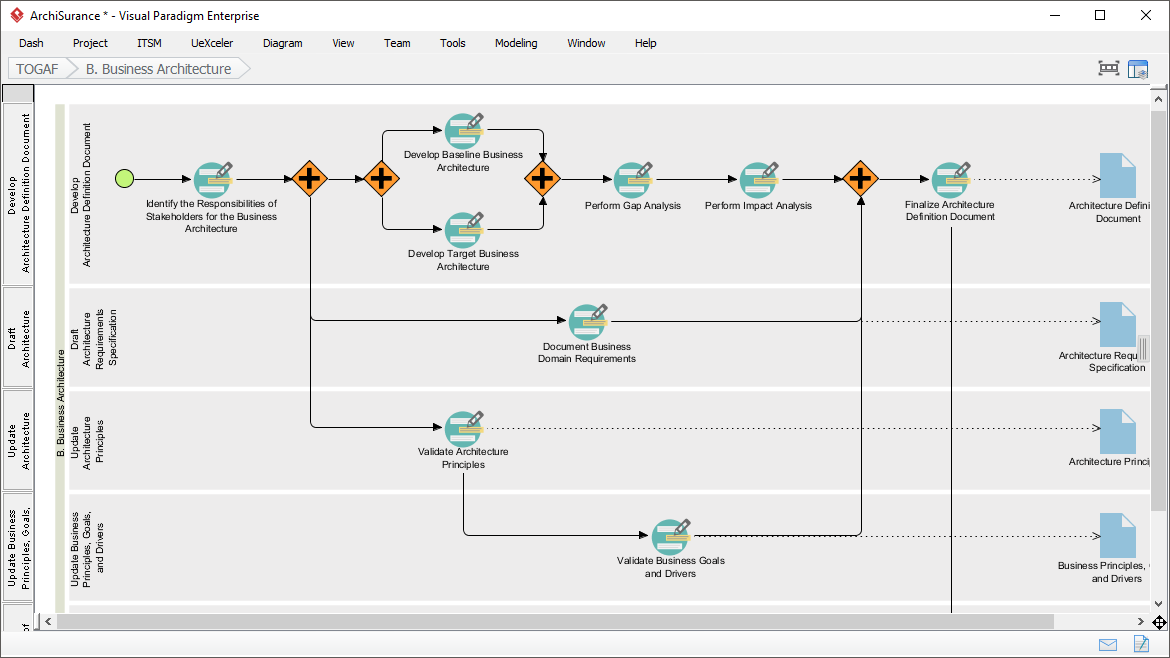
Visual Paradigm TOGAF引导流程全面指南

简介

Visual Paradigm 的 TOGAF 引导流程是一款强大的工具,旨在简化 TOGAF 架构开发方法(ADM)的采用。它提供逐步指导、操作说明和真实案例,以支持企业架构的开发。本全面指南将探讨 Visual Paradigm TOGAF 引导流程的关键特性、优势和应用领域,突出其在企业架构领域中的独特之处。

Transform Your Business with Visual Paradigm and TOGAF - Visual Paradigm Guides

主要特性

  1. 逐步指导:

    • 引导流程为 TOGAF ADM 的每个阶段提供详细且逐步的指导,确保用户能够轻松应对企业架构开发的复杂性。1112.
  2. 与 ArchiMate 的集成:

    • Visual Paradigm 支持 ArchiMate 与 TOGAF ADM 的集成,为企业的架构项目提供强大的组合。ArchiMate 3 拥有灵活的符号系统,使架构师能够有效地表达复杂模型。1314.
  3. 自动化任务管理:

    • 该工具通过自动化任务管理和通知功能提升整个流程,使用户能够逐步且协作地开发架构交付成果。15.
  4. 可视化流程图:

    • 该软件具备可视化流程图,帮助用户轻松地贯穿整个企业架构流程。它提供了一整套规划、设计和开发工具,以完成 ADM 活动。14.
  5. 全面的工具包:

    • Visual Paradigm 提供一系列专为 ADM 活动设计的工具,包括用于建模企业架构中业务、IT 和物理层面的 ArchiMate 图表。这些工具提供了架构的全面视图,使 TOGAF 的理解和实施更加容易。14.

优势

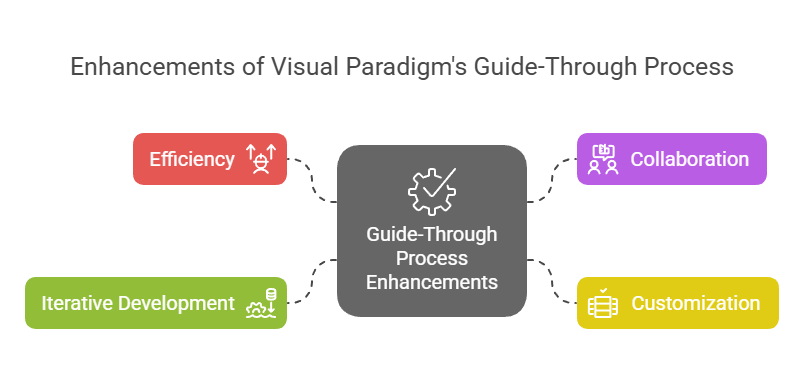
Enhancements of Visual Paradigm's Guide-Through Process: Visual Paradigm

  1. 效率:

    • 引导流程通过提供清晰的指导和自动化任务,显著提升了效率,使用户能够专注于战略决策,而非程序性细节11.
  2. 协作:

    • 该工具促进了项目所有者、业务分析师、企业架构师和IT专业人员等不同利益相关者之间的协作。这种协作方式确保各方在整个架构开发过程中保持参与并充分了解情况15.
  3. 定制化:

    • Visual Paradigm的工具支持定制化,使组织能够根据自身特定需求和目标调整ADM流程。这种灵活性确保架构开发过程与组织的独特需求相一致11.
  4. 迭代开发:

    • TOGAF ADM的迭代特性得到了Visual Paradigm引导流程的全面支持。这使得实践者能够根据不断变化的信息需求和利益相关者的反馈来调整和优化工作,确保架构满足组织不断变化的需求16.

应用领域

  1. 企业架构开发:

    • 主要应用领域是企业架构开发,引导流程帮助组织设计、规划、实施和管理其企业架构。它提供了一种结构化的方法,以有效实现业务目标与IT战略的对齐17.
  2. 数字化转型:

    • 该工具对于数字化转型举措至关重要,组织通过实施新技术和流程来提升客户体验和运营效率18.
  3. 战略规划:

    • Visual Paradigm的引导式流程通过提供一个全面的框架,支持战略规划,包括制定架构愿景、界定范围、识别利益相关者以及制定沟通计划。这确保了架构开发过程与业务目标和战略驱动因素保持一致19.
  4. 敏捷方法:

    • 该工具整合了敏捷方法和UML,为企业发展企业架构提供了全面的解决方案。这种整合确保了架构开发过程既灵活又高效,支持组织内部的敏捷实践14.

结论

Visual Paradigm的TOGAF引导式流程在支持TOGAF ADM方面表现出色,是一款全面且高效的工具。其逐步指导、与ArchiMate的集成、自动化任务管理以及协作功能,使其成为企业架构开发的宝贵资源。通过利用该工具,组织可以提升效率、协作性、定制化和迭代开发能力,最终实现企业架构目标,推动业务价值和转型

ArchiMate 3.2 第三章

3 语言结构

本章描述了ArchiMate企业架构建模语言的结构。其标准元素和关系的详细定义及示例将在第4章至第1章中介绍

3.1 语言设计考虑

在开发企业架构通用元模型的过程中,一个关键挑战是在特定领域语言的精确性与一套非常通用的架构概念之间取得平衡,后者反映了将系统视为一系列相互关联实体的观点。

ArchiMate语言的设计始于一组相对通用的概念。这些概念已在后续章节中说明,针对不同架构层级进行了专门化应用。该语言最重要的设计限制是,它被明确设计为尽可能小,但仍能满足大多数企业架构建模任务的需求。许多其他语言试图满足所有潜在用户的需求。为了便于学习和使用,ArchiMate语言仅限于足以建模所谓80%实际案例的概念。

本标准并未详细说明ArchiMate语言设计背后的详细理由。感兴趣的读者可参考[1]、[2]和[3],其中详细描述了语言构建及设计考虑因素。

3.2 顶层语言结构

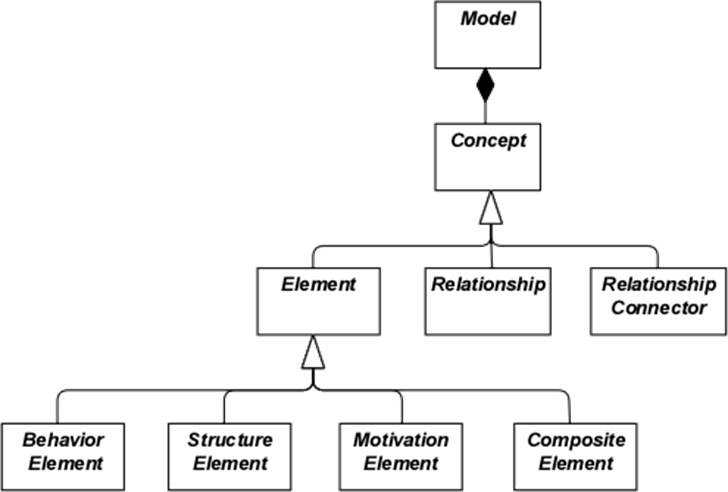
图1概述了该语言的顶层分层结构:

  • 模型是一组概念——一个概念要么是元素,要么是关系
  • 元素可以是行为元素、结构元素、动机元素或复合元素

请注意,这些是抽象概念;它们并非直接用于模型中。为表示这一点,它们以白色呈现,标签使用斜体。有关图1中所用符号的解释,请参见第4章。

图1:ArchiMate概念的顶层层级结构

3.3 ArchiMate语言的分层

ArchiMate核心语言定义了一组通用元素及其关系的结构,这些可在不同层级中进行专门化。ArchiMate核心语言中定义了以下三个层级:

  1. 业务层描述了向客户提供的业务服务,这些服务由业务角色执行的业务流程在组织中实现。
  2. 应用层描述了支持业务的应用服务及其实现这些服务的应用程序。
  3. 技术层包含信息技术和运营技术。例如,您可以建模处理、存储和通信技术以支持应用层和业务层,也可以通过设施、物理设备、材料和分销网络来建模运营或物理技术。

不同层中模型的总体结构相似。使用相同类型的元素和关系,尽管它们的具体性质和粒度有所不同。在下一章中将介绍通用元模型的结构。在第8章、第9章和第10章中,这些元素将被具体化,以获得特定层特有的元素。

与服务导向一致,层之间最重要的关系是由“服务”关系形成的[1]关系,展示一个层中的元素如何被其他层的服务所支持。(然而请注意,服务不仅可支持另一层的元素,也可以支持同一层的元素。)第二种链接由实现关系构成:下层的元素可以实现上层的对应元素;例如,一个

“数据对象”(应用层)可以实现一个“业务对象”(业务层);或者一个

“构件”(技术层)可以实现“数据对象”或“应用组件”(应用层)。

3.4 ArchiMate 核心框架

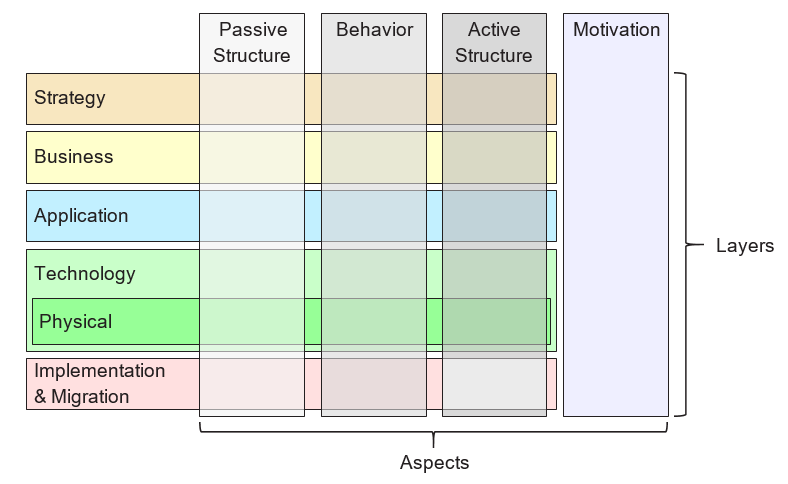
ArchiMate 核心框架是一个由九个单元组成的框架,用于对 ArchiMate 核心语言的元素进行分类。它由三个方面和三个层组成,如图2所示。这被称为 ArchiMate 核心框架。

重要的是要理解,基于方面和层对元素进行分类仅是一种总体分类。现实中的架构元素不必严格局限于某一特定方面或层,因为连接不同方面和层的元素在连贯的架构描述中起着核心作用。例如,提前讨论后续的概念性内容,业务角色作为“纯行为性”元素与“纯结构性”元素之间的中介元素,而某个软件是否被视为应用层或技术层的一部分,可能取决于具体上下文。

图2:ArchiMate 核心框架

该框架的结构允许从不同视角对企业进行建模,其中单元格中的位置突出了利益相关者的关注点。利益相关者通常可能关注多个单元格。

该框架的维度如下:

  • 层——ArchiMate 中企业可以建模的三个层次——业务层、应用层和技术层(如第3.3节所述)
  • 方面:

主动结构方面,代表结构元素(展示实际行为的业务参与者、应用组件和设备;即行为的“主体”)

活动的“主体”)

行为方面,代表行为(流程、功能、事件和服务);结构元素被分配给行为元素,以表明谁或什么展示了该行为

被动结构方面,代表行为作用的对象;这些通常是业务层的信息对象和应用层的数据对象,但也可能用于表示物理对象

这三个方面受到自然语言的启发,因为一个句子包含主语(主动结构)、谓语(行为)和宾语(被动结构)。通过使用人们在其母语中熟悉的相同构造,ArchiMate 语言更容易学习和阅读。

由于 ArchiMate 符号是一种图形化语言,其中元素按空间组织,因此这种顺序在建模中并不重要。

复合元素,如图1所示,是一种不一定局限于框架中单一方面(列)的元素,而可能结合两个或多个方面。

请注意,ArchiMate 语言并不要求建模者使用任何特定的布局,例如本框架的结构;它仅仅是对语言元素的分类。

3.5 ArchiMate 完整框架

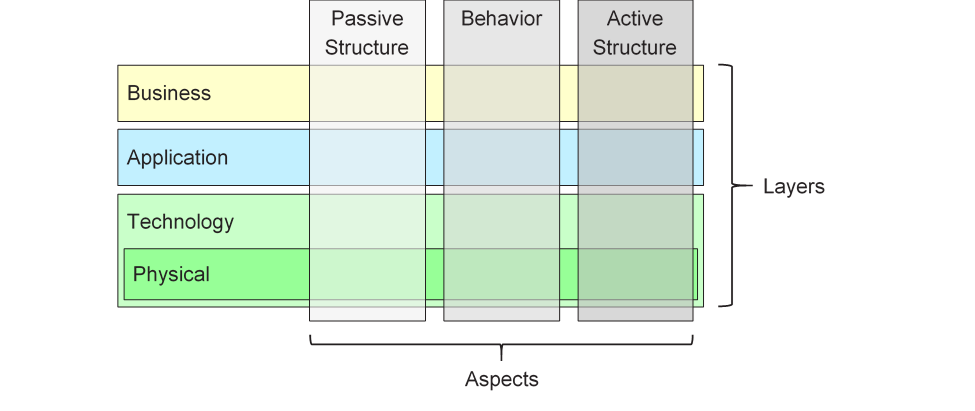
本标准版本所述的 ArhiMate 完整框架在核心框架的基础上增加了若干层和一个方面。物理元素被包含在技术层中,用于对物理设施、设备、分发网络和材料进行建模。因此,这些元素也是核心元素。战略元素被引入以建模战略方向和选择,相关内容在第7章中描述。动机方面在下一章以通用形式引入,并在第6章中详细说明。实施与迁移元素在第12章中描述。由此产生的 ArhiMate 完整框架如图3所示。

图3:ArchiMate 完整框架

ArchiMate 语言并未为信息定义特定的层;然而,被动结构方面的元素,如业务对象、数据对象和工件,被用来表示信息实体。信息建模在 ArhiMate 的不同层级中均得到支持。

3.6 ArchiMate 语言中的抽象

ArchiMate 语言的结构支持几种常见的抽象与细化形式。首先,外部(黑箱,从盒子内容中抽象)与内部(白箱)视图之间的区别在系统设计中十分常见。外部视图描述系统对环境所必须完成的任务,而内部视图则描述系统如何完成这些任务。

其次,行为与主动结构之间的区别常被用来将系统必须完成的任务及其执行方式,与执行这些任务的系统构成要素(人员、应用程序和基础设施)区分开来。在建模新系统时,通常从系统必须执行的行为开始较为有利;而在建模现有系统时,通常从构成系统的人员、应用程序和基础设施入手,再详细分析这些主动结构所执行的行为。

第三种区别是概念、逻辑和物理抽象层级之间的差异。这一区分源于数据建模:概念元素代表业务认为相关的数据;逻辑元素为这些信息提供逻辑结构,以便信息系统进行处理;物理元素描述这些信息的存储方式,例如以文件或数据库表的形式。在 ArhiMate 语言中,这对应于业务对象、数据对象和工件,以及它们之间的实现关系。

逻辑元素与物理元素之间的区别也被应用于应用程序的描述中。TOGAF 企业元模型[4]包含一组实体,用于描述业务、数据、应用和科技组件及服务,以表达架构概念。逻辑组件是与实现或产品无关的数据或功能封装,而物理组件则是有形的软件组件、设备等。这一区别在 TOGAF 框架中以架构构建块(ABBs)和解决方案构建块(SBBs)的形式体现。这一区别在将企业架构从高层次的抽象描述推进到具体的实现级设计时依然具有重要意义。请注意,构建块可能包含多个元素,这些元素通常使用 ArhiMate 语言中的分组概念进行建模。

ArchiMate 语言提供了三种建模此类抽象的方式。首先,如[6]所述,行为元素(如应用功能和技术功能)可用于建模逻辑组件,因为它们代表了与实现无关的功能封装。相应的物理组件则可通过分配给行为元素的主动结构元素(如应用组件和节点)进行建模。其次,ArchiMate 语言支持实现的概念。这最好通过自技术层向上进行说明。技术层定义了实现应用组件的物理工件和软件,同时也提供了与实现信息系统所需其他物理概念(如设备、网络等)的映射。实现关系还可用于建模更抽象的实现关系,例如在(更具体)需求与(更通用)原则之间,需求的满足意味着对原则的遵循。实现关系也允许存在于应用组件之间以及节点之间。这样,可以分别建模物理应用或技术组件实现逻辑应用或技术组件。第三,逻辑和物理应用组件可被定义为应用组件元素的元模型级别特化,如第14章所述(另见14.2.2节中的示例)。TOGAF 内容元模型中的逻辑和物理技术组件也以相同方式定义为节点元素的特化(参见14.2.3节)。

ArchiMate 语言有意不支持类型与实例之间的区别。在企业架构的抽象层次上,更常见的是建模类型和/或示例,而非实例。同样,ArchiMate 语言中的业务流程并不描述一个具体的实例(即该流程的一次执行)。因此,在大多数情况下,使用业务对象来建模对象类型(参见一个UML®类),组织内可能存在多个此类实例。例如,每次保险申请流程的执行可能会产生一个具体的保险保单业务对象实例,但这一实例在企业架构中并未被建模。

3.7 概念及其表示法

ArchiMate 语言将语言概念(即元模型的构成要素)与其表示法分离开来。不同的利益相关者群体可能需要不同的表示法,以便理解架构模型或视图。在这方面,ArchiMate 语言与 UML 或 BPMN™ 等语言不同,后者仅有一种标准化的表示法。第13章中解释的视角机制提供了定义此类面向利益相关者的可视化方法。

尽管 ArchiMate 概念的表示法可以(并且应当)针对不同利益相关者进行定制,但本标准提供了一种通用的图形表示法,可供架构师及其他 ArchiMate 模型开发者使用。该表示法面向熟悉现有技术建模方法(如实体关系图 ERD、UML 或 BPMN)的受众,因此与其相似。在本文档其余部分,除非另有说明,用于表示语言概念的符号均代表 ArchiMate 标准表示法。大多数元素的标准表示法为右上角带有一个图标的小方框。在某些情况下,该图标本身也可作为替代表示法使用。应尽可能优先使用这种标准图示,以便任何熟悉 ArchiMate 语言的人都能读懂该语言生成的图表。

3.8 嵌套的使用

将元素嵌套在其他元素内部,可作为表达某些关系的替代图形表示法。这在第5章以及每种关系的定义中均有详细说明。

3.9 颜色与符号提示的使用

在本标准中的元模型图示中,使用灰色的深浅来区分属于 ArhiMate 框架不同方面的元素,具体如下:

  • 白色:抽象(即不可实例化)概念
  • 浅灰色:被动结构
  • 中灰色:行为
  • 深灰色:主动结构

在 ArhiMate 模型中,颜色没有正式的语义定义,颜色的使用由建模者自行决定。然而,它们可以自由用于强调模型中的某些方面。例如,在本标准展示的许多示例模型中,颜色被用来区分 ArhiMate 核心框架的各层,具体如下:

  • 黄色:业务层
  • 蓝色:应用层
  • 绿色:技术层

它们也可用于视觉强调。推荐参考文献[1]的第6章以获取相关指导。除了颜色外,还可使用其他符号提示来区分框架的各层。元素左上角的字母 M、S、B、A、T、P 或 I 可分别表示动机、战略、业务、应用、技术、物理或实施与迁移元素。该表示法的示例见示例34。

标准符号还使用一种约定,即通过符号角的形状来表示不同元素类型,具体如下:

  • 方形角用于表示结构元素
  • 圆角用于表示行为元素
  • 对角线角用于表示动机元素

[1]请注意,此名称在标准的早期版本中被称为“被使用”。为便于理解,现已更改为“服务”。

ArchiMate 3.2 Chapter 3

3 Language Structure

This chapter describes the structure of the ArchiMate Enterprise Architecture modeling language. The detailed definition and examples of its standard set of elements and relationships follow in Chapter 4 to Chapter 1

3.1 Language Design Considerations

A key challenge in the development of a general metamodel for Enterprise Architecture is to strike a balance between the specificity of languages for individual architecture domains and a very general set of architecture concepts, which reflects a view of systems as a mere set of inter-related entities.

The design of the ArchiMate language started from a set of relatively generic concepts. These have been specialized towards application at different architectural layers, as explained in the following sections. The most important design restriction on the language is that it has been explicitly designed to be as small as possible, but still usable for most Enterprise Architecture modeling tasks. Many other languages try to accommodate the needs of all possible users. In the interest of simplicity of learning and use, the ArchiMate language has been limited to the concepts that suffice for modeling the proverbial 80% of practical cases.

This standard does not describe the detailed rationale behind the design of the ArchiMate language. The interested reader is referred to [1], [2], and [3], which provide a detailed description of the language construction and design considerations.

3.2 Top-Level Language Structure

Figure 1 outlines the top-level hierarchical structure of the language:

  • A model is a collection of concepts – a concept is either an element or a relationship
  • An element is either a behavior element, a structure element, a motivation element, or a composite element

Note that these are abstract concepts; they are not intended to be used directly in models. To signify this, they are depicted in white with labels in italics. See Chapter 4 for an explanation of the notation used in Figure 1.

Figure 1: Top-Level Hierarchy of ArchiMate Concepts

3.3 Layering of the ArchiMate Language

The ArchiMate core language defines a structure of generic elements and their relationships, which can be specialized in different layers. Three layers are defined within the ArchiMate core language as follows:

  1. The Business Layer depicts business services offered to customers, which are realized in the organization by business processes performed by business actors.
  2. The Application Layer depicts application services that support the business, and the applications that realize them.
  3. The Technology Layer comprises both information and operational technology. You can model, for example, processing, storage, and communication technology in support of the application world and Business Layers, and model operational or physical technology with facilities, physical equipment, materials, and distribution networks.

The general structure of models within the different layers is similar. The same types of elements and relationships are used, although their exact nature and granularity differ. In the next chapter, the structure of the generic metamodel is presented. In Chapter 8, Chapter 9, and Chapter 10 these elements are specialized to obtain elements specific to a particular layer.

In alignment with service-orientation, the most important relationship between layers is formed by “serving”[1] relationships, which show how the elements in one layer are served by the services of other layers. (Note, however, that services need not only serve elements in another layer, but also can serve elements in the same layer.) A second type of link is formed by realization relationships: elements in lower layers may realize comparable elements in higher layers; e.g., a

“data object” (Application Layer) may realize a “business object” (Business Layer); or an

“artifact” (Technology Layer) may realize either a “data object” or an “application component” (Application Layer).

3.4 The ArchiMate Core Framework

The ArchiMate Core Framework is a framework of nine cells used to classify elements of the ArchiMate core language. It is made up of three aspects and three layers, as illustrated in Figure 2. This is known as the ArchiMate Core Framework.

It is important to understand that the classification of elements based on aspects and layers is only a global one. Real-life architecture elements need not strictly be confined to one aspect or layer because elements that link the different aspects and layers, play a central role in a coherent architectural description. For example, running somewhat ahead of the later conceptual discussions, business roles serve as intermediary elements between “purely behavioral” elements and “purely structural” elements, and it may depend on the context whether a certain piece of software is considered to be part of the Application Layer or the Technology Layer.

Figure 2: ArchiMate Core Framework

The structure of the framework allows for modeling of the enterprise from different viewpoints, where the position within the cells highlights the concerns of the stakeholder. A stakeholder typically can have concerns that cover multiple cells.

The dimensions of the framework are as follows:

  • Layers – the three levels at which an enterprise can be modeled in ArchiMate – Business, Application, and Technology (as described in Section 3.3)
  • Aspects:

— The Active Structure Aspect, which represents the structural elements (the business actors, application components, and devices that display actual behavior; i.e., the

“subjects” of activity)

— The Behavior Aspect, which represents the behavior (processes, functions, events, and services) performed by the actors; structural elements are assigned to behavioral elements, to show who or what displays the behavior

— The Passive Structure Aspect, which represents the objects on which behavior is performed; these are usually information objects in the Business Layer and data objects in the Application Layer, but they may also be used to represent physical objects

These three aspects were inspired by natural language where a sentence has a subject (active structure), a verb (behavior), and an object (passive structure). By using the same constructs that people are used to in their own languages, the ArchiMate language is easier to learn and read.

Since ArchiMate notation is a graphical language where elements are organized spatially, this order is of no consequence in modeling.

A composite element, as shown in Figure 1, is an element that does not necessarily fit in a single aspect (column) of the framework but may combine two or more aspects.

Note that the ArchiMate language does not require the modeler to use any particular layout such as the structure of this framework; it is merely a categorization of the language elements.

3.5 The ArchiMate Full Framework

The ArchiMate Full Framework, as described in this version of the standard, adds a number of layers and an aspect to the Core Framework_._ The physical elements are included in the Technology Layer for modeling physical facilities and equipment, distribution networks, and materials. As such, these are also core elements. The strategy elements are introduced to model strategic direction and choices. They are described in Chapter 7. The motivation aspect is introduced at a generic level in the next chapter and described in detail in Chapter 6. The implementation and migration elements are described in Chapter 12. The resulting ArchiMate Full Framework is shown in Figure 3.

Figure 3: ArchiMate Full Framework

The ArchiMate language does not define a specific layer for information; however, elements from the passive structure aspect such as business objects, data objects, and artifacts are used to represent information entities. Information modeling is supported across the different ArchiMate layers.

3.6 Abstraction in the ArchiMate Language

The structure of the ArchiMate language accommodates several familiar forms of abstraction and refinement. First of all, the distinction between an external (black-box, abstracting from the contents of the box) and internal (white-box) view is common in systems design. The external view depicts what the system has to do for its environment, while the internal view depicts how it does this.

Second, the distinction between behavior and active structure is commonly used to separate what the system must do and how the system does it from the system constituents (people, applications, and infrastructure) that do it. In modeling new systems, it is often useful to start with the behaviors that the system must perform, while in modeling existing systems, it is often useful to start with the people, applications, and infrastructure that comprise the system, and then analyze in detail the behaviors performed by these active structures.

A third distinction is between conceptual, logical, and physical abstraction levels. This has its roots in data modeling: conceptual elements represent the information the business finds relevant; logical elements provide logical structure to this information for manipulation by information systems; physical elements describe the storage of this information; for example, in the form of files or database tables. In the ArchiMate language, this corresponds with business objects, data objects, and artifacts, along with the realization relationships between them.

The distinction between logical and physical elements has also been carried over to the description of applications. The TOGAF Enterprise Metamodel [4] includes a set of entities that describe business, data, application, and technology components and services to describe architecture concepts. Logical components are implementation or product-independent encapsulations of data or functionality, whereas physical components are tangible software components, devices, etc. This distinction is captured in the TOGAF framework in the form of Architecture Building Blocks (ABBs) and Solution Building Blocks (SBBs). This distinction is again useful in progressing Enterprise Architectures from high-level, abstract descriptions to tangible, implementation-level designs. Note that building blocks may contain multiple elements, which are typically modeled using the grouping concept in the ArchiMate language.

The ArchiMate language has three ways of modeling such abstractions. First, as described in [6], behavior elements such as application and technology functions can be used to model logical components, since they represent implementation-independent encapsulations of functionality. The corresponding physical components can then be modeled using active structure elements such as application components and nodes, assigned to the behavior elements. Second, the ArchiMate language supports the concept of realization. This can best be described by working with the Technology Layer upwards. The Technology Layer defines the physical artifacts and software that realize an application component. It also provides a mapping to other physical concepts such as devices, networks, etc. needed for the realization of an information system. The realization relationship is also used to model more abstract kinds of realization, such as that between a (more specific) requirement and a (more generic) principle, where fulfillment of the requirement implies adherence to the principle. Realization is also allowed between application components and between nodes. This way you can model a physical application or technology component realizing a logical application or technology component, respectively. Third, logical and physical application components can be defined as metamodel-level specializations of the application component element, as described in Chapter 14 (see also the examples in Section 14.2.2). The same holds for the logical and physical technology components of the TOGAF Content Metamodel, which can be defined as specializations of the node element (see Section 14.2.3).

The ArchiMate language intentionally does not support a difference between types and instances. At the Enterprise Architecture abstraction level, it is more common to model types and/or exemplars rather than instances. Similarly, a business process in the ArchiMate language does not describe an individual instance (i.e., one execution of that process). In most cases, a business object is therefore used to model an object type (cf. a UML® class), of which several instances may exist within the organization. For instance, each execution of an insurance application process may result in a specific instance of the insurance policy business object, but that is not modeled in the Enterprise Architecture.

3.7 Concepts and their Notation

The ArchiMate language separates the language concepts (i.e., the constituents of the metamodel) from their notation. Different stakeholder groups may require different notations in order to understand an architecture model or view. In this respect, the ArchiMate language differs from languages such as UML or BPMN™, which have only one standardized notation. The viewpoint mechanism explained in Chapter 13 provides the means for defining such stakeholder-oriented visualizations.

Although the notation of the ArchiMate concepts can (and should) be stakeholder-specific, the standard provides one common graphical notation which can be used by architects and others who develop ArchiMate models. This notation is targeted towards an audience used to existing technical modeling techniques such as Entity Relationship Diagrams (ERDs), UML, or BPMN, and therefore resembles them. In the remainder of this document, unless otherwise noted, the symbols used to depict the language concepts represent the ArchiMate standard notation. This standard notation for most elements consists of a box with an icon in the upper-right corner. In several cases, this icon by itself may also be used as an alternative notation. This standard iconography should be preferred whenever possible so that anyone knowing the ArchiMate language can read the diagrams produced in the language.

3.8 Use of Nesting

Nesting elements inside other elements can be used as an alternative graphical notation to express some relationships. This is explained in more detail in Chapter 5 and in the definition of each of these relationships.

3.9 Use of Colors and Notational Cues

In the metamodel pictures within this standard, shades of grey are used to distinguish elements belonging to the different aspects of the ArchiMate framework, as follows:

  • White for abstract (i.e., non-instantiable) concepts
  • Light grey for passive structures
  • Medium grey for behavior
  • Dark grey for active structures

In ArchiMate models, there are no formal semantics assigned to colors and the use of color is left to the modeler. However, they can be used freely to stress certain aspects in models. For instance, in many of the example models presented in this standard, colors are used to distinguish between the layers of the ArchiMate Core Framework, as follows:

  • Yellow for the Business Layer
  • Blue for the Application Layer
  • Green for the Technology Layer

They can also be used for visual emphasis. A recommended text providing guidelines is Chapter 6 of [1]. In addition to the colors, other notational cues can be used to distinguish between the layers of the framework. A letter M, S, B, A, T, P, or I in the top-left corner of an element can be used to denote a Motivation, Strategy, Business, Application, Technology, Physical, or Implementation & Migration element, respectively. An example of this notation is depicted in Example 34.

The standard notation also uses a convention with the shape of the corners of its symbols for different element types, as follows:

  • Square corners are used to denote structure elements
  • Round corners are used to denote behavior elements
  • Diagonal corners are used to denote motivation elements

[1] Note that this was called “used by” in previous versions of the standard. For the sake of clarity, this name has been changed to “serving”.

Comprehensive Guide to Visual Paradigm’s TOGAF Guide-Through Process

Introduction

Visual Paradigm’s TOGAF Guide-Through Process is a powerful tool designed to streamline the adoption of the TOGAF Architecture Development Method (ADM). It provides step-by-step guidance, instructions, and real-life examples to support enterprise architecture development. This comprehensive guide will explore the key features, benefits, and application areas of Visual Paradigm’s TOGAF Guide-Through Process, highlighting why it stands out in the field of enterprise architecture.

Transform Your Business with Visual Paradigm and TOGAF - Visual Paradigm Guides

Key Features

  1. Step-by-Step Guidance:

    • The Guide-Through Process offers detailed, step-by-step instructions for each phase of the TOGAF ADM, ensuring that users can navigate the complexities of enterprise architecture development with ease 1112.
  2. Integration with ArchiMate:

    • Visual Paradigm supports the integration of ArchiMate with TOGAF ADM, providing a powerful combination for enterprise architecture initiatives. ArchiMate 3, with its versatile notation system, allows architects to express complex models effectively 1314.
  3. Automated Task Management:

    • The tool enhances the entire process with automated task management and notifications, enabling users to develop architecture deliverables incrementally and collaboratively 15.
  4. Visual Process Maps:

    • The software features visual process maps that help users navigate through the entire enterprise architecture process easily. It provides a full set of planning, design, and development tools to complete ADM activities 14.
  5. Comprehensive Toolkit:

    • Visual Paradigm offers a range of tools tailored for ADM activities, including ArchiMate diagrams for modeling business, IT, and physical aspects of enterprise architecture. These tools provide a comprehensive view of the architecture, making it easier to understand and implement TOGAF 14.

Benefits

Enhancements of Visual Paradigm's Guide-Through Process: Visual Paradigm

  1. Efficiency:

    • The Guide-Through Process significantly enhances efficiency by providing clear instructions and automating tasks, allowing users to focus on strategic decisions rather than procedural details 11.
  2. Collaboration:

    • The tool facilitates collaboration among different stakeholders, including project owners, business analysts, enterprise architects, and IT professionals. This collaborative approach ensures that all parties are engaged and informed throughout the architecture development process 15.
  3. Customization:

    • Visual Paradigm’s tool allows for customization, enabling organizations to tailor the ADM process to their specific needs and goals. This flexibility ensures that the architecture development process aligns with the organization’s unique requirements 11.
  4. Iterative Development:

    • The iterative nature of the TOGAF ADM is fully supported by Visual Paradigm’s Guide-Through Process. This allows practitioners to adapt and refine their work based on evolving information needs and stakeholder feedback, ensuring that the architecture meets the changing needs of the organization 16.

Application Areas

  1. Enterprise Architecture Development:

    • The primary application area is enterprise architecture development, where the Guide-Through Process helps organizations design, plan, implement, and govern their enterprise architecture. It provides a structured approach to align business goals with IT strategies effectively 17.
  2. Digital Transformation:

    • The tool is crucial for digital transformation initiatives, where organizations seek to enhance customer experience and operational efficiency through the implementation of new technologies and processes 18.
  3. Strategic Planning:

    • Visual Paradigm’s Guide-Through Process supports strategic planning by providing a comprehensive framework for developing architecture visions, defining scope, identifying stakeholders, and creating communications plans. This ensures that the architecture development process is aligned with business goals and strategic drivers 19.
  4. Agile Methodologies:

    • The tool integrates agile methodologies and UML, providing a comprehensive solution for enterprise architecture development. This integration ensures that the architecture development process is both flexible and efficient, supporting agile practices within the organization 14.

Conclusion

Visual Paradigm’s TOGAF Guide-Through Process stands out as a comprehensive and effective tool for supporting the TOGAF ADM. Its step-by-step guidance, integration with ArchiMate, automated task management, and collaborative features make it an invaluable resource for enterprise architecture development. By leveraging this tool, organizations can enhance efficiency, collaboration, customization, and iterative development, ultimately achieving their enterprise architecture goals and driving business value and transformation.

Comprehensive Tutorial for ArchiMate Supporting TOGAF ADM

Introduction to ArchiMate

ArchiMate is an open and independent enterprise architecture modeling language that supports the description, analysis, and visualization of architecture within and across business domains. It is designed to provide a clear and unambiguous way to communicate complex architectures to stakeholders. ArchiMate is particularly useful when used in conjunction with the TOGAF Architecture Development Method (ADM), providing a standardized way to model and communicate enterprise architectures.

What is ArchiMate?

Key Concepts of ArchiMate

ArchiMate Core Framework

1. Layers of ArchiMate

ArchiMate divides the enterprise architecture into three main layers:

  • Business Layer: Focuses on the business processes, services, and functions that support the organization’s goals.
  • Application Layer: Deals with the application services, components, and their interactions that support the business layer.
  • Technology Layer: Covers the technology infrastructure, including hardware, software, and network components that support the application layer.

2. Core Elements

ArchiMate defines several core elements that are used to model the architecture:

  • Active Structure Elements: Represent the entities that perform behavior, such as business actors, application components, and devices.
  • Behavior Elements: Represent the processes, functions, services, and interactions within the architecture.
  • Passive Structure Elements: Represent the information or data used or produced by behavior elements, such as business objects and data objects.

3. Relationships

ArchiMate defines several types of relationships to connect the elements:

  • Structural Relationships: Such as composition, aggregation, and specialization.
  • Dependency Relationships: Such as association, realization, and used-by.
  • Dynamic Relationships: Such as triggering and flow.

4. Viewpoints

ArchiMate provides several viewpoints to visualize the architecture from different perspectives:

  • Business Process Viewpoint: Shows the business processes and their interactions.
  • Application Cooperation Viewpoint: Shows how applications cooperate to support business processes.
  • Technology Realization Viewpoint: Shows how technology components realize application components.

ArchiMate and TOGAF ADM

TOGAF Architecture Development Method (ADM)

TOGAF ADM is a comprehensive methodology for developing enterprise architectures. It consists of several phases, each focusing on a specific aspect of the architecture development process. ArchiMate supports TOGAF ADM by providing a standardized way to model and visualize the architecture at each phase.

Powerful TOGAF ADM Toolset

Phases of TOGAF ADM

  1. Preliminary Phase: Establishes the architecture principles, framework, and governance.
  2. Architecture Vision: Defines the scope, stakeholders, concerns, and business objectives.
  3. Business Architecture: Develops the business architecture, including business processes and services.
  4. Information Systems Architectures: Develops the data and application architectures.
  5. Technology Architecture: Develops the technology architecture.
  6. Opportunities and Solutions: Identifies and prioritizes architecture projects.
  7. Migration Planning: Develops the migration and implementation plan.
  8. Implementation Governance: Provides governance and support for the implementation of the architecture.

Examples of ArchiMate Models

This diagram illustrates a layered architecture for a healthcare management system, divided into two main layers: the Application Layer and the Technology Layer. Here’s a detailed explanation of each component and their interactions:

archimate diagram example

Application Layer (Blue)

This layer consists of the various applications and systems that directly interact with users or other systems to manage healthcare services. The key components in this layer are:

  1. Inpatient Care Management:

    • Manages services and processes related to patients who are admitted to the hospital.
  2. Outpatient Care Management:

    • Manages services and processes for patients who visit the hospital for treatment but are not admitted.
  3. CRM System (Customer Relationship Management):

    • Manages interactions with patients, including communication, follow-ups, and patient relationship management.
  4. Billing:

    • Handles the financial aspects, including generating bills, processing payments, and managing financial records.

Technology Layer (Green)

This layer provides the underlying infrastructure and services that support the applications in the Application Layer. The key components in this layer are:

  1. Messaging Service:

    • Facilitates communication between different applications and systems within the healthcare management system.
    • Ensures that messages are delivered reliably and in the correct order.
  2. Data Access Service:

    • Provides a centralized way to access and manage data across the system.
    • Ensures that data is retrieved and stored efficiently and securely.
  3. Mainframe:

    • The central computing system that hosts core services and data.
    • Includes two main components:
      • Message Queuing: Manages the queuing and processing of messages to ensure reliable communication.
      • DBMS (Database Management System): Stores and manages the data used by the various applications.

Interactions

  • Inpatient Care ManagementOutpatient Care ManagementCRM System, and Billing interact with the Messaging Service and Data Access Service to perform their respective functions.
  • The Messaging Service and Data Access Service rely on the Mainframe for core services like message queuing and database management.
  • The Mainframe ensures that messages are processed correctly and data is managed efficiently, supporting the entire system’s operations.

The diagram depicts a structured approach to managing healthcare services by separating the application-level functions from the underlying technology infrastructure. This separation allows for more modular and maintainable system design, where changes in one layer have minimal impact on the other. The Messaging Service and Data Access Service act as intermediaries, facilitating communication and data management between the application components and the mainframe.

Recommended ArchiMate EA Tool

Visual Paradigm is widely recognized as one of the best tools for ArchiMate modeling in Enterprise Architecture (EA) projects. Here are some reasons why it is highly recommended:

Navigating TOGAF: Your Guide to the ADM Process - Visual Paradigm Guides

1. Comprehensive ArchiMate Support

  • Full ArchiMate Standard: Visual Paradigm supports the latest ArchiMate standards, including ArchiMate 3.1, ensuring that you can model using all the official ArchiMate elements and relationships.
  • Rich Library of Elements: It provides a extensive library of ArchiMate symbols, making it easy to create detailed and accurate models.

2. User-Friendly Interface

  • Intuitive Design: The tool offers a user-friendly interface that is easy to navigate, even for users who are new to ArchiMate modeling.
  • Drag-and-Drop: The drag-and-drop functionality allows for quick and efficient model creation.

3. Advanced Modeling Features

  • Layered Views: Supports the creation of layered views (e.g., Business, Application, Technology) to provide a holistic view of the enterprise architecture.
  • Cross-Layer Relationships: Easily define and visualize relationships across different layers of the architecture.

4. Collaboration and Sharing

  • Team Collaboration: Visual Paradigm supports collaborative work, allowing multiple users to work on the same project simultaneously.
  • Version Control: Integrated version control helps manage changes and track the evolution of your models.

5. Integration Capabilities

  • Tool Integration: Seamlessly integrates with other tools and platforms, such as JIRA, Confluence, and various databases, enhancing the overall EA practice.
  • Import/Export: Supports importing and exporting models in various formats, including ArchiMate Exchange File Format, ensuring compatibility with other tools.

6. Documentation and Reporting

  • Automated Documentation: Generates comprehensive documentation from your ArchiMate models, saving time and ensuring consistency.
  • Custom Reports: Allows for the creation of custom reports tailored to specific stakeholder needs.

7. Training and Support

  • Extensive Resources: Offers a wealth of tutorials, guides, and examples to help users get started and master ArchiMate modeling.
  • Customer Support: Provides robust customer support to assist with any issues or questions that may arise.

8. Scalability

  • Scalable Solutions: Suitable for both small and large-scale EA projects, making it a versatile tool for organizations of all sizes.

9. Compliance and Standards

  • Industry Standards: Aligns with industry standards and best practices, ensuring that your EA models are compliant and up-to-date.

Conclusion

ArchiMate provides a powerful and standardized way to model enterprise architectures, supporting the TOGAF ADM methodology. By understanding the key concepts, layers, elements, and relationships in ArchiMate, you can effectively model and communicate complex architectures to stakeholders. The examples provided illustrate how ArchiMate can be used to model business processes, application cooperation, and technology realization, supporting the various phases of the TOGAF ADM.

ArchiMate Tool Resource

  1. Free Online ArchiMate Diagram Tool

    • Description: Create ArchiMate diagrams online with a free tool that supports ArchiMate 3 visual modeling language. Includes examples and templates to help you get started.
    • URLFree Online ArchiMate Diagram Tool 1
  2. Main Page – ArchiMate Resources for FREE

    • Description: Offers a visual language to model and capture enterprise architecture, providing a means to visualize relationships within and between different domains.
    • URLMain Page – ArchiMate Resources for FREE 2
  3. Visual Paradigm – UML, Agile, PMBOK, TOGAF, BPMN and More!

  4. Chapter 7. ArchiMate – Visual Paradigm Community Circle

  5. What is ArchiMate?

    • Description: Step-by-step learning guide for ArchiMate, including how to use it for enterprise architecture modeling.
    • URLWhat is ArchiMate? 5
  6. ArchiMate tools

    • Description: Learn how to use Visual Paradigm, a design and management tool designed for agile software teams.
    • URLArchiMate tools 6
  7. Best ArchiMate Software

    • Description: Certified ArchiMate tool for effective EA design and modeling. Quickly draw ArchiMate diagrams that conform to The Open Group official specification.
    • URLBest ArchiMate Software 7
  8. How to Format ArchiMate Elements?

  9. ArchiMate Viewpoint Guide – Resource Map Viewpoint

  10. ArchiMate Diagram Tutorial

    • Description: Tutorial that helps you learn about ArchiMate diagrams, how to create them, and when to use them. Includes examples and tips.
    • URLArchiMate Diagram Tutorial 10

These resources should provide a comprehensive starting point for using Visual Paradigm’s ArchiMate tool for enterprise architecture modeling.