


In the complex world of software engineering and data management, the Entity Relationship Diagram (ERD) stands as a critical structural tool. Much like a blueprint is essential for architects to construct a safe building, an ERD allows database architects to plan, visualize, and maintain intricate data systems. This guide explores the fundamental concepts of ERDs, the stages of their development, and how modern Generative AI tools like Visual Paradigm are revolutionizing the design process.

1. Key Concepts of Entity Relationship Diagrams
To effectively design a database, one must first understand the core building blocks of an ERD. These diagrams map out the “nouns” of a system and the logical connections between them.
- Entities: These represent the definable objects or concepts within a system—typically the nouns. Examples include a Student, a Product, or a Transaction. In standard visualizations, entities are depicted as rectangles.
- Attributes (Columns): These are the specific properties that describe an entity. For a student, attributes might include names or ID numbers; for items, they could include price or SKU. These attributes are assigned specific data types, such as varchar for strings or int for integers.
- Relationships: A crucial component that signifies how entities interact. For instance, a relationship exists when a “Student” enrolls in a “Course.”
- Cardinality: This defines the numerical nature of the relationship between entities. Common cardinalities include one-to-one (1:1), one-to-many (1:N), and many-to-many (M:N).
- Primary Key (PK) & Foreign Key (FK): A Primary Key is a unique identifier for a record, ensuring no duplicates exist. A Foreign Key is a reference used to link one table to the Primary Key of another, establishing the relationship.
- Notations: Standardized visual languages are used to draw these diagrams. Chen Notation, for example, uses rectangles for entities, ovals for attributes, and diamonds for relationships.
2. Levels of Abstraction in Database Design
Creating a database is rarely a one-step process. ERDs are typically developed through three stages of “architectural maturity,” moving from abstract ideas to technical specifics.

Conceptual ERD
This is the highest-level view, focusing on business objects and their relationships without getting bogged down in technical details. It is primarily used for requirements gathering and communication with non-technical stakeholders.
Logical ERD
At this stage, the design becomes more detailed. Attributes are explicitly defined, and keys are established. However, the model remains independent of any specific database technology (e.g., it doesn’t matter yet if you use MySQL or Oracle).
Physical ERD
This is the final technical blueprint tailored for a specific Database Management System (DBMS). It defines exact data types, column lengths, constraints, and indexing strategies required for implementation.
3. Accelerating Design with Visual Paradigm AI
Traditional database design can be manual and error-prone. The Visual Paradigm AI ERD tool integrates generative AI to automate complex parts of the lifecycle, transforming how engineers approach data modeling.
- Instant Text-to-ERD: Users can describe requirements in plain English, and the AI instantly generates a structurally sound ERD complete with entities and relationships.
- Conversational Editing: Through an AI Chatbot, designers can refine diagrams verbally. Commands like “Add payment gateway” or “Rename Customer to Buyer” are executed immediately without manual drawing.
- Intelligent Normalization: One of the most difficult tasks in design is normalization. The tool automates optimization from 1NF to 3NF, providing educational rationales for the structural changes it makes.
- Live Validation & Playground: The tool generates SQL DDL statements and creates an in-browser “Playground.” It seeds this environment with realistic sample data, allowing developers to test their design via queries immediately.
- Multi-Language Support: To support global teams, the AI can generate diagrams and documentation in over 40 languages.
4. Specialized AI vs. General LLMs
While general Large Language Models (LLMs) can write text about databases, specialized tools like Visual Paradigm AI offer an engineering-grade environment.
| Feature | Visual Paradigm AI | General AI LLM |
|---|---|---|
| Model Traceability | Automatically keeps Conceptual, Logical, and Physical models in sync. | Provides static text/code; no link between different abstraction levels. |
| Standards Compliance | Ensures “textbook-perfect” notation (e.g., Chen or Crow’s Foot). | May generate inconsistent or non-standard visual descriptions. |
| Engineering Integration | Directly generates DDL/SQL scripts and patches existing databases. | Limited to generating text-based SQL; requires manual implementation. |
| Live Testing | Features an Interactive SQL Playground with AI-seeded data. | Cannot host a “live” database environment for immediate query testing. |
| Visual Refinement | Uses “Smart Layout” and conversational commands to arrange shapes. | Cannot interact with or “clean up” a professional modeling canvas. |
Summary: The Architect vs. The Friend
To understand the difference between using a general AI chatbot and a specialized ERD tool, consider this analogy: Using a general LLM for database design is like having a knowledgeable friend describe a house to you. They can tell you where the rooms should go, but they cannot give you a blueprint that the city will approve.
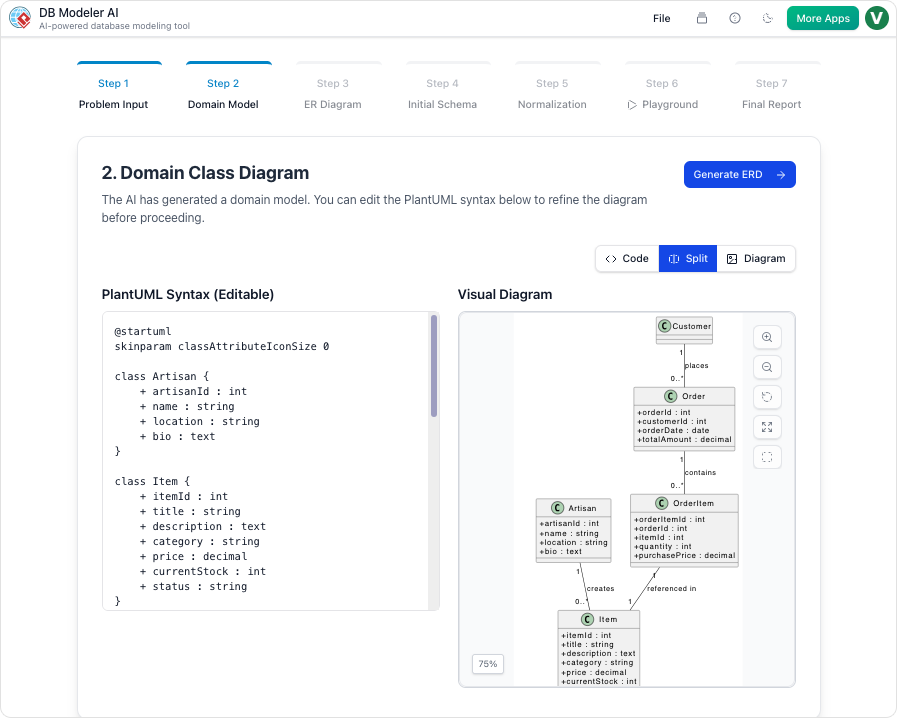
In contrast, using the Visual Paradigm AI tool is like hiring a certified architect and an automated builder. They draw the legal blueprints, ensure the infrastructure meets code (normalization), and build a small-scale model you can actually walk through (SQL playground) to verify functionality before the real construction begins. By bridging the gap between natural language and production-ready code, specialized AI ensures data integrity and drastically reduces architectural debt.
-
Comprehensive Guide to Visual Paradigm AI Table Generator: From Natural Language to Executable Code: This guide walks users through transforming natural language descriptions into fully functional database tables and executable code using Visual Paradigm AI’s advanced table generation engine.
-
Kata AI Marketing Platform ERD – Sample Database Design: A real-world example of an ERD for an AI-powered marketing platform, demonstrating how to model users, campaigns, analytics, and content relationships.
-
The Comprehensive Guide to DBModeler AI… – Cybermedian: Visual Paradigm ’s DBModeler AI represents a significant leap forward in database design. By combining expert guidance, visual diagramming, and live SQL testing , it allows users to…
-
AI-Powered Database Modeling with DBModeler AI: Discover how DBModeler AI enables intelligent database schema design and automated modeling in Visual Paradigm.
-
Comprehensive Review of DBModeler AI for Schema Design: A detailed analysis of how DBModeler AI transforms database schema design through automation and intelligence.
-
DBModeler AI: Intelligent Database Modeling Tool: Access the AI-driven tool for automated database modeling and schema generation in Visual Paradigm.
-
DBModeler AI: AI-powered database design tool with 7-step workflow . Generate domain models, ER diagrams, normalized schemas, and complete design reports. Launch live in-browser database playground to test queries instantly.