


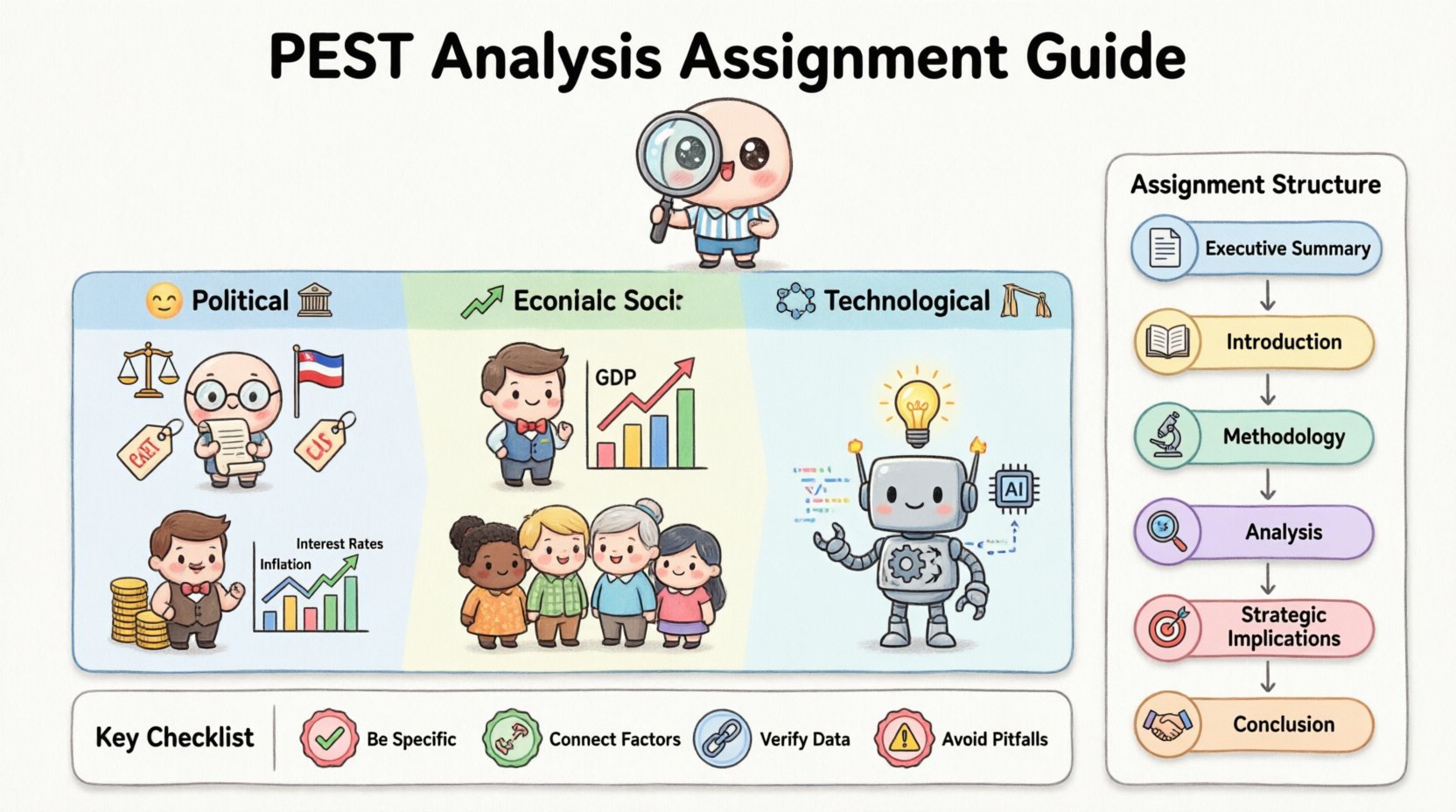
Conducting a strategic analysis is a fundamental skill in business, economics, and academic research. Among the various frameworks available, the PEST Analysis stands out for its clarity and utility in understanding external environmental factors. This guide provides a comprehensive look at how to approach a PEST Analysis assignment with precision and depth. Whether you are a university student or a professional analyst, understanding the mechanics of Political, Economic, Social, and Technological factors is essential for robust strategic planning. 🧭
This document outlines the methodology required to structure a high-quality response. It avoids vague generalizations and focuses on actionable steps, detailed breakdowns, and logical flow. By following this structure, you ensure your analysis is grounded in evidence and relevant to the specific context of the organization or industry under review.
Understanding the Framework 🏗️
Before diving into the writing process, it is crucial to grasp the core concept. A PEST Analysis examines the macro-environmental factors that impact an organization. These factors are typically outside the control of the business, yet they significantly influence decision-making, growth potential, and risk management. The framework is often expanded to PESTLE, adding Legal and Environmental factors, but the core four remain the foundation.
- Political: Government actions, policies, and stability.
- Economic: Growth rates, interest rates, inflation, and exchange rates.
- Social: Demographics, cultural trends, and lifestyle changes.
- Technological: Innovation rates, automation, and R&D activity.
When assigned this task, your goal is not merely to list these factors. You must analyze how they interact and what they imply for the subject of your study. A superficial list is insufficient. The value lies in the synthesis of these elements to reveal strategic opportunities or threats.
The Four Components in Detail 🔍
To write a comprehensive assignment, you need to know exactly what to look for within each category. Below is a breakdown of specific indicators you should research for each pillar.
1. Political Factors 🏛️
Political factors relate to how government intervention affects the industry. This includes tax policy, labor laws, trade restrictions, and political stability. When analyzing this section, consider the following:
- Regulatory Environment: Are there new compliance requirements emerging?
- Government Stability: Is the political climate stable, or is there risk of upheaval?
- Trade Policies: How do tariffs or trade agreements impact supply chains?
- Subsidies and Grants: Does the government offer financial support for specific sectors?
2. Economic Factors 📈
Economic factors determine the purchasing power of potential customers and the cost of capital. This section requires data-driven insights. Key elements to investigate include:
- Interest Rates: How do borrowing costs affect expansion plans?
- Inflation Rates: Is the cost of living rising, affecting consumer spending?
- GDP Growth: Is the economy expanding or contracting?
- Exchange Rates: How does currency fluctuation impact import and export costs?
3. Social Factors 👥
Social factors explore the cultural and demographic aspects of the external environment. These are often the most dynamic and require careful observation of trends. Consider these points:
- Population Growth: Is the market expanding or shrinking in size?
- Age Distribution: Is the population aging, or is there a youth boom?
- Lifestyle Changes: Are people becoming more health-conscious or remote-work oriented?
- Attitudes Toward Work: What are the expectations regarding work-life balance?
4. Technological Factors 🤖
Technological factors encompass the rate of technological change and its impact on the industry. This is often the most volatile category in modern analysis. Focus on:
- Innovation Rates: How fast is new technology being adopted?
- Automation: Are processes being automated, reducing labor costs?
- Research & Development: Is investment in new tech high or low?
- Access to Information: How does the internet or digital infrastructure affect operations?
Structuring Your Assignment 📝
A well-structured assignment is easier to read and demonstrates logical thinking. Below is a recommended outline that ensures all necessary components are covered. This structure helps maintain a professional tone and ensures clarity.
1. Executive Summary
Start with a brief overview. Summarize the organization or industry being analyzed and the key findings of the external environment scan. This should be written last, even though it appears first.
2. Introduction
Define the scope of the analysis. State the purpose of the PEST Analysis and the specific industry or company it focuses on. Explain why this analysis is relevant to the current strategic context.
3. Methodology
Describe how data was collected. Mention the sources used, such as government reports, academic journals, or industry publications. This adds credibility to your findings.
4. The Analysis (Body Paragraphs)
This is the core of the assignment. Dedicate a section to each of the four factors. Use subheadings for clarity. Do not just describe the factor; explain its impact.
5. Strategic Implications
Connect the dots. What does this mean for the organization? If political instability is high, what is the risk? If technology is advancing, what is the opportunity? This section shows critical thinking.
6. Conclusion
Summarize the main points without simply repeating them. Reiterate the most significant factors and their combined effect on the strategic outlook.
Data Gathering and Verification 📚
The quality of your assignment depends on the quality of your sources. Avoid relying on a single article or outdated statistics. Use a mix of primary and secondary data sources.
- Government Websites: For political and economic data.
- Industry Reports: For specific market trends and social data.
- Academic Databases: For peer-reviewed insights and historical context.
- News Outlets: For real-time updates on technological or political shifts.
Always verify the date of the information. A report from five years ago may not reflect the current landscape, especially in the technological and economic sectors. Cross-reference data points to ensure accuracy.
Writing the Analysis: Best Practices ✍️
Writing the content requires a balance of factual reporting and analytical insight. Here are specific techniques to improve the quality of your text.
Be Specific
Avoid general statements like “The economy is growing.” Instead, write, “The GDP growth rate has increased by 2.5% year-over-year, indicating a favorable environment for capital investment.” Specificity demonstrates research depth.
Connect the Factors
External factors do not exist in a vacuum. Economic changes often influence social behaviors. Technological advancements can alter political regulations. Look for these interconnections and mention them in your analysis.
Use Visual Aids
While text is primary, visual aids can break up dense information. If possible, include charts or graphs to illustrate data trends. However, if the format is text-only, ensure your tables are clear and concise.
Common Pitfalls to Avoid ⚠️
Many students and analysts make the same mistakes when tackling this type of assignment. Being aware of these errors can save you from losing marks or credibility.
| Pitfall | Description | Correction |
|---|---|---|
| Listing vs. Analyzing | Simply listing facts without explaining impact. | Explain why the fact matters to the business. |
| Internal Focus | Discussing internal strengths or weaknesses. | Keep the focus strictly on external macro factors. |
| Outdated Data | Using information that is no longer relevant. | Ensure all data points are from the last 2-3 years. |
| Lack of Context | Applying general trends to a specific niche incorrectly. | Tailor the analysis to the specific industry context. |
Ensuring Logical Flow 🔄
A logical flow is essential for readability. Use transition words to guide the reader from one section to the next. For example, after discussing economic conditions, you might transition to social factors by noting how economic shifts influence consumer behavior.
Ensure that each paragraph has a clear topic sentence. This helps the reader follow the argument without getting lost. If a section becomes too long, break it down into smaller subsections with their own subheadings.
Final Checklist ✅
Before submitting your assignment, review your work against this checklist to ensure completeness and quality.
- Have I defined the scope clearly?
- Are all four PEST factors covered in detail?
- Is the data current and from credible sources?
- Have I analyzed the implications, not just listed facts?
- Is the formatting consistent (headings, fonts, spacing)?
- Are there any grammatical errors or typos?
- Did I avoid using internal company strengths/weaknesses?
- Is the conclusion actionable and summarizing?
The Value of Rigorous Analysis 🎯
Completing a PEST Analysis assignment is more than an academic exercise. It trains you to think strategically about the environment in which organizations operate. By mastering this framework, you develop the ability to scan the horizon for risks and opportunities. This skill is transferable to real-world business planning, investment decisions, and policy formulation.
The process requires patience and attention to detail. You must sift through vast amounts of information to find what is relevant. However, the payoff is a clear understanding of the external landscape. This understanding forms the basis for sound strategic decisions.
Remember that no analysis is perfect. The environment changes rapidly. A PEST Analysis is a snapshot in time. Acknowledge this limitation in your conclusion to show critical awareness. This honesty adds to the professionalism of your work.
Expanding the Framework 🔄
While PEST is the core, some assignments may require an expanded version. Be prepared to discuss PESTLE or STEEPLE if instructed.
- Legal: Specific laws regarding employment, health, and safety.
- Environmental: Climate change, carbon footprint regulations, and sustainability.
If you choose to expand, ensure you do not dilute the analysis of the core four factors. The additional factors should complement, not overshadow, the primary framework.
Conclusion on Structure 🏁
Structuring your response effectively is the key to a successful PEST Analysis assignment. By following the outline provided, utilizing data sources correctly, and avoiding common pitfalls, you can produce a document that demonstrates deep understanding and analytical skill. Focus on clarity, evidence, and relevance. These three pillars will support your argument and ensure your work meets the highest standards of academic and professional writing.
Take your time with the research phase. The quality of your output is directly proportional to the depth of your input. With this guide, you have the tools to navigate the complexities of external environmental analysis with confidence. Proceed with your assignment knowing you have a solid foundation for your strategic evaluation.