


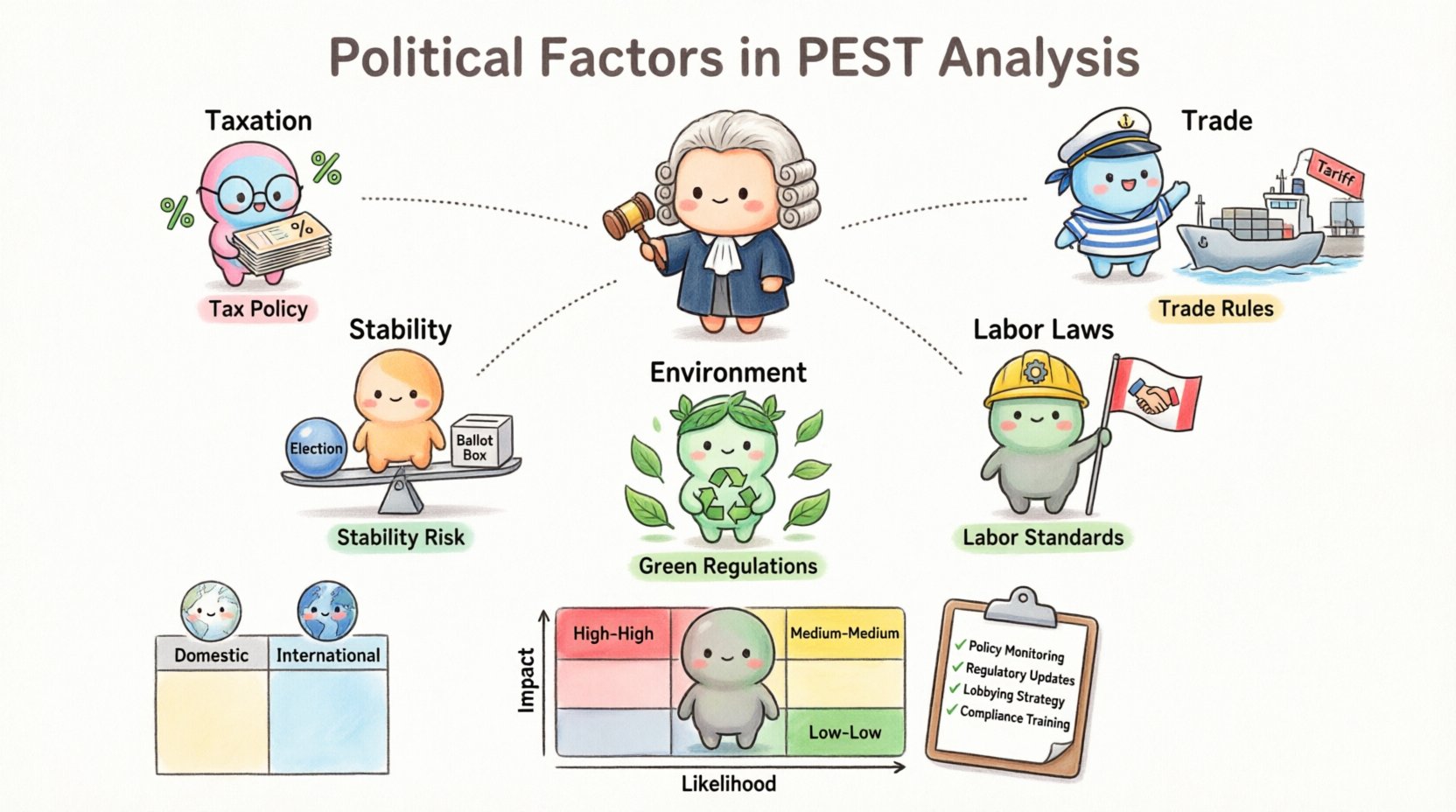
Understanding the external environment is crucial for any organization aiming for long-term viability. The PEST analysis framework provides a structured approach to evaluating macro-environmental factors. Within this framework, the Political component stands out as a critical driver of risk and opportunity. Political factors encompass the extent to which a government intervenes in the economy and the stability of the political landscape. This detailed breakdown explores how these elements influence business strategy and operational decisions.
Defining Political Factors in Business Context 📜
Political factors refer to government policies, regulations, and the general political climate that affect how businesses operate. Unlike economic or social factors, political elements are often the result of deliberate human decisions made by elected officials or bureaucratic bodies. These decisions can range from local municipal zoning laws to international trade agreements.
When conducting a political analysis, organizations look at the following core questions:
- How stable is the current government?
- What are the current tax policies?
- Are there restrictions on foreign trade?
- How strict are labor and environmental laws?
- Is there a risk of civil unrest or regime change?
These questions help leaders anticipate changes that could disrupt supply chains, alter cost structures, or open up new markets. Ignoring these signals often leads to reactive rather than proactive management.
Core Elements of Political Analysis 🗳️
To conduct a thorough assessment, it is necessary to break down political factors into specific, actionable categories. The following components represent the most significant areas of influence.
1. Taxation Policy and Fiscal Measures 💰
Tax rates directly impact the bottom line. Changes in corporate tax rates, value-added tax (VAT), or import duties can alter the profitability of a venture overnight. Governments often use tax policy as a tool to encourage specific behaviors or industries.
- Corporate Tax: High rates may discourage expansion, while incentives can attract investment.
- Import/Export Duties: Tariffs affect the cost of goods sold and pricing strategies.
- Capital Gains Tax: Influences investment decisions and executive compensation structures.
2. Trade Regulations and Tariffs 🚢
International trade is heavily regulated. Political agreements, such as free trade zones or embargoes, dictate where and how goods can move. A shift in diplomatic relations can immediately close a market or restrict access to raw materials.
- Quotas and Embargoes: Limits on the quantity of goods that can be traded.
- Customs Procedures: Bureaucratic red tape can delay shipments and increase logistics costs.
- Trade Wars: Retaliatory measures between nations can disrupt global supply chains.
3. Political Stability and Risk ⚖️
Stability refers to the likelihood that the current government will remain in power and maintain consistent policies. High stability allows for long-term planning, while volatility requires flexible strategies.
- Election Cycles: Policy shifts often occur after major elections.
- Civil Unrest: Strikes, protests, or riots can halt operations.
- Regime Change: A new administration may nationalize industries or revoke contracts.
4. Labor Laws and Employment Standards 👷
Government intervention in the labor market shapes hiring practices, wage structures, and union relations. These laws are designed to protect workers but add compliance costs to employers.
- Minimum Wage: Sets the floor for compensation.
- Working Hours: Regulations on overtime and mandatory breaks.
- Unionization: Laws governing collective bargaining and strike rights.
- Health and Safety: Mandatory standards for workplace environments.
5. Environmental Regulations 🌿
Modern political agendas often prioritize sustainability. Governments impose strict rules on emissions, waste disposal, and resource usage. Non-compliance can result in heavy fines or operational shutdowns.
- Emission Limits: Restrictions on carbon output.
- Waste Management: Requirements for recycling and disposal.
- Green Subsidies: Financial incentives for sustainable practices.
Domestic vs. International Political Considerations 🌍
Businesses must distinguish between the political environment at home and in foreign markets. Domestic factors are generally more predictable, while international factors introduce currency and diplomatic risks.
| Factor | Domestic Focus | International Focus |
|---|---|---|
| Stability | Known voting patterns, established institutions. | Unpredictable regime changes, foreign policy shifts. |
| Compliance | Standard regulatory bodies. | Diverse legal systems, language barriers. |
| Taxation | Single national framework. | Double taxation treaties, repatriation rules. |
| Trade | Internal market flow. | Customs, tariffs, import quotas. |
Strategic Impact on Operations 📉
Political factors do not exist in a vacuum; they ripple through every department of an organization. Understanding these impacts helps in risk mitigation.
Supply Chain Disruptions
Geopolitical tensions can block shipping routes or restrict the export of key components. For example, a trade embargo on raw materials can force a company to find alternative suppliers, often at a higher cost. Political instability in a supplier region can lead to production delays.
Pricing and Margin Pressure
Changes in tax policy or currency manipulation driven by political decisions affect pricing. If a government devalues its currency, imports become more expensive. Conversely, inflation control measures can reduce consumer purchasing power.
Human Resources and Talent
Labor laws dictate how talent is acquired and retained. Stricter immigration policies can limit access to skilled foreign workers. Changes in minimum wage laws can increase payroll costs significantly.
Real-World Scenarios and Case Examples 📊
Reviewing historical instances provides clarity on how political shifts play out in the real world.
- Brexit (United Kingdom): The decision to leave the European Union created significant uncertainty for businesses operating in the UK. Supply chains were disrupted, and currency volatility impacted pricing strategies.
- Tariff Wars (Global): Imposition of tariffs on steel and aluminum altered manufacturing costs globally. Companies had to restructure their sourcing strategies to avoid duties.
- Environmental Acts (Various): Stricter emissions standards forced automotive manufacturers to invest heavily in electric vehicle technology to remain compliant.
Building a Political Risk Matrix 🧩
To manage these factors effectively, organizations should create a risk matrix. This tool helps prioritize threats based on likelihood and impact.
| Risk Level | Likelihood | Impact | Action Plan |
|---|---|---|---|
| High | High Probability | Critical Disruption | Immediate mitigation, contingency funding. |
| Medium | Moderate Probability | Significant Cost | Monitor closely, prepare fallback options. |
| Low | Low Probability | Minor Inconvenience | Accept risk, standard monitoring. |
Continuous Monitoring Strategies 🔍
Political landscapes are dynamic. A one-time analysis is insufficient. Continuous monitoring ensures the organization remains agile.
- Government Watchlists: Subscribe to updates from relevant ministries and regulatory bodies.
- News Aggregation: Use media feeds to track legislative proposals and election polling.
- Industry Associations: Join groups that lobby on behalf of the sector to stay informed on upcoming changes.
- Local Experts: Consult legal and political advisors in foreign jurisdictions.
Common Pitfalls to Avoid 🚫
Even experienced strategists can misinterpret political signals. Avoiding these errors is key to accurate analysis.
- Assuming Stability: Just because a government has been stable for a decade does not mean it will remain so. Overconfidence leads to vulnerability.
- Ignoring Local Nuance: National policies often interact differently at the state or regional level. A federal law may be implemented differently in different provinces.
- Overlooking Soft Power: Diplomatic relationships and cultural alignment matter. Political friction can exist even without formal sanctions.
- Neglecting Compliance: Focusing only on high-level policy and ignoring specific regulatory compliance can lead to fines.
Integrating Political Data into Strategy 🎯
Data regarding political factors should feed directly into strategic planning sessions. It is not merely an administrative task but a core strategic input.
When planning market entry, for instance, the political risk assessment determines the mode of entry. A high-risk environment might require a joint venture with a local partner to share the burden. A stable environment might allow for a wholly-owned subsidiary.
Financial forecasting must also account for potential tax hikes or currency devaluation. Scenario planning allows the finance team to model different political outcomes and prepare cash reserves accordingly.
Checklist for Political Assessment ✅
Use this checklist before finalizing any major business decision.
- Election Calendar: Are there upcoming elections that could change policy?
- Lobbying Activity: Is there active lobbying that could alter regulations in our favor or against us?
- Regulatory Pipeline: Are there pending bills or regulations that affect our industry?
- Geopolitical Tensions: Are there conflicts in regions where we source materials?
- Corruption Index: What is the level of corruption in the target market?
- Contract Enforcement: Is the legal system reliable for enforcing contracts?
The Cost of Inaction 💸
Failing to analyze political factors carries a tangible cost. Companies that ignore political shifts often find themselves trapped in markets that have become hostile or unprofitable.
Consider the cost of sudden compliance changes. If a company fails to anticipate stricter environmental laws, retrofitting facilities later is far more expensive than designing them correctly from the start. Similarly, unexpected tariffs can erase profit margins that were built into pricing models.
Proactive analysis allows for adaptation. It transforms potential threats into manageable variables. By understanding the political landscape, leaders can navigate uncertainty with greater confidence and precision.
Final Thoughts on Strategic Foresight 🧭
Political factors are a constant variable in the business equation. They are not static, nor are they entirely predictable. However, through structured analysis and continuous monitoring, organizations can reduce the uncertainty associated with government intervention.
Integrating political risk assessment into the broader PEST analysis ensures a holistic view of the external environment. It allows businesses to align their operations with the realities of the governing structures they operate under. This alignment is essential for sustainable growth and long-term resilience in a complex global economy.